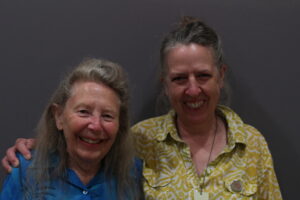
Beverly Hasper and Alison Gooding
Description
Beverly Hasper [no age given] talks with her friend Alison Gooding (62) about moving from Ephrata, Washington to Soap Lake, Washington, where she spent 35 years working at Masquers Theater. She talks about the efforts to fundraise for the theater and lists off many of the plays that were performed there.Subject Log / Time Code
Participants
- Beverly Hasper
- Alison Gooding
Recording Locations
Natural MedicineVenue / Recording Kit
Tier
Partnership
Partnership Type
OutreachKeywords
Subjects
Transcript
StoryCorps uses secure speech-to-text technology to provide machine-generated transcripts. Transcripts have not been checked for accuracy and may contain errors. Learn more about our FAQs through our Help Center or do not hesitate to get in touch with us if you have any questions.
[00:05] ALLISON GOODING: Okay, I'm Allison Gooding. I'm 62. It's Monday, July 25, 2022, in Soap Lake, Washington. And I'm here with Beverly Hasper, my friend, and looking forward to hearing her life in Soap Lake and her interest in massacre's theater and theater in general.
[00:36] BEVERLY HASPER: My name is Beverly Hasper, and this is Monday, July 25, 2022. And it's so plague. And my partner is Allison Gooding, and she's a friend of mine.
[00:54] ALLISON GOODING: Okay, so, Beverly, how long have you been in Soap Lake?
[00:59] BEVERLY HASPER: Well, I think it's about 40 years.
[01:06] ALLISON GOODING: And then how did. What brought you here?
[01:10] BEVERLY HASPER: Oh, what brought me here? I think it was a theater. There was a theater here when I lived on the other side of Ephrata and I wanted to move to Soap Lake, which I did, and I think it was because of the theater.
[01:35] ALLISON GOODING: So what's your interest in theater in general? Did you had done this for, since your youth? What was your interest? What was the counts? Did you go to school and study it?
[01:49] BEVERLY HASPER: Well, yes, I took. I really hadn't had much experience with onstage, but I had written a few plays, and I'd taken a class in playwriting at the University of Washington. But I've never really done any of the plays that I had written. They just didn't appeal to me. After I read some other plays, I kind of gave up on that.
[02:22] ALLISON GOODING: Do you still have some of those?
[02:24] BEVERLY HASPER: I don't think so.
[02:27] ALLISON GOODING: So then, once you moved to Soap Lake, was there a group of people. How did that happen? Did you. Just to get involved with, you know, the community and any kind of other.
[02:43] BEVERLY HASPER: Well, I liked. So I was living on the other side of Ephrata and living on the farm out there. And soap lake just kind of appealed to me because it seemed kind of, it seemed, oh, maybe a little avant garde or something, or my idea of avant garde, which wasn't really. But at any rate, it just seemed that people were a little bit looser and freed, friendlier in Soap Lake than where I was. So that's when I bought a building in a house to live in.
[03:26] ALLISON GOODING: So who were some of the people that you gravitated towards? Was anybody in particular in town that, like, started this core. This is their core group that you.
[03:39] BEVERLY HASPER: I think so. John Glasgow was a friend of mine for a long time, and I was married at the time. My husband's name was Red Crete, and he passed away in 2012. But at the time that I moved here, I think I moved here to get away from him. Then he followed me here. So that didn't work out, but actually we had a very long and nice relationship.
[04:20] ALLISON GOODING: Was he involved with the theater?
[04:22] BEVERLY HASPER: No, he wasn't involved in the theater, but we had a lumberyard out on the other side of y Freda and we kind of specialized in inexpensive lumber. And there in our lumberyard out there was the first time that I met Shirley Dunlop, who she and her husband were out there to get. They wanted some cheap lumber. They just wanted to buy something cheap. And so we kind of covered that because we were selling to farmers and they also wanted something cheap. So anyway, we got talking about, they started telling about what they were doing, that they were building a theater in Soap Lake, that they were going to. Well, it wasn't building a theater, but they were, they were in a theater and they were doing theater. And that really intrigued me. And I moved to Soap lake and I bought what was then a very small apartment building. And then, well, I left my husband red, and then he followed me, so that didn't work. So we lived in so plague together for quite some time and he passed away in 2012.
[06:13] ALLISON GOODING: So then once you moved here, you got to know the Dunlaps. And was there other people? John Glasgow and did they kind of lure you in?
[06:27] BEVERLY HASPER: Yes. Could I read some of that?
[06:29] ALLISON GOODING: Yeah, definitely. Please.
[06:35] BEVERLY HASPER: The Dunlops came to where we had our lumberyard and we are starting a live theater. Shirley told us we need the cheapest lumber we can get to build a set that was right up our alley because we were specializing in inexpensive lumber. But it also was my start in what would become a 35 year old commitment to Maskers theater. At that time, the theater was located in what had been an empty storefront on Main Street. I think it was the building that is now the food bank that's up on the end of the street there. The Dunlop's had converted it into a theater with folding chairs for seating. They named it Masker's theater. I was fascinated and of course wanted to be in one of their productions. Their first production was firemen save our child. It was a melodrama and the proceeds hardly covered the cost of the lumber. But there was more to come. They managed to find another vacant building at the top of the hill on Main street. It became more, I became more involved in the theater. The Dunlop's left the group and we moved the theater again. This time it was the building that is now the alternative school. John Glasgow was there for the moves and managed the task of turning an old building into a theater. He was good at building sets but also had a vision for the theater, which was to build our own building. We were in four different buildings before his vision became a reality. And we did build that building, and the funds were raised. And to me it was a miracle because I didn't think it could even happen. And we've, we've had that, the theater building ever since.
[09:02] ALLISON GOODING: This one that's right next to where we are right now.
[09:05] BEVERLY HASPER: Yes. And, well, we've done a lot of plays. I put it that way. I haven't.
[09:19] ALLISON GOODING: You have your list with you?
[09:21] BEVERLY HASPER: Yeah. Well, and I don't have a list of all the plays we've done, no.
[09:28] ALLISON GOODING: Well, what were some of the height like? You've directed several plays, too, written some, have you? What are some of the ones that you remember?
[09:37] BEVERLY HASPER: You know, well, one that stands out for me was one that I was actually in, which I wasn't in many plays. I did directing mostly, but I did Daisy and driving Miss Daisy, and that was really fun. I really enjoyed that.
[09:58] ALLISON GOODING: Who was in the play with you? Who's the other lead? Do you recall?
[10:06] BEVERLY HASPER: I was Daisy. Yeah. Oh, yes. Bob Runnells, Washington. It was the other person in it, and that was kind of amazing because there are not too many people of color around this neighborhood, and that called for a person of color, and there he was. So that worked out really well. And that was probably my favorite of the plays. I was in it, and later I didn't get in plays so much, but I directed a lot of plays.
[10:43] ALLISON GOODING: How many do you think, roughly over the years that you directed?
[10:48] BEVERLY HASPER: I think it's been about 25. And when we were able to get the funding, Hank Warden was the person who really got going with the funding of building a theater. And between him and John Glasgow, they were able to raise the kind of funds that we needed, which was, that was like a miracle because we didn't really expect what we got.
[11:24] ALLISON GOODING: How long did it take? I mean, roughly from the idea, when you first thought of the idea of building a theater and then also to it being completed, it probably took about three years.
[11:36] BEVERLY HASPER: And when we first moved in there, we didn't have any seats, and we had a, what was it? A fundraising event, and we called it the unceded event. And we raised the money then to get seats for the theater. And what was that event?
[12:05] ALLISON GOODING: What did you do at the event?
[12:06] BEVERLY HASPER: Pardon me?
[12:07] ALLISON GOODING: What did you do at the event? Types of things?
[12:11] BEVERLY HASPER: Oh, we did a short play, and that was about it, and then begged for money. That was the way we were going then. And now the theater is thriving. And it's just. I quit my job. I was the artistic director, and I quit that in. Oh, golly, about 2017, I think.
[12:48] ALLISON GOODING: Yeah. I think it's. Since I've been here. Yeah.
[12:50] BEVERLY HASPER: Yeah. And. And the theater is, you know, and I thought, well, they can't. They can't possibly live without me. They're doing just fine. They're thriving.
[13:00] ALLISON GOODING: They're struggling, I'm sure.
[13:04] BEVERLY HASPER: No, they're putting on good plays, and they're doing a wonderful job of it, and I'm just so happy that it's going that way.
[13:12] ALLISON GOODING: Yes. And then you did a lot of the posters for the plays. You had quite a collection of those that you designed yourself.
[13:21] BEVERLY HASPER: Yes, I designed a lot of posters and made them, and that was. That was kind of a fun thing for me. I just sort of enjoyed doing that. And I had, you know, when we started out, people didn't have computers as much, and then as soon as I got a computer, I was doing posters for the theater, and I really enjoyed it.
[13:49] ALLISON GOODING: I still have to print them out.
[13:51] BEVERLY HASPER: Yeah.
[13:51] ALLISON GOODING: I still have the files that you gave me.
[13:55] BEVERLY HASPER: Yeah.
[13:56] ALLISON GOODING: To do that show for, of just your posters. I think that will be.
[13:59] BEVERLY HASPER: Yeah.
[14:00] ALLISON GOODING: A great show. So then also, let's see, trying to. Eileen Beckwith. But how about the. You had some world premieres there as well. There's two of them. She said that one Ken Green wrote. Do you remember the one that he wrote? The name of his.
[14:25] BEVERLY HASPER: Yeah, Ken Green wrote it, but I didn't know. I can't think of the name of the play. Yeah.
[14:30] ALLISON GOODING: Let me think if I can see it.
[14:32] BEVERLY HASPER: Here.
[14:34] ALLISON GOODING: Oh, roses can't see.
[14:36] BEVERLY HASPER: Roses can't see. Okay.
[14:38] ALLISON GOODING: Yeah. And I think there was another one. She said here, bedride. Matt Weaver.
[14:48] BEVERLY HASPER: The what?
[14:49] ALLISON GOODING: Matt Weaver bed ride.
[14:53] BEVERLY HASPER: Oh, yeah, yeah. Bedride. That was. That was one of the plays that we did.
[14:59] ALLISON GOODING: So who are the other? I was just thinking of Ken and also his part in it. Was he one of the ones originally?
[15:06] BEVERLY HASPER: Ken. Ken Green. Yes, he was. He was a brilliant actor, I thought. And, of course, some people found him hammy, but I didn't. I thought he was great.
[15:17] ALLISON GOODING: He had his moments. Huh? What thespian doesn't, huh?
[15:23] BEVERLY HASPER: Yeah. But he was just so outgoing and out there, and I just. I really thought he did a good job. Always with his roles in the theater. He played several of them.
[15:39] ALLISON GOODING: Well, he would be sitting here right now with you, I'm pretty sure.
[15:43] BEVERLY HASPER: It's like, oh, yeah, I think so.
[15:45] ALLISON GOODING: Ken, you gotta be there. Unfortunately, that's not the case. Yeah.
[15:53] BEVERLY HASPER: Yeah.
[15:54] ALLISON GOODING: So what other recollections do you have that you've been thinking about since we.
[15:59] BEVERLY HASPER: About this year?
[16:00] ALLISON GOODING: Yeah, I know. It's been whirling around.
[16:03] BEVERLY HASPER: My recollections are kind of before we built our theater, and we were. We were going. We were basically closing down the theater. I mean, we lost the building. We couldn't pay the rent. We couldn't this and that. And I'd say, let's start a play. And that put the pressure on John. Oh, I gotta find a place to do it. Which was a miracle to me, because I thought I was going to have to. And so we moved. We started in what's now Sigrid in.
[16:46] ALLISON GOODING: This building right here where we're sitting.
[16:48] BEVERLY HASPER: Right here. This is our first building. Yeah. And then we moved. What was it we moved up to? We were in four different buildings. Oh, I got it written here. Okay.
[17:08] ALLISON GOODING: We'll have to make a little map of this sometimes.
[17:10] BEVERLY HASPER: And. No, our first building was. I got that wrong. Was where the food bank is now.
[17:18] ALLISON GOODING: Right across the street from Sigrid's building.
[17:21] BEVERLY HASPER: Yeah. And then we were in this building at some point, but then we went to the upper main on the. On the corner. That was kind of a small building. And it wasn't a really good theater. And then we moved to the building where the alternative school is now. And so.
[17:50] ALLISON GOODING: So who. So the property owners, were those buildings just vacant?
[17:54] BEVERLY HASPER: And you went, yes.
[17:57] ALLISON GOODING: The property owners, were they local or was it, say, samus properties or any.
[18:03] BEVERLY HASPER: They were mostly local. And we paid rent on the building. And then the big thing came when John Glasgow was able to make contact with Hank Warden. And Hank Warden knew how to raise funds.
[18:28] ALLISON GOODING: Yeah, that's what I've heard.
[18:31] BEVERLY HASPER: That was his specialty. And he was really good at it. And we started on a big fun drive, and we ended up with enough money to build that theater out of that. Hank Warden had all kinds of little tricks, and that's what I heard.
[18:53] ALLISON GOODING: I did get a chance to talk to him about a couple years ago when they were redoing the lobby of maskers, and they were trying to figure out where the painting by Ethan, the artist. I can't think. Can't remember his last name, the one he did of Masker's theater. And so. So I ended up talking to Hank Warden to find out where that was. Cause they wanted to put it in the lobby and he happened to have it. So I did get a chance to talk to him, and he seemed like an interesting.
[19:25] BEVERLY HASPER: Yeah, I think he had that in my house, I'm not sure, but any rate. Yeah.
[19:37] ALLISON GOODING: So is there some highlight of one of the productions during the. You know, because this was started in the early seventies.
[19:43] BEVERLY HASPER: Yeah.
[19:45] ALLISON GOODING: So, I mean, that's a long span. Are there any highlights of plays or during productions or being the director where it's things that. Oh, my. That really stand out? Certain performers or the frustrations of being a director, the joy of being a director?
[20:13] BEVERLY HASPER: Well, Marina Romarie gave us. Gave us the property where we built the theater, and she ran a restaurant here in Soap Lake for many, many years, and she gave us that land. And that was really. That was the first thing that. And we had started. Hank Warden knew how to raise funds, and we just had events, fundraising events, and one thing another, and it was kind of miraculous how we were able to actually build a building there.
[20:58] ALLISON GOODING: Was that a vacant piece of property at the time?
[21:00] BEVERLY HASPER: Yes, it was. Yeah, that was a vacant piece of property and. Yeah. And Marina gave it to us, so that was very nice.
[21:08] ALLISON GOODING: So it seems like. So when you first started, just attendance wise, I mean, you drew in a lot of people from the surrounding area, not just soap lake, but a lot of people from Moses Lake Euphrate and beyond. It seemed like you had really solid supporters.
[21:25] BEVERLY HASPER: Well, we were. Yeah, there wasn't really a theater in Moses Lake at that time, so we had quite a few Moses Lake people that came here for theater. And.
[21:41] ALLISON GOODING: I've heard that it's one of the oldest community theaters in the country.
[21:49] BEVERLY HASPER: I think it probably is, maybe the.
[21:51] ALLISON GOODING: State, but I'm nothing. But it's impressive how you continue to get performers wanting to be involved in the plays and having a.
[22:08] BEVERLY HASPER: You know, sometimes we get. Gotten a lot of people to a play, and you have a big selection, and there have been plays wherever people just don't show up, and you have to then get on the phone and try to find somebody to do a play. And we've done. I thought I had it written down, but we've done a lot of plays. I think it's.
[22:42] ALLISON GOODING: Well, I was thinking of the, one of the first times I've met you at a winter solstice party, and people were just chatting and stuff, and then you got up and started reciting something from one of your plays, and it was like, oh, what? You just got into character and put on a little performance?
[23:10] BEVERLY HASPER: Yeah.
[23:10] ALLISON GOODING: Spontaneously. That was a good memory for me.
[23:15] BEVERLY HASPER: Well, I have a list here of plays that we've done, and it's quite long. Do you want me to read the list.
[23:24] ALLISON GOODING: I don't.
[23:26] BEVERLY HASPER: You do. Yeah.
[23:27] ALLISON GOODING: There you go.
[23:28] BEVERLY HASPER: Okay. 2005, we did anything goes and visiting Mister Green. In 2006, we did little Abner, Hollywood arms Picasso. And then we had a music event, which was Pavlo. That was a busy year. Then 2007, we did see how they run and defying gravity. And we had Bonnie guitar do a musical. And in 2008, we did visiting Mister Green and man of La Mancha. I guess we probably did another one that I don't remember. And in 2009, we did Macbeth. One moment on Golden Pond in 2009. And ten season, we did reckless, we did the traveling lady, brilliant traces, the doctor in spite of himself going ape. And gosh, I can't read my writing. Okay. And then in the 1112 season, we did sex. Please, we're 60. And Gypsy and chapter one, Harold and Maud and the Velveteen Rabbit.
[25:21] ALLISON GOODING: Who was in Harold and Maude.
[25:24] BEVERLY HASPER: Yeah.
[25:24] ALLISON GOODING: Who wasn't. Who was. Who were the leads in that one?
[25:30] BEVERLY HASPER: Do you recall who did them?
[25:33] ALLISON GOODING: Yeah.
[25:35] BEVERLY HASPER: I don't know. I don't know who was in it. And then in 2000, in 1914, we did Charlie's aunt Fiddler on the roof.
[25:51] ALLISON GOODING: I saw that one that was really good.
[25:55] BEVERLY HASPER: And the Snow queen, and that. We started, at some point, doing a musical every year. And musicals. Musicals are much more difficult than just a regular play. They just require so much and someone to do the, you know, the piano and everything. And so we could only. We only had the energy, I guess, to do one musical a year.
[26:27] ALLISON GOODING: Well, and I like the idea that, you know, that's what Stacy and Clifford would have been able to add to that part of the story. Yeah.
[26:38] BEVERLY HASPER: And then 14 and 15, we did bob a life and a pajama game and play on. And in 16, we did aces, our feverish Sweeney Todd, them three, and the wizard of Ozdev. And in 17, we did the little Mermaid noises, off postcard steel magnolias and weekend comedy. And that's as far as I. That was about the time that I retired from the theater. And I don't have the later ones in here, but that's a lot of plays.
[27:31] ALLISON GOODING: Did you do any when you were younger, like a kid? Were you involved in theaters at all or putting on plays in school or. Oh, I like. What was your.
[27:45] BEVERLY HASPER: I didn't have any background.
[27:47] ALLISON GOODING: You didn't have an.
[27:51] BEVERLY HASPER: I saw a play when I was in Seattle. When I was. After I went to. I went to a couple of years of college in Seattle and I saw a play there, and I don't remember what it was, but it just really got me going. And that was before we had the theater.
[28:21] ALLISON GOODING: Okay.
[28:22] BEVERLY HASPER: And then when I. When I came back from Seattle, that was when we started thinking about a theater here. What is it? It takes a village to do a theater, and that's certainly what it was. There were so many people involved and there would. They would jump in and jump out, you know, and go someplace else or do something else, and it's still going on and I'm no longer involved. I retired about three years ago, four years ago, and I'm just so happy to see that there's still.
[29:11] ALLISON GOODING: Yeah, it's really impressive that it's continuing on.
[29:17] BEVERLY HASPER: I, of course, thought it was. I thought it'd fall apart when I left and it thrived, you know, I.
[29:23] ALLISON GOODING: Bet they struggled, I'm sure. Aren't they calling you regularly to come back?
[29:29] BEVERLY HASPER: No, they didn't do that.
[29:34] ALLISON GOODING: Were you ever on the board of directors after that?
[29:36] BEVERLY HASPER: Oh.
[29:37] ALLISON GOODING: Or is that part of what you were?
[29:39] BEVERLY HASPER: I was the artistic director. That kind of puts you on the board of directors. It's kind of with the board of directors and not with them. But I went to all the meetings at that time when I was. When I was the artistic director. That's kind of an requirement of the artistic director. And they go to the plays but are not necessarily members of the. And I don't know, it could have changed by now. I haven't been to one of their board meetings for long time.
[30:12] ALLISON GOODING: I just think that the kind of pop up theaters that you guys did before, I think is impressive too.
[30:20] BEVERLY HASPER: Yeah.
[30:21] ALLISON GOODING: Here's some folding chairs. Stage. How was it in the rise building when you had that set up? Was it just in the main room like that first floor, set up the folding chairs and just put on the play?
[30:36] BEVERLY HASPER: No, we had theater seats and one of my memories is taking those theater seats and they came in sections and there were about, I think, four seats to a section. And John Glasgow was the one who was in charge of the moves and moving those seats at far end of the. Of the street and then moving them down to where the alternative school was. We did that. And then after the alternative school, we were. That was when we started our. Got our new building going.
[31:24] ALLISON GOODING: I feel like John should be on speakerphone right now with you. He'd have a lot to add.
[31:31] BEVERLY HASPER: Yeah, right. Yeah.
[31:37] ALLISON GOODING: Well, next time.
[31:42] BEVERLY HASPER: Let's see. Oh, I was gonna. I have a list of plays. Do you want to hear other plays we've done or. Yeah, well, we just started it. Where did we end with?
[31:58] ALLISON GOODING: Was there anything that you thought that you'd just like to add to it just before we. The time is running out here.
[32:10] BEVERLY HASPER: Well, it takes a village to do the plays, and that's kind of the way it is. All the people that have been involved in the plays and all the people that come and go and everything, and it's just. It's so many people that it takes to do that. And I'm just so happy that it's still going and thriving and that I don't. I'm not doing it.
[32:44] ALLISON GOODING: I think there's a lot of people that would benefit from you still being there. And some of them recently, when I got to do the field trip with some of the students at the school, the first time they were able to go into the theater, you know, that's right here in their town, and they'd never been there before. And to see, you know, kind of the look on their face and the really interesting questions that they asked. You know, they asked Stacy. She was the one that gave a tour of it. So to see this next generation, these younger kids, being able to see what's here in our community is and try to, you know, get them interested in it. And also, you know, Clifford, when he introduced the camp, the performance, then, how important it is for the community, you know, the kids and learning how to interact with others, it's not just being on stage. It's behind the scenes, you know, all these different levels of it that can help them in the future. And any job that they end up getting, you know, or if it's directing, you know, some job, or, you know, if they're interested in set design or lighting or sound or costume. So I think we're really lucky to have it here.
[33:58] BEVERLY HASPER: I think it's so good for people to be in a play, to kind of explain teamwork, for sure.
[34:06] ALLISON GOODING: Yeah.
[34:08] BEVERLY HASPER: To be on the stage, and, golly, you have to perform. And, you know, it's. It's frightening. You know, it's really frightening. And I think that. I doubt if there's anybody that doesn't get little stage fright now and then, but usually that that doesn't last. And after you're on the stage a while, it goes away. You just kind of get in the groove. But I think this is about as.
[34:39] ALLISON GOODING: Much as I could say, oh, yeah. Even though I did do it in high school. But that's like.
[34:49] BEVERLY HASPER: Yeah.