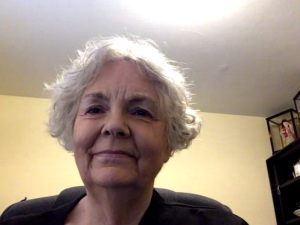
Janice Hinton and Jack Jenkins

Recorded February 24, 2022 49:53 minutes
0:00 / 0:00
Id: ddv001423

Description

One Small Step conversation partners Janice "Jan" Hinton (73) and Jack "Jay" Jenkins (54) share about their personal backstories, how their politics were shaped, and about the difficulty of sharing political values.

Subject Log / Time Code

JJ and JH read each other’s bios.
JJ talks more about his life and backstory, sharing that he adopted his wife’s kid, and they decided to have another kid, who was born with down syndrome. He talks about how that has impacted his life and outlook.
JH shares more about herself, starting by saying that she’s been married to her husband for 49 years. She says that her father grew up in northwest Oklahoma during the dust bowl and he went into the Navy at 16 for WWII. She also shares about her parents.
JH shares that when he went to Oklahoma State University, almost all the guys were republicans and wanted to be like Gordon Gecko. He explains that his politics really started to be molded when he had his son, Hunter. He noticed that people started treating his family differently because their kid had a disability.
JJ says that when he read JH's bio, it reminded him of his mother. He also talks about when Obama was inaugurated and learning more about him.
JJ notes that you can’t be far right or far left to have a conversation like One Small Step.
JH says that it’s very hard for people to talk about their political values.
JJ says that he wanted to participate in One Small Step because he lost a few friends over politics.
JJ brings up critical race theory and asks JH how she feels about that being taught in school.
JJ talks about why he was excited to speak to JH.

Participants

  • Janice Hinton
  • Jack Jenkins

Partnership Type

Outreach

Initiatives


Transcript

StoryCorps uses secure speech-to-text technology to provide machine-generated transcripts. Transcripts have not been checked for accuracy and may contain errors. Learn more about our FAQs through our Help Center or do not hesitate to get in touch with us if you have any questions.

[00:00] JAY JENKINS: And I start with Jay.

[00:02] JAN HINTON: We're going to start with you, actually.

[00:04] JAY JENKINS: Yeah, go ahead.

[00:08] JAN HINTON: Hi, I'm Jay Jenkins. I am 54 years old. Today is February 24, 2022. I am speaking from south Tulsa, Oklahoma, more specifically in Bixby. I am here with Jan, and she is my one small step conversationalist, and we're going to have a great interview today.

[00:39] JAY JENKINS: My turn. Okay. I'm Jan, and I live in Stillwater, Oklahoma, and I'm here to talk with Jay uh, for one small step story core. And I'm 73 now, and I forget what else I'm supposed to say. Oh, that's good. All right.

[01:08] JAN HINTON: All right, Jan. Her bio says she's 72, so I guess she's had a birthday since then. I, female, caucasian, married, master's degree in psychology, two children, very liberal, two grandchildren. Graduated from OSU, lived through Vietnam, which was a very big event in her life. Lived in Japan during part of the war and volunteered at military hospital. She has some very interesting stories to share.

[01:42] JAY JENKINS: Okay, I'm here with Jay, and he's a graduate of University of Oklahoma. He graduated in 1989 with an accounting degree. He earned his CPA shortly thereafter and started his practice from scratch. He has three grown children and a wife of 29 years. That's great. One child with a disability, and he's in his twenties, mid twenties, and he lives with his family. He was born in Hampton, Virginia, when his dad was in the Air Force. He moved to Oklahoma when he was about three. He lived in several towns around Oklahoma, and he loves to travel and exercise and read and watch football, and he believes that we can overcome this divisiveness. Great, Jay. I'm really glad. Yeah, I am, too.

[02:42] JAN HINTON: The divisiveness being. You're probably an OSU fan and I'm an ou fan.

[02:46] JAY JENKINS: Yes, that. That is definitely true.

[02:51] JAN HINTON: Well, I. We. Some of our best friends are OSU fans. We go on a lot of trips with them, so we have a really good time with our rivalry, and we never let it cause problems.

[03:06] JAY JENKINS: Yeah. And we can joke about it.

[03:08] JAN HINTON: Yeah.

[03:09] JAY JENKINS: Yeah. Yeah, we can joke about it.

[03:12] JAN HINTON: All right. Excellent. So do you want to maybe take a moment to give a little bit.

[03:18] JAY JENKINS: More background about yourselves? Sure. Okay. You want to go, Jay?

[03:26] JAN HINTON: Sure. Well, my son, he's. He'll be 27 next month. He has down syndrome, obviously. Since my wife and I have been married 29 years, we have an older daughter who I adopted once we. We were married, and then a couple years after we were married, we decided to have another child. He was born with down syndrome. Of course, that's not something that you ever plan for. So it took us by surprise. The doctors said not only did he have down syndrome, but he also had a hole in his heart, and he would have to have open heart surgery when he was one year old. So we had that just. I mean, it was pretty devastating. And as you can imagine, it was kind of like my wife and I had to go through a grieving process, and. And I think that helped our marriage so much, too, because, you know, we. You know, at first, it was just like we were, oh, poor, pitiful me. And, you know, it was. You just felt like, um, this isn't what I signed up for. And. And then, um, he was born April 1, 1995. And within three weeks, there was an Oklahoma city bombing. And a lot of. A lot of preschoolers died during that bombing. And I think that was kind of a wake up call for us to quit feeling sorry for ourselves and move on with our life and appreciate every day. And. And even when he turned one and we were back in the hospital, he was having his open heart surgery. I remember holding him in a blanket, this warm blanket, having to give him up to the doctors. And then we were just sat waiting to. For his surgery to be over. And it happened to be along the same time as they were having the anniversary of the Oklahoma City bombing. And, you know, it just seems so real, like it happened, you know, yesterday or last week. But, you know, it. It was just. I've always felt like our life was so. And, you know, so that that had a big impact on our life, was the Oklahoma City bombing. I was working at broken arrow schools at the time, and, you know, we. It was just devastating. And anyway, I'm sure you probably had some kind of moment, like, just like, 911 for people in Oklahoma is like, where were you when they had the Oklahoma City bombing? And, you know, I was working at broken arrow public schools. I hadn't quite started my practice, but anyway, we. We travel a lot, my wife and I do. But, you know, we have a. We decided to have another child after Hunter about three years afterwards. So he has an older sister and a younger sister. As we. As we. As the kids grew up, you know, I was. We were really involved in church early on when the kids were real little. And. And so it's kind of funny. My daughter, my oldest daughter turned up real conservative. And as we were getting older, I really started to feel more confident in. In the belief that I just didn't really accept organized religion anymore. And so we quit going to church. And after that, it was kind of ironic that our younger daughter became more liberal. So we've, we've got two girls that are pretty much opposite ends of the spectrum, and they're about eight or nine years apart, so it's kind of interesting. And, you know, and that was about, we probably quit going to church about 1617 years ago. I know a lot of our friends who, I mean, we lost some friends who no longer, you know, just kind of didn't like that, that we chose to do that. But some of the friends that were still around that still go to church, they're like, well, don't you feel lost that you did this? And actually, I, I feel like that was my, my way, you know, and I feel relief because I would actually get frustrated at church. But anyway, that's, I had a practice that I started from scratch. I've, I am in a book club with a lot of ladies your age. Funny thing is, I see I've come to realize that men don't like to read books. And if they do like to read books, it's only John Grisham and Stephen King, and, and they don't like to read. What I like to read, which is about life, about, I like fictional stories about people's lives. And probably the reason I signed up for Storycorps after seeing that 60 minutes episode was, was I was like, well, this is what I do at the book club every month. I talk to these. I didn't know it was going to be a lady who was kind of in the same demographics as the ladies in my neighborhood, but I just thought, well, I've always had to learn to find common ground with a lot of superintendents in the state because we audit and do work for public schools in the state. And so I've always had to try to find, like, do I know somebody that they know? Do I, you know, and I'm, I don't golf and I also don't.

[09:49] JAY JENKINS: Was.

[09:49] JAN HINTON: I gonna say, well, I don't do a lot of hunting and fishing, and so I'm, I really don't have a whole lot to talk about unless I can talk about people that they know and, and just other things. I do talk about traveling in books, and I like to, you know, jog and talk about ou football and Osu football. But anyway, that's, that's pretty much us. My wife and I traveled a lot. We got married in Vegas. They said it never lasts. But, you know, here we are. We're, we're going to be celebrating this fall. We're going to set, our anniversary is on New Year's Eve, but we're going to celebrate in September, going to go to Hawaii. That's our first time we've ever gone to Hawaii, so we're excited about that. And we're taking Hunter with us. That's, that's all I have to say for right now. So tell me about yourself, Jan. Um.

[10:49] JAY JENKINS: I've been married to my husband 49 years since. Yes, we had an anniversary in February and early February. My father grew up in northwest Oklahoma during the Dust bowl, and I think we're going to get into some of that later. But he went into the Navy during world War Two. At 16, he had to have somebody sign him. His dad signed for him to go in, and it was, he went to California and met my mother on a blind date, and he went off overseas. He was in Okinawa and promised to marry her. And so when he came back, he did what he promised to do, but I don't think they knew each other very well. And my mother was from Florida and my dad was from Oklahoma, and he grew up very, very poor, and my mother did, too. Very, very poor. And he, they came back to Oklahoma, and eventually he got on with Phillips Petroleum Company, which you probably know was in Bartlesville.

[12:17] JAN HINTON: Right.

[12:18] JAY JENKINS: And by the time he had died, he had made it to vice president of Phillips Petroleum Company in the Far east and had done remarkably well. He just got his GED in high school, and he did go get a, some college classes, but for him to make it as far as he did in Phillips without a college degree, although he told people he had a college degree, he told him he had a master's in geology, but he, nobody questioned that. And he made it all the way to a vice president. And they lived in Tokyo and Singapore and several other large cities in the Far east. But my mother was never happy and my father was not particularly faithful and did a lot of things that weren't right, and my mother would, would be very abusive. And my dad was never around, so a lot of scars from that, you know, a lot of difficult times. And they, they began to show up in me, and I could see that I was not being a good mother. And it bothered me. It bothered me a lot. And I decided that I wasn't, I wasn't going to follow down that path. I just knew that I was being hurtful. So I decided to get a master's degree, and I went to counseling, and then I decided I graduated with a degree in sociology, which shows that I was a child of the seventies and the sixties, you know, I mean, everybody was interested in sociology, and so I got my degree in sociology, and that was here at Oklahoma State. And I met my husband here, and he's a lifelong Oklahoma. In my high school years, my father went to work in New York City, and I came back to Oklahoma and.

[14:56] JAN HINTON: Hold on, let me let these dogs out real quick.

[14:59] JAY JENKINS: Okay.

[15:01] JAN HINTON: Hey, Carla, put them up. So sorry. My wife swore that they would be good. They must have saw some birds outside. Go ahead. I'm sorry.

[15:21] JAY JENKINS: Well, I get excited when I see birds, too. So who was it? So I decided that I was going to go for my master's degree. And we lived in St. Louis at the time. And there was a small college. There is a small college in St. Louis. And then I decided that I wanted to specialize in art therapy because I'd always loved art. And I had to take a bunch of art classes to qualify for an art therapist. And my kids were small, but they weren't small. They were grade school. We had two children. And so I went to night classes and weekend classes, and I got my masters in the counseling psychology. And so I started, I worked for mostly community mental health. So I worked a lot with marginalized people, and I worked in some very marginalized areas. We lived in Detroit. I worked in downtown Detroit where there was barbed wire parking, you know, and you didn't dare come down at night or you just had to really be careful. I went, I was, I worked with foster kids, and sometimes I had to go into some very unsavory places in Detroit, and that's pretty much. And my husband took a lot of different jobs, and it was always pretty much up to me to find a job wherever I could. And because I worked for community mental health, there's almost always a job in community mental health. And I worked a lot with foster kids, and I worked in a treatment environment for high school kids, college, not college outside of DC, so had pretty tough crowd there. This was their last stop before going into prison. I've done a lot of. Well, mostly foster care and adoptions. I've done a lot of work with adoptions. And then the last few years that I was in practice and I would still be practicing, I was licensed in three states, and my husband's last move was to Texas before we were here. And every state that we moved in, I would, in order to practice, I had to have a license. And it was just a huge ordeal to get licensed. And the last move to Texas, I just didn't have it in me. And I've had several bouts of depression. And I think they were probably related to having to do everything I had to do to get licensed and to be able to do what. I loved it. I mean, I loved working with people who are on the edge. And I was good at it. I was very good at it. And I was good at working with the kids. And I formed a lot of bonds with those kids. I still remember them and I still have clients who are in touch with me. I just missed it so much. I did open my own private practice, and it's hard. It's hard. But once it got started, I had more clients than I could take care of. I had to turn clients away. And because I specialized in working with kids, that, I mean, kids are a huge population to work with. And so that's kind of, and then when we moved to Stillwater about three years ago, my husband has a huge family around here, and my family, they're just broken, as we all are. We are all broken. And I believe God is what has gotten me through some very, very tough times. And my kids aren't especially close to us, mainly because we're conservative and they don't talk to us. You know, they just don't talk to us over politics, which I think is so ridiculous. And we don't even talk politics with them. But just the fact that we're conservatives, it's enough for them to not care whether they talk to us or not. And I'm just so saddened over that, even, even if we don't talk about it. Someone to talk. So I wonder, Jan, if you want to share with Jay, you were talking about your father and the Dust bowl, and I wonder if that relates maybe to some of your earliest memories of politics. He talked all the time about growing up poor. That was something that he wanted us to realize because he felt like we had such an easy life. And, I mean, I have so many stories of what his life was like because he didn't have shoes. I mean, he was so embarrassed because he didn't have shoes and he didn't have food. So I don't, you know, he was a Democrat, but I think all time Democrat, I think all time Democrat was different than Democrats today. So I don't, I don't know, maybe. But he was very conservative. He died here about three years ago. And, you know, he, his philosophy was, you can do anything because he did, he went from shoeless to being a very wealthy man. And he said, if I could do it. Anybody could do it. So I don't think that sounds like a Democrat. I don't, you know, he had very little sympathy for anyone who couldn't work themselves up to do anything they wanted to do.

[22:36] JAN HINTON: How about you, Jay? Do you want to share with Jan what some of your earliest memories with politics were? Well, you know, when I went to ou, just about all the men were. All the guys were Republican. It was in the eighties. You know, the movie Wall street was real popular, so everybody wanted to be Gordon Gekko and to make a get rich. I wasn't any different than them. You know, I was in a fraternity, and we just wanted to, once we got out of college, to make as much as we could and provide for our family. I think everybody wants, you know, that's the american dream to do that. I think my politics probably started getting molded as soon as I had hunter, because all of a sudden, you know, I went from having, you know, I was the captain on the football team, and I. I was popular in the fraternity house, and I had done well in an accounting firm as soon as I got out of college. And once Hunter was born, I started seeing people treat us a little bit differently with a child with a disability. And it wasn't always. I mean, you know, it. It was people that you thought they should be better than this. The people at church that we would go to, we had a music school teacher who. Yeah, in hunter, when Hunter was in grade school, there was a little Thanksgiving musical that they were going to put on for the class, and all the parents were supposed to go there. The mothers, at least the ones who could get off from work. And Carla goes to it, and everybody's dressed up as either a cowboy or an indian, except hunter. And they're all given kazoos and they're singing along, and Hunter's just standing there because the teacher never bothered to give him a note or let Carla know that he needed to be dressed up as a cowboy or Indiana. And so he just stood out like a sore thumb in the group. And, I mean, my wife, she cried and cried. It was just. It was hard to deal with for a while because it was so upsetting to her. And a few years after that, we had gone to, our neighbors had talked us into going to a Rodney Carrington comedian show. I didn't know anything about him, and he's from Bixby, so you'd think I'd know. But we go to that and, you know, it. It's just that typical potty humor. And he he makes songs, joking about just all kinds of, you know, things I won't discuss. But one part of his act, he started talking about kids on the short bus. And he was not only talking about the kids on the short bus, but he was actually pretending, you know, he was slurring their words and, you know, talking about licking the windows. And. And, I mean, at that point, I think in my mind, I started thinking about how it was so cruel to try to make fun of somebody who can't defend themselves. And it was. I was so humiliated. And, you know, it was like everything was happening in slow motion at that concert. And if we had driven separately from our friends, we would have left and just immediately left. But to look around and see everybody laughing, I mean, just like, belly laughs, they thought it was so funny to talk about these kids on the short bus. And. And, I mean, it just seems so cruel. Not that he's, you know, somebody that we looked up to before. I didn't even know the guy, but that was just another example. And in our old neighborhood, we lived that. There was a preacher who came up to our yard and we were playing ball, and he asked to pray for our son. And we were kind of taken aback because we're like, well, who doesn't want to have their child prayed for? But I think it wasn't until he started doing, started praying for Hunter that we realized we were kind of in a trap. And he started praying for God to heal this affliction. And he obviously doesn't understand trisomy 23, and this is a genetic thing. This isn't something that, that's going to be cured. And I felt just like I did at that comedy club, I felt like I wanted to lash out and physically hurt somebody because they had violated my family. And yet, you know, I felt guilty for time after that because, you know, as that guy walked away and he had a big smirk on his face and he said, you're going to see some real changes from here on out. Well, the changes, that probably that was one of the things that caused me to decide to walk away from the church. Not only him, but I had an uncle who, he was a pentecostal preacher who, you know, when, when he was giving a sermon of his brother, which was my mother's brother, he talked about the fact that he was pretty much going to burn in hell because he didn't believe in God And I thought that that was an inappropriate time to talk about this, but he was more interested in an altar call and bringing the attention to himself than he was on the life of my uncle Sonny, who was a beautiful man. He just, you know, he, he was simple minded, kind of like my son, and he just didn't really see the world like his brother saw it. But that didn't make that him a bad person. Now, Jan, I had, it's kind of, I laughed whenever I saw your short bio because it was, at first I was like, oh, my gosh, I think, I think I'm going to be interviewing my mom. My mom's 76. She got a degree in psychology. She's ultra conservative, and she's got two kids that are very liberal, me and my brother Jeff. Jeff's worked with me for 25 years, and he was kind of more liberal long before I was. And he probably, you know, I never really ever thought about being liberal until, and, you know, you can cut me off if I, if I've overd talk too long. But all I was going to say was that I voted for John McCain and I thought he was a great man. I do a lot of work for school districts and a lot of charter schools. We do bookkeeping and payroll. And I went to this one charter school that's predominantly black. And when I saw Obama getting inaugurated and them crying, like, just, just beside themselves crying to see a black man being inaugurated, that was impactful to me because I was like, well, I thought John McCain was a really good, you know, a good man. And he's kind of one of those old school republicans, you know, that they would call a Republican in name only now. But she, they were really beside themselves with Obama. And so I kind of thought, well, I didn't know much about him, but I started kind of paying attention. And also what I paid attention was like, for instance, I had an uncle on my dad's side who sent out a chain letter. This was before Facebook and Twitter and everything got real popular. But he sent out a chain letter and it had a picture of Obama on the beach without a shirt on. And I was like, well, you know, he's ripped. He's a good looking man. And like, what, what would he have to say about this? And below the, below that picture, he said, look at the tar that washed up on the beach. And this is a, my dad's brother was somebody that I always looked up to because I wanted to travel like he did and I wanted to go places. And my parents never went anywhere, but that really bothered me. And I sent him a letter and I responded to him. I didn't reply to all, but I just sent it to him. And I said, you know, you shouldn't make an attack on somebody personally. You know, if you have some disagreements with this policy, that's one thing. But you're talking, you're making light of the fact that he has skin of a different color and you're not necessarily sticking to the issues. And so that kind of ruined our relationship ever since then. And I didn't, and probably back then I was still a registered Republican. It hasn't been until three or four years ago that I decided to be a Democrat. So I haven't been one very long. So I don't know if you could say I'm very, you know, real liberal like your, like your kids. I'm just kind of more of a centrist. But right now we're going through some times where I think that's kind of where I feel comfortable on the side of.

[33:16] JAY JENKINS: Yeah, me, too. I think.

[33:23] JAN HINTON: You two.

[33:25] JAY JENKINS: Centrist. More centrist.

[33:27] JAN HINTON: Okay. Well, and I would imagine both of us have to be, you can't be far right or far left to have a conversation like this. And when you were saying, like, your kids don't want to talk to you about politics, I think if you're in, if you're too far right or too far left, it's only going to make you mad that somebody just can't understand the way that you think.

[33:56] JAY JENKINS: Yeah, I don't, I don't understand the way they think. I don't. But we can't talk about it.

[34:04] JAN HINTON: We'll talk about it. To me, what, what is it about you that you really don't understand? And maybe I can give you some insight.

[34:12] JAY JENKINS: I don't understand where the Democrat party is going right now. I don't, I don't understand, I don't understand why they stick with somebody like Biden who has been making, really, to me, he is making really, really poor choices and that, that he is supported by the, his party and I, and that he's hurting so many people by his choices and he doesn't seem to know what he's doing. And it's, and it's scary to me.

[35:01] JAN HINTON: Can you be more specific? What choices?

[35:04] JAY JENKINS: Well, like cutting down the pipeline. I'm gonna just real quickly, I'm gonna sort of reorient us real quick and.

[35:14] JAN HINTON: Go back to one of those earlier.

[35:16] JAY JENKINS: Questions that I mentioned. And I think both of you are.

[35:19] JAN HINTON: Sort of hitting on this question, but.

[35:21] JAY JENKINS: Maybe not fully discussing it with each other.

[35:23] JAN HINTON: So maybe you can take a minute.

[35:24] JAY JENKINS: To talk about why you wanted to.

[35:26] JAN HINTON: Do this interview today.

[35:27] JAY JENKINS: Like, why it's important to you to have these conversations for me to. To understand, you know, I can't. It's so hard to talk about what people are thinking when we're having a surge in crime and we're. And we're okay with a president who hardly speaks to his. To the people. And he cut down our. He cut off our petroleum source of petroleum. And now that Russia has done what they've done and Russia has full control over the world's petroleum. I don't understand that. And I don't understand the whole defund the police thing, and I don't understand that. You know, explain to me why that's okay and explain to me why it was okay to shut down the petroleum industry here in the United States when we were. When we were independent of any other country so that it never got into politics. And this whole pandemic thing. Why did that decision all have to be made where we closed everything down and we hurt our economy and we hurt people? I don't understand those things. Those are mainly the things, but I just. I don't understand those things.

[37:23] JAN HINTON: Okay. Do you want to talk about why you wanted to.

[37:27] JAY JENKINS: Wanted to sign up for this and have a conversation with someone like this?

[37:34] JAN HINTON: Sure. I've lost a couple friends in the last couple years. Not, not death, just, they won't be my friends anymore, because when they were having the riots a couple years ago because of George Floyd.

[37:52] JAY JENKINS: Yeah.

[37:53] JAN HINTON: The one of them had posted on Facebook, when they start looting, they lose their. The reason for why they're doing this. And so I responded to him on his page. I probably shouldn't have, but I said, well, what was their reason? And he didn't really understand what my point was, obviously, because we got into it and didn't just end on Facebook. We were texting back and forth, and he was telling me to shut the f up and all that. But my point was, people who go looting are opportunists. There's another group of people who were rightfully peacefully protesting. The looters could have been white, black. I don't really think that they should be. I don't think that he should have said they lose their reason for protesting when they're doing the looting, because the people who were peacefully protesting, they. They had good cause to protest. You know, we're ten. Oh, ten minutes. Oh, boy. Just like, I mean, are you. Do you have, what is your feeling on, like, critical race three? Do you think that this should. Do you think that we should be explaining to our children that we came from a country that fully believed in slavery. Is this. I mean, do you think. What. What is your feeling on this, Jan?

[39:49] JAY JENKINS: Uh, critical race theory? I don't. I don't know a lot about it, but for what I hear of it, I don't. I see that it has no valid validity to it. I don't think that we should hold one race up over another. When I say I worked in marginalized people. I don't think I ever knew of one black family that I've worked with over the years who would agree with it. I don't know one black family who would. No black mother would allow their child to go out and riot and loot. I don't. They have a very strong family ties, and if a black mother knew that their child was out looting, they would take them by the ear and bring them home and give them a good whipping. That's what I think they would do.

[40:59] JAN HINTON: How do we go from critical race theory to looting and rioting?

[41:02] JAY JENKINS: Oh, well, you just brought it up.

[41:06] JAN HINTON: Right? Yeah. I mean, that's kind of what they're all discussing in the news now and how, you know, a lot of board of educations or, you know, I go to a lot of board meetings, and at my audit presentations, I have to wait for all the local participants to talk about how they need to get critical race theory out of the school. And my understanding is just to tell our history accurately, which is that we've done a grave injustice through the Jim Crow, through slavery. And I think that there's a lot of issues that's going on today that. And I really believe that what they were protesting about is very understandable. So with them protesting a couple years ago, I understood. I do believe that black lives matter, and I believe that if you're a white person, until you can get to the. Until you can get to the place where you can say that black lives matter, you just don't really understand that. We've treated them like a second class citizen for a long time, and things need to be changed. That's. That's why I'm liberal. That's why I think that they need to be changed. And that's not the only issue. You know, I. I think women has a right to their own body. That's. That's something that I don't think I. And you got a lot of senators and congressmen, mainly males, that are making these decisions, and I don't think that they. You know, I think things have got to change, and that's why I'm kind of, I lean more liberal.

[43:07] JAY JENKINS: Yeah. And again, I would say that the majority of black folk that I have worked with believe that they are living today and they're not living in the past. And nobody is going to tell them anything because that's their lived experience, that they make their own way. It doesn't matter what happened in the past. And that's the thing that we have to get past is there's nothing we can do about the past.

[43:44] JAN HINTON: Well, we can preserve it and we can talk about what happened.

[43:48] JAY JENKINS: Well, we can talk about what happened, but what good is it gonna do?

[43:52] JAN HINTON: You learn from the past.

[43:56] JAY JENKINS: Jan, I'm gonna, I'm gonna interrupt here real quickly. And we have about five minutes left, and I wonder if we can, sorry. There's someone on the street playing music really loud as well.

[44:07] JAN HINTON: I wonder.

[44:08] JAY JENKINS: There's, I'm loading a couple of questions in here.

[44:11] JAN HINTON: I think the last one is a.

[44:13] JAY JENKINS: Good one to sort of close with. Is there anything you learned about me today that surprised you, Jan? Do you want to go ahead and ask Jay that? Um, I didn't, I didn't know what to expect today. I think you're, you're, I love talking to you day. I really love this. And I wish we could continue it because that's, that's what, that's what I want to know is, is how other people think and how they get to this point. And I loved it. Thank you. Jay

[44:50] JAN HINTON: Thank you, Jan. Yeah, I think this.

[44:54] JAY JENKINS: Comes from your book club. I love talking to people with different ideas.

[44:59] JAN HINTON: Yeah. It'd be a little bit of a commute for you, but, yeah, you're welcome. Yeah. I mean, anything you learned about me today that surprised you? You know, I was interested to talk to you because you had real similar background to my mother. I haven't been on good speaking terms with my mother. My mom and dad, they had separated about eight years ago, and I've since put my dad in an assisted living center. And the only conversation I've had with my mom, it hasn't gone well. But recently I've tried to help her and dad get a divorce so they could finally be separate of each other. And my dad could get a, maybe a pension from the military that he's entitled to. But, you know, we have to, this was kind of one thing that was helpful if he could finalize the divorce. Um, and then she started sending me a lot of conspiracy theories through email, thinking I would be like, oh, this is just right up my alley. And I didn't know about that ancient civilization and, and, you know, it's just like, I know that we're kind of, we're, we're, it's obvious we're molded into what we're watching on tv, Facebook, Twitter. You know, we need to have more discussions like this where we kind of meet the, meet an actual person and have good discussions. It's, but I think we all get in our corners and just start, you know, lashing out and, and it doesn't do anybody any good. I, I wish you the best of luck with your kids.

[46:53] JAY JENKINS: Maybe miss them.

[46:55] JAN HINTON: Yeah. Right. I understand. These, these are hard topics. There's a reason why they don't cover them. It's, you know, we're in different generations, and it's hard to understand how we can think so differently from one another, but it just happens. And, you know, I, I'm definitely an oddball here in Oklahoma because I'm, I kind of err, more on the side of liberal. And I know when I go to vote, my vote's not going to count because, you know, everybody just is. It's a very red state. But I'm kind of ingrained here with my business, and I, until I retire, I don't think I'm going to be moving anywhere. But anyway, I, I can definitely have conversations with people as long as they don't get too hateful, you know? And I had some friends that were kind of just pretty much canceled me, and that's fine.

[48:00] JAY JENKINS: Yeah, I've had the same thing. Yeah. Yeah. Yeah. Because I do speak my mind and I, but, you know, I also have to keep quiet sometimes, too.

[48:16] JAN HINTON: Well, the, like Biden, you know, it's, it's funny you had mentioned, like, other than the pipeline, it didn't seem like you really went into specifics of why you thought he was a poor leader. And to me, it's like, well, anybody would have been a better alternative than the guy that we had in there who was out for nobody but himself.

[48:39] JAY JENKINS: Yeah, I like that he set boundaries, and we need to set boundaries and make them clear. And none of this, whatever he said.

[48:52] JAN HINTON: You like that Trump set boundaries like a wall.

[48:56] JAY JENKINS: Well, yeah. I mean, are you having any immigrants come stay at your house?

[49:03] JAN HINTON: Any immigrants stay at my house? No.

[49:05] JAY JENKINS: Yeah. Why not?

[49:08] JAN HINTON: Well, uh, why should I?

[49:11] JAY JENKINS: Well, because they're coming. They need homes, they need jobs.

[49:18] JAN HINTON: Well, there's some jobs that some Americans.

[49:20] JAY JENKINS: Won'T do well, but they need a place to stay. Are you going to open up one of your bedrooms for them?

[49:28] JAN HINTON: Are you?

[49:29] JAY JENKINS: No. Because I I don't think they should come in illegally.

[49:33] JAN HINTON: Well, I wouldn't open up my bedrooms to anybody. Really.

[49:39] JAY JENKINS: Wrap it up.

[49:40] JAN HINTON: Okay, just a question.

[49:42] JAY JENKINS: But they're the ones that need you. Open your house. Never mind. Okay, another time.

[49:51] JAN HINTON: I.