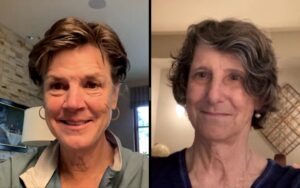
Melanie Kemper and Mary Liedel
Description
Longtime friends Melanie Kemper [no age given] and Mary Liedel [no age given] share stories of volunteering at the Mass vaccination sites together and other moments in their friendship.Participants
- Melanie Kemper
- Mary Liedel
Venue / Recording Kit
Tier
Partnership
Partnership Type
Fee for ServiceKeywords
Subjects
Places
Transcript
StoryCorps uses secure speech-to-text technology to provide machine-generated transcripts. Transcripts have not been checked for accuracy and may contain errors. Learn more about our FAQs through our Help Center or do not hesitate to get in touch with us if you have any questions.
[00:00] MELANIE KEMPER: Go ahead and introduce yourself.
[00:03] MARY LIEDEL: My name is Mary Liedel and I am living in Portland, Oregon. And I am here with my friend of 50 years, Melanie.
[00:18] MELANIE KEMPER: And I am her friend of 50 years, Melanie Kemper, also live in Portland, Oregon. And yes, Mary and I met in about 1973. So. And I guess my first question, so if I get to ask the first question, it would be, Mary, tell that fun story of how you started at the vaccination clinics. Your route was circuitous.
[00:46] MARY LIEDEL: I think.
[00:46] MELANIE KEMPER: Arizona.
[00:48] MARY LIEDEL: Yeah. Well, as soon as I knew the vaccine clinics were coming, I leapt to wanting to help. And so I contacted the state of Oregon. There's a medical reserve corps, and I also contacted OHSU, Oregon Health Science University, because they were conducting it. I also went to legacy health because I had worked there, couldn't get through to them anyway. I was shooting arrows wherever I could hit a target. And what came up kind of simultaneously was the state thing and the OHSU, and they had different processes. I am a retired medical person, but I wanted to help vaccinate and leaping forward through all the paperwork and computer work, I got accepted at both places, and so I started working right away, but I couldn't give vaccinations. I went through OHSU and it went on and on and on. Meanwhile, Melanie leapt through the process, and I also left through the process with the state. Anyway, the problem was that in my background check, I got, I was frozen because they could not get any information about the, the year that I lived in Arizona, which, of course, I'd never lived in Arizona. And it dated back to somewhere where my daughter was in college and I co signed her utility bill or something. Anyway, it took a long time to be able to actually start vaccinations. By long time, I mean a few, two or three weeks. Meanwhile, I worked in traffic control at the vaccination clinics. That's a silly story. How about you, Melanie? How did you get there?
[03:14] MELANIE KEMPER: I remember so well, Mary, you and I kept, we text and call back and forth. We were so as retired nurses, so desperate to help. And it was like, for once, we could be on the right side of history and I could not. We both were just worded at so many turns. And then suddenly, yes, this thing through Ohsu and the Max vaccination sites came up. And I put down that when it said, are you listing various things? I did not put rn because I'm a retired nurse. So I got a job as a traffic controller and went out for my first volunteer shift on maybe one of the rainiest, coldest nights I've ever seen windy, cold, rainy nights in February. And. But when I got there, and I was so excited, I was so completely excited to just be there. And, oh, my God, I got an orange or a green vest. It was all so cool. And then when I was signing up, when I came into the first tent, they said, are you vaccinated? And I said, no, I'm not. It's February. And they said, well, would you like to get vaccinated? And I still can just practically tear up at the thought of it. I was so completely excited to think I was going to get vaccinated. And yes, of course, along with probably every other volunteer there, the thought crossed my mind, if you want to get vaccinated, go where the vaccines are. You'd read that. I had read that sometimes there were extras left over at the end of a shift, that kind of thing. But in this process, they were simply vaccinated their volunteers. And I skibbled out to the far backcountry of the parking lot there with my little wand and my flag and my vest, and I called my husband and my children to say, oh, my God, I'm getting vaccinated. I was so excited. And I also just directed traffic like nobody's business. I loved being out there. I was singing and dancing, and at the end of the 4 hours, I was also frozen to death, sopping wet. I went to where they were going to vaccinate us and happened to talk to a woman named Connie, mentioned that I was a retired nurse, and she said, well, great, then tomorrow night you can be in charge of the monitoring parking lot. I said, well, sure, why not? And that just started. Anyway, I got my first vaccination there and went and sat in one of the little bus shelters for my 15 minutes wait with every all the other volunteers, and I just kept going back. I loved being there.
[06:03] MARY LIEDEL: Yeah, I did, too. For the four said reasons. I started a couple weeks after Mel. By then, I'd had my first vaccination, but I couldn't vaccinate yet. And where they placed me, there were two major mass vaccination clinics in the Portland area. One was in their very large interior space. The other was at the Portland airport in a very large, completely exposed and uncovered space. And people just drove through in their cars, never got out of their cars. You vaccinated people in their cars there. But at the convention center, people parked and they came upstairs and inside, and that's where I began. And again, like Melanie, I was a traffic director and a paper pusher and a kind of a human traffic cone. But it was thrilling to be there. Thrilling. You didn't want to leave. When my shift was done, the time flew. Bye. And there were masses of people and. Unbelievable. And of course, we'd all been in total shutdown for a solid year, and now we were suddenly amongst thousands upon thousands of people. And there was no fear. I had zero fear. We, of course, were masked. Everyone had to be masked. You never had contact with any one person. The logistics of both those sites, because once I started vaccinating, I moved out to the airport, which is where Melanie was. That's where they needed more help. Both those sites, though, the logistics were very different. One was people streaming in nonstop, coming up a stairwell and nonstop for 12 hours at a time. And they never. The people never stopped moving. They had it so well orchestrated at the convention center that the only time you actually had to stop was to fill out a few forms. And then once you got to the line to be vaccinated, you might have to wait five, possibly ten minutes. It was astonishing. I got to know the logistics person because I was so interested in how they ran this, and I watched them mid shift decide that the flow was getting stuck somewhere and they would just move cones and put people different and fix it. It was fascinating. Same was true at the airport. Everybody in their cars and masses of cars.
[09:23] MELANIE KEMPER: Yeah, we. The airport didn't move quite as smoothly. There was one night when nobody. There were still people there at 11:00 p.m. it was supposed to close at about seven. There were people that came for their four hour shift and stayed 6 hours and then stayed a couple more hours. And by and large, you were pretty happy to do that. We got to know. I got to know other Ohsu people and various volunteers. I mean, I worked with x ray giving injections. Once I got cleared to do the injection, once I refilled out the forms and said, yes, rn then I got cleared fairly quickly because my license had only been. It had been two years since I let my license go, and that was. That was good enough for them. But my gosh, I worked with x ray technicians and physical therapists and anybody who had the cojones to give an injection they had giving shots. And I never worried for tons of traveling nurses. I never felt any qualms whatsoever about the people I worked with. I liked some better than others, but it was. I loved the people that were there giving shots. Some days it was so cold, you couldn't. It was scary because I just couldn't feel my hands doing what they were supposed to do, and they'd pass out those pocket warmers like crazy. And you had 18 layers of clothes on, and then, God forbid, you had to pee and make your way over to the Porta potty and take all that off and then get it all back on again. It was just rain pants, rain jackets, rain hatsheen, sopping wet t shirts. It was just there. There were tents over the injection places, but it rained sideways in the winter. And.
[11:16] MARY LIEDEL: It must be said that the porta potties were heated. They were the fanciest porta potties out there at the airport that I've ever been in.
[11:26] MELANIE KEMPER: Yeah. So anyway, it was pretty marvelous.
[11:30] MARY LIEDEL: Pharmacists.
[11:33] MELANIE KEMPER: I worked a number of shifts with a woman who was an oral veterinarian. She only did mouths of animals. I just didn't know there was such a thing, but. And she was awesome. I just so looked forward to working with her. One of my other favorites was a woman who named Rita, who was from the south. And I won't even pretend to imitate her accent, but she always kind of muscled you out of the way so she could give injections to the guys in the big pickup truck because she liked her. A guy in a big pickup truck. She had to love Rita, who's not going to love that.
[12:15] MARY LIEDEL: It was just a privilege.
[12:17] MELANIE KEMPER: It really, really was. What else was fun is that in 50 years of knowing each other and going through nursing school, it was the first time Mary and I had ever worked together since nursing school. You can do that one, mayor.
[12:31] MARY LIEDEL: Yes. Well, once they cleared me of my non year in Arizona and I was, my background check was clear and I could vaccinate, I immediately went out to the airport site and ended up, I think Melanie and I both worked two to three times a week. She may have worked some weeks a little bit more, but I don't think it was our first shift, my first shift up there. But shortly, Melanie and I got coordinated and showed up for our airport shifts for vaccinating at the same time. And it was a glorious time. We met in nursing school, actually, in 1972, but it was not. And we sort of couldn't stand each other from across the room. We were so very different. Very different.
[13:41] MELANIE KEMPER: Mary sat in the notes. I slept in the back row.
[13:46] MARY LIEDEL: Yeah, yeah. Smoking only on breathe. Yeah. So we were quite different and steered clear until the first summer vacation of nursing school. As student nurses, we were assigned to the same shift on the same floor for the whole summer, at which point we broke through one another's facades and found some very common spots in our hearts and souls and have been soul mates ever since. But after nursing school, we went on to our areas of nursing. Melanie worked in an oncology floor and became an administrator and then went back. After many years, she went back to her real love, which was bedside nursing in the oncology unit, and that's to be admired. There aren't a lot of administrators that go back to bedside nursing, but that is what my friend Melanie does better than you would want her there if you were sick. I, on the other hand, went into on to become a certified nurse midwife, and therefore, we were at very different ends of the spectrum of life.
[15:26] MELANIE KEMPER: We used to say Mary birthed them and I buried them. That was pretty much.
[15:32] MARY LIEDEL: But what we shared over our many, many years of friendship was an understanding that being present, that those transitions in life, whether it's into life or out of life, is one of the most. Those are sacred moments in all lives, and we have the good fortune as individuals to be present for those moments in many people's lives. And the similarities are huge, but we didn't exactly work together, and so it was very fun to show up at the airport and, Don, are the yellow vests?
[16:34] MELANIE KEMPER: Those were orange. I think maybe we're orange by then, or whatever.
[16:39] MARY LIEDEL: I have a picture vest, neon vest, neon, neon something, and raise our hands to say, we want to be in that line, and we want to work together. And lo and behold, that's what we did for many, many days over the last spring, to the point that we were actually kind of. I felt sort of sad when they didn't need me anymore. So it was fun to work together, and we worked together well, and we had so much fun. I have never had a more rewarding or fun volunteer gig, and I've done a lot of volunteering. It was. Melanie mentioned this, our desire to be part of the solution, to help to, you know, we've been stuck inside and helpless for so long in regard to the pandemic, and to be able to be part of the solution was joyful. And the people that came, whether walking through at the convention center or driving in their cars, were. Some were begrudging. There were the few that were, you know, I'm only here because my kids said I had to be there. For the most part, people were grateful. So grateful, you just couldn't do anything wrong. They thought you were an angel from heaven. And those who were nervous, you know, it just came naturally, after many years of our professions, to reassure, to use humor when it was appropriate to use gentleness. When that was right, I. And as the age, at first, we were just doing older people. Remember how that was ranked. You know, at first, the vaccines were only available for people over 75 or something, and they kept lowering it down. Ultimately, we were doing teenagers. And so that was thrilling, too, those sort of way, those new age waves that came through and said, yes, it's our turn. And the people that said, I'm here because my friend drove me here, or my neighbor. The stories that people could tell you in the. How many minutes did it take to move someone through four, four, six, maybe fours or six. And we were back and forth, you know, getting the meds, getting this and that, you know. But somehow the stories we heard in those short minutes, the stories of their family members who had been ill or, you know, who. Oh, Melanie, you can remember some of these stories. They were moving. They were fun, they were funny, they were touching. They were happy, they were sad.
[20:06] MELANIE KEMPER: They were.
[20:07] MARY LIEDEL: There was so much humanity driving through. It was incredible.
[20:16] MELANIE KEMPER: I have a couple of. One I remember in particular, and it was. Miss Rita must not have been there that day, because it was a guy in a big pickup, and he was. It must have been later. He was maybe 40 years old. And one of the things that I always appreciated about nursing, and I miss it, being retired, is that you were constantly given the opportunity to leave your preconceived notions at the door and just deal with the person in front of you. And this guy pulls up, and I thought the things I think when a guy pulls up in a big pickup, and it ended up that he was one of those supremely grateful to get this vaccination today people. And that he only hoped he could convince his by getting it and. And being okay, that he could convince his wife it was a fourth grade future that the vaccinations were, and she ought to get one, too. And I thought, wow, didn't see that one coming at all. None of that was what I expected. I just adored that guy. I wished him well, and I always hoped that someday later, I'd see that big old pickup roll through again and he'd have his wife at his side, you know, he'd say, nope, that side of the car that's getting vacuumed, I really, really like that particular person. We had lots of people. We had interpreters, because there was so many people who came through who were non english speaking, and there were people who interpreted for us, and they were. Sometimes you use the machines that they had set up for interpreting. And some of those were a bit of a crapshoot. This part as well. That interpreter's not really available right now, and neither is the machine. And you weren't supposed to let the third grader in the backseat interpret for you. And what do you know? Sometimes you did it anyway. Sometimes I did it anyway. But these people, I believe everyone I vaccinated knew exactly why they were there.
[22:32] MARY LIEDEL: And it was okay that they were there.
[22:34] MELANIE KEMPER: There were also people. Remember, Mary, you'd look in and realize this is their home, this part. And the mounds of debris in it were there. This was their life. And it was really humbling to realize that when it was the end of my six hour shift, where else? I was going to go home, do a warm, cozy home with clean sheets. And this person was going to probably stay in that car. In fact, that woman got out. Remember one woman got out and there were just. She was sitting on springs. I mean, the car was just trashed. And she just said, oh, I'll just take any excuse to get out of that car. Let me just stand up for you. Just stand up in here. Give me my shot in my arm. Just get me out of my car. You're undercover.
[23:23] MARY LIEDEL: There were stories of people who had already lost, been to family members to. And there were many tears, many tears of joy, of fear, surprising the number of people. And you can't guess who it is. Sometimes it's that big, lovely guy who's terrified of heels. But. But no, they were mostly just. Again, the humanity that I got to unix to actually touch during that time was incredible. May I tell a bit of my personal story in that era?
[24:20] MELANIE KEMPER: Yes.
[24:25] MARY LIEDEL: My husband of 40 years died not of COVID but of Parkinson's disease in December of 2020. His last act, out of bed, which was one week before he died of. And the last day in his life that he was up and out of bed was to salute with me and my daughter and her partner, the first vaccine given in the United States. He tried to get out of his chair and we went to help him and stand him up. And he, who had not had any alcohol to drink for over 20 years, had insisted that we pour him a beer. Okay? And he got that beer and he stood up and he toasted to the. To the television. And we looked because we hadn't been watching the news. And the news program was the woman who was getting her vaccination, the first vaccination given in the United States of America on December 14, 2020. So that's a little bit of the story. There's a whole lot of about losing your partner of four years. And, you know, needless to say, it was, it was a challenging time for me, but as soon as I realized I had, I could do something, I, as I said before, I rushed, I rushed, I poured all over the computer. How can I sign up? Take me. Take me. So at that moment in my life, it was a way for me to transition. In part, the transition continues, but it was my first chance to go out into world between COVID lockdowns and my own personal grief, to go out into the world and give back. And, well, I just took John with me every day. He would have been there if he could have been there, but he was there. So my personal story and why that.
[27:35] MELANIE KEMPER: Was.
[27:38] MARY LIEDEL: An incredible moment for me, coinciding with the incredible moment in the world.
[27:49] MELANIE KEMPER: I remember thinking, Mary, that it was like this healing thing we got to be part of was just pulling you back into a piece of the world for a while and in a way that you weren't going to stay housebound. I mean, I knew that about you, but it was lovely to have this healing thing beef. What compelled both of us, and you particularly, back out there was a man you vaccinated who knew John. Do you remember that? I don't remember who that was. Someone who inspired you to take a.
[28:39] MARY LIEDEL: Break for a few minutes. Fellow vaccinators who knew John was a pediatrician and had practice in Portland for many years. So he knew some people. So that, for me, that context plays into my experience.
[29:11] MELANIE KEMPER: Yeah. Another piece of the story for Mary and I in these last 50 years is that besides standing in the rain at PDX giving vaccinations, is that we in 19, sorry, 2002, I was fixing to turn 50 and reached out to Mary to say, you want to walk a marathon with me? Because it was a few days after I turned 50 in the fall. And so we started walking while we talked, instead of changing diapers while we talked or fixing food. Well, me watching Mary fix food while we talked, we walked a whole lot of marathons and trained for them together. And I don't think in. How many did we do together? Six? Seven. We never ran out of things to talk about. It was terrifying, actually, in that regard. But, you know, Tom would say, I can go, what the. What the hell do you talk about that much? I said, oh, we just. We just do. You could just. We talked the whole time. Our, between Mary, let's see, Mary's firstborn is 40. My firstborn is 39. Her second born is 38. My second born is 38. My third born turns 35 today. And Mary's third born turns 34 this year. In six years, we had six babies.
[31:01] MARY LIEDEL: Between us, a match step of two girls and a boy.
[31:05] MELANIE KEMPER: Just. Anyways, we had a lot. But it was lovely because marathon walking was just us. It was our goal. It was our thing. It had nothing to do with being somebody's mommy or wife or nurse. It was just these two friends who get to do this thing. And it was. It was great. It was liberating lines, too.
[31:30] MARY LIEDEL: It was liberating.
[31:31] MELANIE KEMPER: Yeah.
[31:32] MARY LIEDEL: We had two goals that first year. The first was to finish, which we did. And the second was to not receive, not be injured, not get hurt. We almost did, but Melanie wore new socks and got some blisters.
[31:51] MELANIE KEMPER: Kids gave me those new. Oh, here, mom. The new socks. And I wore them. Idiots.
[31:58] MARY LIEDEL: But my memory, at least the first year, if not the first three times we did it, was that we caught. We spent miles and miles and miles and miles of training, just catching up on those years that we each were raising three kids and working and, you know, had no time. And a lot of the catch up was about our children and our experiences in that. But we did share a great deal of mothering and, in fact, parenting, because our families are as close to family as you can be. Spend every Christmas Eve together. Everyone comes to everyone else's weddings.
[32:49] MELANIE KEMPER: Even during COVID Even during COVID.
[32:55] MARY LIEDEL: And.
[32:55] MELANIE KEMPER: We shared a lot of nursing stories, too. It was just fascinating to do these deep dives into each other's careers and have the uninterrupted time to listen to the entire arc of, you know, a 20 hours labor or a, you know, the weeks it took someone that I'd known for years to die of cancer. And it was humbling to listen to those sides of this story. I like that part.
[33:32] MARY LIEDEL: Another thing we have shared is our gardening. Your gardens.
[33:39] MELANIE KEMPER: Yes.
[33:40] MARY LIEDEL: And for fun. Now, what we do, we did it two days ago, was meet at a nursery. Did either one of us buy anything? We just walked around and looked. I mean, our gardens are pretty full.
[33:57] MELANIE KEMPER: I bought two succulents.
[33:59] MARY LIEDEL: That's right. But we'll go and look at gardens any day of the year and at nurseries and we consult on one another's gardens. And we share plants and we share our nurturing of the earth. So we have indeed shared a lot of nurturing, haven't we?
[34:20] MELANIE KEMPER: We have. And then we get to be grandmothers.
[34:27] MARY LIEDEL: Yes. And now we're grandmothers. And our grandchildren know one another, and we are shifting from our annual, I believe. I'm not sure, but I think we're beginning to shift from our annual Christmas Eve at the campers. I don't know. Melanie's giving me a.
[34:52] MELANIE KEMPER: That would be the stink eye that you can only see, but not here on the recording.
[34:56] MARY LIEDEL: Yes, the stink eyes. She's not sure she can let go of it, but it is getting larger. But last year, we had our first annual, and this year scheduled second annual Liedel Kemper camping trip, where we go find a small campground, rent the whole thing, and have free range children, dogs, parents, people. And that's pretty fun.
[35:31] MELANIE KEMPER: It's very fun, and I hate camping, and I still have fun. So, yeah, that says a lot. It's. It's been. It's been pretty fun.
[35:41] MARY LIEDEL: So I guess for me, I just want to take an opportunity to say how thankful I am to have been part of that historic mass vaccination response to the terrible pandemic that Covid-19 has been. It grieves me to think that there are so many people in this country, and sadly, in other countries, who have, even though they would use the vaccine, remain unvaccinated. The losses are incomprehensible. But I am grateful that I did what I did, and I am very grateful to have done it with my best friend forever, Melanie. And I do think it comes into that bucket of nurturing that we have shared.
[36:55] MELANIE KEMPER: Absolutely. Absolutely. I was. I miss it. I miss the airport. I miss the red lot. I still feel, personally, that I own just a small piece of. There was a texting thread from a group that had been there on the one year anniversary, and one of them said, I still occasionally go to the Albertsons parking lot and, you know, get out a flashlight and just start directing traffic, because it's just in my DNA now, and I. And I miss it. And I do stay away from other people's car windows. I don't approach them and ask if I can give them a shot. But. But it was. Yes, being out there and then getting. Finally, after all these years of being all the people we were to be nursing side by side with Maryland was just one of life's privileges. And I can't. Yes. I couldn't believe it closed. We couldn't stay open forever, that people wouldn't just keep coming in screams and be grateful. I didn't see that.
[38:10] MARY LIEDEL: I refer to that era as, you know, as being a modern day Rosie the riveter. Everyone respond.
[38:22] MELANIE KEMPER: Yeah. Okay. Lastly, love you, Mary. Have for a long time, a very, very long time. And I just don't know that there's any better way to be friends than all the ways we've been able to be friends.
[38:42] MARY LIEDEL: And. Well, I look forward to finding a few more.
[38:47] MELANIE KEMPER: We'll figure it out. We will figure it out. Okay?
[38:51] MARY LIEDEL: We always do.
[38:54] MELANIE KEMPER: Thanks. Think I'm done.