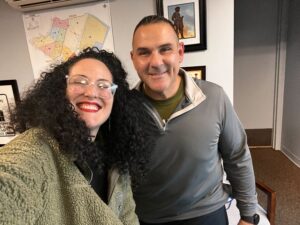
Angela interviews Police Chief Giacomo Sacca, Elizabeth Police Department, Elizabeth, NJ. Part 3 of 4.
Description
Part 3 of 4. "What is the difference between the law and justice?" The pandemic, social unrest, and the way forward.Participants
-
Chief Giacomo Sacca
-
Angela Kariotis
Interview By
Keywords
Places
Languages
Transcript
StoryCorps uses secure speech-to-text technology to provide machine-generated transcripts. Transcripts have not been checked for accuracy and may contain errors. Learn more about our FAQs through our Help Center or do not hesitate to get in touch with us if you have any questions.
00:00 We are natural storytellers. It's what makes us human. David Isay of StoryCorps describes oral history interviews seek to record and preserve in depth accounts of personal experiences and reflections. Welcome to walking the beat. You're tuning into our oral history project. This is our part in documenting knowledge, capturing the hard earned learning, making space for legacy so we can build forward. If we want to know about better policing, lets build off of the efforts of a chief who does that. If we want to understand the impact of lockdown drills on children, ask one. There is great intimacy in listening, allowing a beloved to unfurl their wisdom. There is also risk for us. We might be changed a little. We offer these testimonies as historical documents. The stories are as diverse as the people. What can we learn from each other about the conditions for safety? What is our role in interrupting violence in our communities? How might we collectively challenge violence as a culture and replace it with healthy habits, not just bodies? How can we protect each other's psyche? What might a story about a time we felt safe tell us about necessary public policy? Youth in the walking the beat program learned how to conduct oral history interviews on matters of community violence and public safety. We'll hear from a judge, a detective, a police chief, an elder, a third grader, a reverend, a social worker, a bunch of teenagers, a drama teacher. We have so many folks show up from our community, and we have you. Let's listen. Okay, so I gave you a little bit of a foreshadowing last time you saw each other, and it was important that we didn't end the conversation the way that we did because there's one super important question I have to ask you, and that will be the last question that I will ask. So I'm just letting you know why this is so super great. All right. What is a problem? All right. No, what is something that frustrates you? Try to be as narrow as you could. So that's like part a of the question. Something that's really frustrating you right now. What is a problem that you really want to solve? And those two things might be connected. What might be particularly frustrating, and what's a problem that you really want to solve? Maybe something that you're hoping to solve before you retiree.
02:48 So what do I want to solve? Right. So it's not so much as to solve as to what is my main goal. So when I took over as police chief, what was my main goal to my position, to my function. Right. So the overall goal, right. Is to make sure that we had a fully functional and a fully functional police department that the public was happy with their service. Right. So that was an overall goal. And how that relates to crime suppression is that my goal for crime suppression is eradication. Right. My goals. My beliefs are that the city of Elizabeth. Right. Even though it has so many people in it, such size, right. That there's no reason why it can't be such a safe city, that you can feel confident that you can park anywhere you like, leave your valuables anywhere you like, you know, in your car. And I'm talking about your regular day to day stuff. Right. You shouldn't be able to. You shouldn't have to worry that, oh, I'm leaving my car and my bag is in the backseat, that you can walk anywhere you like, go to a restaurant, go to a club, and not have a fear of being assaulted when you leave there. Right. I don't believe that because of Elizabeth's size and because of the, you know, the volume of people, that it's not achievable. Right. I believe that that is extremely achievable. I believe that there's a lot of things that have to happen to make that achievable. Right. I believe that there has to be a functioning police force that actually works the right way. I believe that we have to have all of the tech in place to support it. And I believe that the public also has to play a giant role in it. Like we discussed earlier, the police can't be everywhere. It's physically impossible. But the public can be great witnesses. They can call the police right away. You know, so many times I will hear a complaint, you know, oh, this happened. Oh, these crimes happened. Oh, this occurred. Okay. And then I'll say, did you call the police? No. Well, why didn't you call the police? Oh, because I called and they never came. All right. But that's not now, you know, that's not this police department. That's not, you know, this area era that we're dealing with. So kind of changing that public perception that they do have a vital role. Right. Because what is our overall crime strategy? Again? In order for a crime to occur, you need a victim, you need an opportunity, you need a lack of guardianship. We want to make it appear as if there's. As if there's guardianship all the time. So criminals, they're repeat offenders. Nobody goes out and is a one time criminal. That's it. And it's over. Right. They build up to their crimes and they repeat their crimes. So when you have a person let's say you have a person who's committing street robberies or muggings. That person is mocking multiple people. Right. And they will return to areas where they get away with their crime. We want to make it so it's not comfortable for them to return to that area. So they don't want to commit that crime. So they feel that there's a piece of guardianship there. So that's our overall crime strategy. And that's basically how my goals are. What frustrates me. What is frustrating and how is it linked to it? Is that not part of. Part of the safety and security of a town? Right. Think about my vision. Can you park anywhere? Can you leave your stuff? Can you walk in and out of a place? You can't do that if your perception of. Of the area is that you perceive the area to be unsafe. Right. And how do you perceive what. What perceptions make you think an area is unsafe? Okay, so the hardscape areas we work on, right. If. If a police officer sees that there's a streetlight out, they can pull the number on there and they can simply give it to our radio room, and we'll call PSE&G and j and get it fixed. If there's private properties where we have crime, we can contact them. We can ask for additional lighting or landscaping to be done. But there are certain human factors that we can't fix. And that's when. Part of the frustrating part is homelessness. Right? Again, I said nobody chooses to be homeless, and we have to be able to get them the right services. Mental health services, shelter services, food services. But that's a frustrating problem because of the problem. Because it's a wicked problem with a difficult solution, because you're dealing with human beings and human beings that may not want to participate in the program or making the correct link between the people and the services is extremely difficult. Right. So I have a person that that's their sole job, right. Is they're working in the mental health car. Their job is to do street follow ups to try and get them services. And for every 20 contacts, they may have one success. So that's a frustrating problem. It's not a frustrating problem that the problem exists. It's frustrating on how difficult it is to make the problem work.
08:56 Thank you for that. Because you were talking the police and people working together for public safety. But there are these other avenues, like policymakers and social services and all these other organizations, too. And it's so hard to do anything. All right, Maya, thank you for that. Are you from here yeah.
09:15 I was born and raised in Elizabeth. Yes.
09:18 So I don't know if there's, like, the idea of causation and correlation, but I'll ask. It seems like a lot of the officers are from here.
09:30 Yes. They have to be. It's. It's. It's. It's.
09:34 Tell me more. Because some places you only have to live somewhere for. Is it then you have to live somewhere. There's.
09:39 There's a. There's a.
09:40 And do you think officers should live where they work?
09:43 So there's a law, okay, that says that you cannot force a police officer to live within the town that they work. Right. It's under title 48.
09:52 All right.
09:53 However, you may have a city ordinance which forces you to be a resident before you're hired. And also that the ordinance can state that you have to be here during your probation period, which is what ours is. Right. So as a police officer, you absolutely have to live in the city of Elizabeth before you're hired. Our probation period is one year after you graduate the academy. So you have to be. When you're hired here, you have to stay within the city for approximately a year and a half before you can move out. Now, what are the pros and cons? Right. So the pros are that people will say, well, people will just move in to get the job. Right. And that's very, very rare. It really doesn't occur that much because I do all of the employee interviews prior to hiring.
10:50 Okay.
10:51 So every police officer goes through a background check. At the end of their background check, I give them a final interview. And again, I can only speak for the past three years. Right. So I'm telling you what the process is. Now, when I do those interviews of those people, the opening paragraph is their social background, where they were born, where they went to school. I want to tell you that 90% of them, 90% of the people that we're hiring are born and raised in Elizabeth, attending the Elizabeth public school system. Even if they don't attend the Elizabeth public school system, they attend local schools, either a parochial school or a charter school. So. But they're. They're based. And I would say 90% of them, one out of every ten, I get a person who. Yeah, you know, I was born and raised in Jersey City, and then we moved to Elizabeth when I was high school, or I was born or raised in this town, but then I got married and I. Here. That's one of every ten. So I wanna say 90%. I'm confident in saying that born and.
12:01 Raised in Elizabeth, do you think that makes a difference?
12:03 It makes a huge difference. Yes, it's a huge difference.
12:06 We believe that. Yes.
12:07 Because here's why. Everything about policing, and we'll go back to all of my other answers. It's about contact. Right? It's all about contact. And you are more likely, more likely to be on the offensive with a person that you don't know. Right. And even if you don't, because every police officer isn't going to know every person they come in contact, that's a city resident. But chances are that they will know somebody within their immediate social network or they are common to the area in that they have the same culture, so that they, even though they're not from the same culture, they understand the culture. Right. They understand the neighborhood that they're in. They understand it the way that the. That they are speaking. They will understand that way that people are acting. The way that a person speaks and acts can be completely normal. Right. But if you're strange to that and you don't understand it, you may be offended or you may take it as aggressiveness, and the person who's used to it, they may see it as. No, that's just. That's just normal for them. They don't mean to be offensive. They don't mean to be aggressive by it. It's just, you know, the way they speak.
13:34 That's great. It was super exciting where the officers were like, I went to this high school, and they were like, oh, who was your teacher? Or is the cafeteria the same? Or. Yeah, I was it. You know, I took music classes. Is the music, you know, the areas, it's still in the same part of the building. So seeing that sort of low stakes, casual conversation between the officers and the kids was amazing. What do you think about the psychological test? Yeah, yeah, yeah. Go ahead. Go ahead.
14:03 One thing I wanted to touch on is, well, should the officer be allowed to move out of the district? And does that make a difference?
14:09 Okay.
14:10 And I think the answer is yes, they should be allowed to move out. Here's why. Because fair. Because of what they. What they're, what we ask them to do, right. In no other business do we ask them to go into so many contacts where people are having their worst time. Right. Their worst day. Nor are we asking them to be, you know, the enforcers and the police officer needs to be able to decompress, needs to turn off being a police officer, and needs to be a regular citizen all of the time. Right. Here's why. Every single day, the police officer needs to be able to break off between. Now I'm in police officer mode, now I'm in civilian mode. If you don't do that, if you don't do that, you will lose your empathy for the civilians. Right. And you will lose the ability to contact, to connect with people who are not law enforcement. When you force somebody to live in a town, you're almost forcing them to be a police officer all the time because they remain guarded all the time. And I know this from experience, because when I lived here, right, I lived, I was born and raised in Elizabeth when I first bought a home here in Elizabeth. Everything that you do socially in Elizabeth, whether you're working or you're not, you're plain clothes or not, you are recognized and you are engaged as if you were a police officer. Now, when you have so many contacts that you forget who's a good guy, who's a bad guy. Right. You forget who is. Was this person a negative interaction, positive interaction, until you have a few seconds of recall memory. So as a result of that, you have to stay guarded all the time. Staying guarded and alert all the time is like. Right. Creates a such high stress levels.
16:26 Level ten.
16:27 On your day off, you're supposed to be rested. So when you come back, you're not at level ten. If we have our officers running around at level ten all of the time, that's harmful. Every contact, they're going to get hurt.
16:38 And they're going to get hurt too. Right?
16:39 And they're going to get hurt. So I.
16:42 You're at the office all the time.
16:44 Yes. You're at the office.
16:45 You're at the office all the time. City is your workplace, all right? Right, right. Okay.
16:51 Now listen, people may be able to do it, but they really have to. They have to be able to have that social breakdown.
17:01 I asked about the psychological tests. What do you think? How do you feel? General, sort of. Do you think that tests the questions or the way they're cause so much of it? Right. Temperament or the weight, empathy or the ability to empathize? I don't know. Guess that's what the psychological tests are for. Trying to engage.
17:19 So we run psychological testing before every hire.
17:23 Okay?
17:24 And in the police department, we may order people back for psychological testing. There are criteria. So absolutely. Before you come on, you have to pass a psychological test. And then when you're on the job, if you've had a traumatic incident, you may be ordered back for another psychological test. If you are involved in specific incidents, you're ordered to a psychological test, for example, domestic violence. Domestic violence affects everybody. It doesn't matter your social status, it doesn't matter what your job is. With a police officer. With a police officer, there is an extreme amount of restrictions. So in every other profession, if you get involved in a domestic violence, whether you are a victim or the aggressor, let's just say you're a plumber or a doctor or whatever it is, you get involved in the incident, you may or may not be arrested. You know, you may or may not get a restraining order. Tomorrow you go back to your place of employment and you continue as usual with the police department. It doesn't work that way. You're immediately taken off duty. You're immediately put into, whether you're a victim or a suspect, you're immediately put into an administrative role. If you're a suspect, you're suspended from duty. Now you can be a completely innocent suspect. The other part of your relationship could have completely made the whole thing up. However, until the problem is rectified through the courts, you're not working in your full capacity. You may be brought in to work desk, you may be, but. But when you're. You're definitely stripped of your firearms. All of your firearms. You're active, they're on duty and off duty. And as with, as such, you cannot wear a uniform. So you come in in civilian clothes, you'll do administrative work or you may be put out on full suspension. These incidents take time, six months to a year to clear up. Because you've been through this before, we're going to put you back out into full capacity before you've had all of this. Even if you're fully innocent, all of this stress related to this, you must be sent for a psychological examined. So what does a psychological exam entail? You know, when you're looking for a hiring exam versus a fitness for duty exam versus a person who's been gone through a psychological trauma exam, they're all completely different. They're not looking for. It's not a psychic exam where you're looking for a person's sanity, right? Because the assumption is that the person is sane who is either taking the test or doing this. What you're looking for in the initial is, is this a person who has the maturity level and the empathy level to be a police officer? That's what you're trying to gauge. And they're using very specific testing systems and conversations to gauge that on a person.
20:47 Conversations too.
20:49 So the way that the psych wondering, how can you do that?
20:52 How can you capture.
20:53 So the way the psych exam works is you take a series of tests. So you'll take two tests. One, I think, is a 500 question test. One is another 100 question test. But they're not questions that are based on anything that you can learn to study for. What their questions are based on is they're based on an evaluation of your personality, what your worldview is of yourself, and what your view is of other people. Right? So the questions are designed to pull out people's tendencies. What the doctor does, the doctor then takes those questions, looks at what they scored, and then has a conversation based on that score. Right. So a person could fail the question. Right? So let's just say it's a not question and the person marks it as a positive. They're going to fail it. You know, according to the way the question says, right, it's going to put a red flag for whatever, racism. Right through the conversation, the doctor then basically says, hey, you marked this. What do you mean? And they. They confirm or deny it the person's beliefs about that.
22:06 Okay.
22:07 If a person truly has biases against other people that are beyond normal biases, it's going to come out. It's going to come out in their conversations. If the person can't exhibit empathy or doesn't have enough maturity to work through a situation, it's going to come out because the way that they answer and the way that they structure their questions, that's what the doctor's trained to pick up on.
22:34 Okay?
22:35 Now, psychological exam, when you go through a trauma. Right?
22:40 Right.
22:41 Is not the same because that doctor has now got to be looking for how much impact that trauma have on your life and how much is that impact going to affect your job? So the questions may go into sleeping patterns. Right? How long do you sleep? How often do you sleep? Do you sleep too much? Do you sleep too little? What is the change in your sleeping patterns since the trauma has? What is your irritability level? Since the trauma has. So the doctor is simply gauging, how much coping mechanism have you gone through? How much more do you need? Are you fully functional? Same thing with going through a traumatic incident that's not related to something from the job like a domestic violence. So psychological exams are, are key tools that we use here, and they're absolutely imperative to the functionality of policing.
23:32 One question unrelated that I'm just curious about, now that marijuana is legal, do you think records should be expunged? They are nonviolent. Is that tele. Nonviolent possession?
23:47 All marijuana records and about who's still doing something.
23:52 Like, I'm thinking about Rockefeller laws or like, tell us what you think about.
23:55 So all marijuana. All marijuana records. Right. Nonviolent are expunged.
24:01 Right.
24:01 And if they have not been expunged off of the record yet. Right. It's just because the courts have not gotten around to doing it because there's so many people. However, when you are reviewing it, I'm to treat it as if it was expunged.
24:21 Okay.
24:22 Okay. So let's just say a person applies for a firearms permit. Right. If it was expunged, I don't even see. Right. And a marijuana arrest. However, if I do see it, it just means that the file hasn't. The courts have not caught up to the file yet, and I should treat it as if it were expunged.
24:42 Okay.
24:43 I cannot use it against them.
24:45 Do police get frustrated by judges and lawyers?
24:48 Absolutely right.
24:50 Just like, what are you thinking? Or what happens here? Or. Because sometimes when we think about justice, we have so much focus on police and cops, and it's like, well, lawyers, like, and I always say, you know, prosecutors and the defendant lawyers, they all go to lunch together. And judges play a massive role in how they hand out sentences and how they don't. And how same crimes or penalized differently, you know, treated differently, depends on who the people. I'm like, that's judges, that's lawyers.
25:28 So the police. Absolutely. The police get frustrated with the judicial system like anybody else. Right. But when you step back, okay, and you really look at the situation, why do victims get frustrated? Okay. Because they may feel that there is either too much penalty in one area and not enough penalty in the other area. Right. Like you just said. Right. People may get off, for one thing, get on it. Right?
25:59 Sure.
26:00 So that's what their belief is. And then the police worldview is I get frustrated because, you know, I work so hard to bring these cases to fruition, and sometimes the person is released before I finish the police report, or sometimes the person is being arrested multiple times for the same thing. So, you know, just on news twelve today, there was a person who was arrested for, you know, driving and crashing a stolen vehicle was being detained. This was the disease because the person was arrested and detained, you know, nine days prior and was on probation for the same thing. So the police get frustrated because, you know, you'll see people with multiple arrests multiple times, and you arrest the same person for the same crime over and over again. Okay. And you think, when is this person finally going to end up doing jail time, which is supposed to be the deterrent to it. But now let's look at the prosecutors and the defense attorneys and the judicial world, okay? They have to, they have to adjudicate all of these cases. Right. The prosecutors have to have enough evidence so it's beyond the reasonable doubt in order to convict the person. Okay? The. The defense, this job is just to make sure that they don't have enough beyond the reasonable doubt. So when you don't have. Now you look at a case as a prosecutor, you may say, you know what? I've got proper cause. I've got preponderance of the evidence. Like, I got three quarters of the way there. But do I have 100% of a jury? And they may feel like, you know what? I don't think I have 100% jury. Or they may know the special rules that they can and can't introduce in crime in court systems. So they may look at a case and say, hey, I have to settle this because I'm gonna lose.
27:58 Okay?
28:00 So. And I'm just, I'm, listen, I'm not saying I agree with it. Yeah.
28:02 It's what I'm telling, like we were talking about.
28:04 What I'm telling you is why it occurs.
28:07 Yeah.
28:07 Right. That's why it occurs. Right. What's the problem now with, with the judges section that would make people frustrated? One judge may be more harsh than the other. One judge may be more liberal rumors, maybe more strict, you know? And that is something that, again, is frustrating and difficult to live with. Right. Depending on what side you're on. Right. If you're the defendant, you may want a liberal judge. You may want a judge that's giving out the benefit of the doubt. If you're in the prosecution, end of it. If you're the victim end of it, you want a judge that gives him the max. Ok. But the beauty of all of this, all of this is that nobody has the final say ever. Ever. Right. Everybody has a complaint process and an appeal process, and it's not a perfect system, but it's the best system in the world. Yes. Right. Because it is. It is extremely fair and balanced to the person who has. Is going to lose their liberty. So. Yeah. It's not, it's not a perfect system. Right. And the factor that you're going to deal with and what. So the opening question was, do the police get frustrated and why? And the frustrating part is because of the human elements.
29:31 Yes.
29:32 Right. Because we don't want to have a mechanistic society where this is it you're arrested, you're sitting here until this occurs. Because those are dictatorships.
29:42 Right.
29:43 And in those, in those type of systems, there's no appeal process, there's no rebuttal. Everybody, everybody, even, all the way up to judges, has a series of checks and balances where if you don't like the way they're operating, you can complain to somebody and there will be an investigation, and they will. Even judges, even judges have that system. Right? Even the state regulates the judges. The federal regulates the, you know, the federal judges. And there's an appeals process in levels. It takes time, it takes money. But, you know, the system is the best system that we have, 100%.
30:29 There's more to this interview. Keep listening. Click on the next upload. Stay with us.