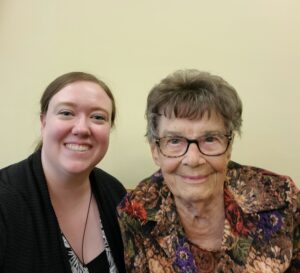
Bernice Brown and Jennie Fidler

Recorded September 28, 2023 43:24 minutes
0:00 / 0:00
Id: cte000578

Description

Jennie Fidler (35) interviews conversation partner Bernice Brown (99) about her life and family in the 20th century.

Participants

  • Bernice Brown
  • Jennie Fidler

Recording Locations

Shorehaven Center for Life Enrichment

Partnership Type

Fee for Service

Transcript

StoryCorps uses secure speech-to-text technology to provide machine-generated transcripts. Transcripts have not been checked for accuracy and may contain errors. Learn more about our FAQs through our Help Center or do not hesitate to get in touch with us if you have any questions.

[00:01] JENNY FIDDLER: Hi, my name is Jenny Fiddler. I'm 35 years old. Today is September 28, 2023. We're in Oconomowoc, Wisconsin. My partner is Bernice Brown and I am her librarian.

[00:17] BERNICE BROWN: My name is Bernice Brown I'm 99 years old, and today's date is 928 23. And we're in Oconomowoc, Wisconsin, and I'm here with Jenny Fiddler. She is a librarian.

[00:36] JENNY FIDDLER: All right, so, Bernice we're going to be talking about your life, your childhood. You've lived 99 years. Your birthday's next week, so we're going for the full hundred. That's really exciting. So we're going to be talking, looking back on your life and talking about what's changed, your memories, your experiences. So, let's start off at the beginning. Can you tell me a little bit about your childhood?

[01:02] BERNICE BROWN: Okay. Well, I was born in Racine, Wisconsin. And then my folks moved to a little farm out in Caledonia, which is between Racine and Milwaukee, which is mostly farming. And we didn't have a large farm, but we had a animals. And every morning after I got a little older, like six or seven, I would take the cows down to the river and bring them back in the evening. That was my job. And during the day, of course, my mother would have a BIG garden, and we would pick all the vegetables and strawberries and raspberries, and I would help with that. And usually, I just was on the farm helping. My mother went to a parochial school, a one room school, where she had 52 kids, one teacher, and everyone learned everything. All our read, arithmetic was written on a chalkboard. In the morning, we'd get there, and we'd have to take the lesson off of the board and Write it down. And this kept going on all DAy Long. There was no messing around because she was a Strict lady.

[02:36] JENNY FIDDLER: Absolutely. Yeah.

[02:37] BERNICE BROWN: And had to keep the Kids in Toll. So, that was part of my schooling, and it was a good 2 miles from my Home, and I had to walk a lot of times. Sometimes my DAD would take me, if he had time, and we would pick up other kids along the way. And I had friends out there. We play kick the can and all these other kind of games that. I don't know if kids even know those games now, but that was part of my childhood. And so then I kept doing all these things, and. Well, then I went to high school in Racine, Wisconsin, to Horlick High School, and graduated there in 1942. And the war was just really going on. And some of my friends, most the boys were inducted into the army right during the classes that were going on, and a lot of them never came back. And I had one really good friend in there. He was killed in Belgium for the. They were fighting the Germans, and he was the best guy. And I think we probably would have gotten married later on when he came back, but that was a bad deal for all those kids. Never came back. So then I.

[04:35] JENNY FIDDLER: Well, here, if you don't mind letting me interrupt there. So you were born in 1923. I mean, you lived through many kind of quintessential historical moments, right at that age, at World War Two, where your peers were being drafted. So clearly, absolutely huge aspect of your memory in your life. You grew up during the Great Depression. So if you don't mind if we jump back to the Great Depression, I really want to hear more about you in high school and at that age. But jumping back to the Great Depression, since you lived on a farm, how did you find that the great Depression affected your family, your childhood? Did you have any brothers and sisters?

[05:27] BERNICE BROWN: Yes, I had one sister. I was older. I was five years older than my sister. And then we had a little brother. I was age 14 when he was born. He was a little, cute little guy, but sadly, he was killed in an automobile accident when he was 19, which was very devastating for my parents, because I guess they thought he would probably take over the farm, but that was not to be. So, yes, the Great Depression was bad. We had plenty of food where I lived because we had a farm, and we had chickens to kill and we had pigs, and my dad would always have us ham and other meat that we could have, but a lot of people didn't. We would sell vegetables or give vegetables to people that needed them. And, well, I got through that, but I never had nice clothes when I was going to high school. They were all hand me downs because that was depression. And we couldn't buy a lot of. I would always want a new skirt or a new blouse. But when I was 16, I went to the dime store in Mary's scene and got a job, and I was selling cookies in back of the. In the cookie department, and I got $0.25 an hour, all right, for paying for selling cookies. And I tried to get a couple dollars together so I could get a new skirt. That was my thing, to have a nice skirt.

[07:33] JENNY FIDDLER: Did you ever wear the patterned flower bag dresses? Oh, yes, because my grandmother was living on a farm during the Great Depression in Janesville. And, yeah, she talked about wearing the patterned flower flower bag dresses.

[07:50] BERNICE BROWN: Yes, she did. Yeah, we wore those in the summer. Yes. And we always had an apron. Okay, we wore an apron. I don't see aprons much now.

[08:02] JENNY FIDDLER: I wear one when I'm baking.

[08:04] BERNICE BROWN: You do?

[08:04] JENNY FIDDLER: But that's just because I'm rather reckless with the flour. But, yeah, I have one. But you're right, it's not as natural as it once was.

[08:17] BERNICE BROWN: And of course, no one wore pants like we wear now. Yeah, but in winter, we had a lot of snow. We had a shovel. Sometimes we didn't have school because there was so much. We'd have big snowstorms.

[08:34] JENNY FIDDLER: Yeah. And if you're traveling 2 miles to school and.

[08:37] BERNICE BROWN: And if the snow plow didn't come through, we would be stuck and we couldn't get out. My dad couldn't shovel all that.

[08:46] JENNY FIDDLER: Okay. I have some recollection. My guess is that I read it in farm boy by Laura Ingalls wilder. That's where my memory is going, where they have a snowstorm and they have to drape a rope from the house to the barn.

[08:59] BERNICE BROWN: Oh, yes, we did.

[09:00] JENNY FIDDLER: So you did that? Okay.

[09:01] BERNICE BROWN: Yes, we did.

[09:03] JENNY FIDDLER: Sure. So what I'm reading in stories is what you lived in real life.

[09:08] BERNICE BROWN: My mother would have to gather the eggs several times during the day because they would freeze. It would get so cold at night, you know, after the storms, and be sure to keep the eggs warm.

[09:27] JENNY FIDDLER: Now, I know with you living on a farm, you had cows.

[09:30] BERNICE BROWN: Yes.

[09:30] JENNY FIDDLER: And I know that you have a very specific memory of an interaction with a cow. So what can you tell me about that one?

[09:38] BERNICE BROWN: Yes. I was like, I think was about four years old, and my father said, don't go near the barn today, because this cow had this calf, and. And she's very protective of it. So then this was in the summer, and that was the first place I went. I went down to the barn and climbed over the fence and got in the barnyard where the cow was. And then she saw me and she came running over the. Over the barnyard, galloping over it. And she was really angry. She had. Well, what could I say? Her nose. She had all this stuff coming up.

[10:26] JENNY FIDDLER: She's a mama who's got to protect her calf.

[10:29] BERNICE BROWN: Yeah. Then she got me down.

[10:31] JENNY FIDDLER: Okay.

[10:32] BERNICE BROWN: Rolled me around in the cinders that were on the farmyard. I don't know why we had cinders, but we did. And I was screaming and screaming, of course, and she had big horns. Well, my grandfather was in the back of the barn, and he came out with a pitchfork and hit her over the head several times. And she stopped and she left me alone. My dress was in shreds, and I was. I had stones all over my face and all over everywhere. And he took me into the house, and my mother was very upset. We thought maybe we had broken bones, but I didn't. No broken bones.

[11:26] JENNY FIDDLER: It's incredibly scary to think of what happened. Yeah.

[11:30] BERNICE BROWN: So that was one of the things I did when I was little. But, like, growing up on the farm, there was always something to do.

[11:41] JENNY FIDDLER: Yeah.

[11:41] BERNICE BROWN: Yeah.

[11:42] JENNY FIDDLER: Were you a part of four h or any other kind of.

[11:47] BERNICE BROWN: No, I wasn't. No.

[11:50] JENNY FIDDLER: Yeah, but you're right. There's always something to do. Yeah.

[11:53] BERNICE BROWN: But they. We used to have nice farm, they called it. And the fair, when we went to the fair, that was very interesting and very exciting for us because we didn't get to do too much. Or if we could go to the zoo, that was another great deal. And there were just simple little things that we could do when we were small. Nothing so exciting like they have now.

[12:27] JENNY FIDDLER: You know, they were maybe more special.

[12:32] BERNICE BROWN: Yeah.

[12:32] JENNY FIDDLER: Because they were not as common.

[12:35] BERNICE BROWN: No.

[12:36] JENNY FIDDLER: And so, you know, if you think about, you know, someone who's regularly doing fun things like that, it's just normal and it might be fun, but like that. That memory of. That aspect of your childhood of, oh, my goodness, the first time I got to do this, you know, it more common it is. It loses a little bit of its specialness, I think. So that's. It's interesting to hear about. Yeah. Just the excitement and the special times.

[13:07] BERNICE BROWN: We didn't have, you know, extra toys or. I did have a couple dolls. We played with dolls. But then I would always have to wear hand me down clothes. My mother would try to take coats apart, old coats, and make coats for me. And that was a big, big job to do. But that's how I had to have my childhood. I didn't have bought and clothes.

[13:39] JENNY FIDDLER: Yeah.

[13:41] BERNICE BROWN: And so now the kids, of course, have a lot to do.

[13:46] JENNY FIDDLER: Yeah. Things being mass produced, factory produced, things are cheaper. Yeah. It's just very different.

[13:53] BERNICE BROWN: Yeah.

[13:54] JENNY FIDDLER: So you had talked about how you got a job selling cookies to buy a skirt. What else was your teen years like?

[14:03] BERNICE BROWN: Well, I did. Let's see, after I got to be about 16 or 17, I would go ice skating with a bunch of girls group that we would have on the root river when it was all frozen up. And that was very. A lot of fun. We would build a big bonfire and skate on this river. And I guess there were guys there that we would always play around with, you know how that was. So. It was fun, but we didn't. You know, my mother wouldn't let me go out in cars with guys till I was older. She would always be so worried. So then, of course, I graduated from high school.

[15:02] JENNY FIDDLER: Yeah.

[15:03] BERNICE BROWN: And.

[15:09] JENNY FIDDLER: And you had mentioned that the war was on, and I. And you had lost some great friends.

[15:15] BERNICE BROWN: Yes. Yeah, that's right. Mm hmm.

[15:20] JENNY FIDDLER: What are your memories of kind of the home front life during World War Two?

[15:27] BERNICE BROWN: Well, we had ration books. We couldn't buy sugar. We couldn't buy a lot of things that you normally buy now, of course. And we always had food because we had eggs and chickens, and so my mother would always try to help other people with her products, too.

[15:59] JENNY FIDDLER: So it sounds like you had a real good sense of community, helping people. Yeah, that sense of.

[16:05] BERNICE BROWN: Sure.

[16:06] JENNY FIDDLER: Yeah. Just like I said, community. What was it like, or what did it feel like? Having loved ones, fighting overseas, that was hard. How did you deal with your emotions about it? Just the sense of it feels helpless to me to think about that.

[16:27] BERNICE BROWN: High school was hard, okay. Because the guys were young, and they went into the service right away. They're only 18. They. They wanted to enlist.

[16:38] JENNY FIDDLER: Oh, yeah.

[16:39] BERNICE BROWN: They wanted. They thought that was going to be a big deal, you know, but they didn't come back. We lost a lot of them.

[16:49] JENNY FIDDLER: Yeah.

[16:50] BERNICE BROWN: And things were. Gasoline was very short. Couldn't do much with cars or drive anywhere. The rations went on and on, and finally the war ended, and I met a guy, and I was about 22 then, and he had just been in the south Pacific for quite a number of years, and he came home on furlough, and I met him. And so we probably dated for a couple, couple months when he had to go back into the service, and then he finally got released from the service, and we got married. And I think I was 22 years old, and he was about 30. And we moved to Madison, Wisconsin, where he worked for an implement dealer.

[18:18] JENNY FIDDLER: And what does an implement dealer do?

[18:20] BERNICE BROWN: And they sold farm machinery.

[18:23] JENNY FIDDLER: Oh, okay. So that's an area that you know, then. Yeah, yeah.

[18:27] BERNICE BROWN: And he worked there for quite a while, and so I was in a new environment in Madison.

[18:36] JENNY FIDDLER: Yeah.

[18:37] BERNICE BROWN: So it was very nice. We had a little apartment, and then we had a little boy, Jerry. And, of course, that took up a.

[18:48] JENNY FIDDLER: Lot of my time, I'm sure.

[18:51] BERNICE BROWN: And then.

[18:54] JENNY FIDDLER: Or how did you feel about being away from your home, your family?

[19:00] BERNICE BROWN: I was a little lonesome at first.

[19:02] JENNY FIDDLER: Right.

[19:03] BERNICE BROWN: Sure. This was all new to me, living in an apartment in a different city.

[19:09] JENNY FIDDLER: And not everyone had phones. Were you able to. How did you communicate with your family?

[19:14] BERNICE BROWN: Yeah, well, we just wrote letters.

[19:17] JENNY FIDDLER: Okay.

[19:17] BERNICE BROWN: It's about all we could do. And it was about 100 miles or two, about 150 miles. So they couldn't visit too often.

[19:28] JENNY FIDDLER: Oh, right. Yeah. Especially with the farm. You gotta get home, take milk, the cows. You gotta do that.

[19:33] BERNICE BROWN: So that was different. And then my husband heard of a different type of job that he wanted. It was with the farm implements that. But then we were moved to Indiana.

[19:50] JENNY FIDDLER: Oh, that's a bigger, bigger change.

[19:53] BERNICE BROWN: Yes. We moved to Lafayette, Indiana.

[19:57] JENNY FIDDLER: All right.

[19:58] BERNICE BROWN: And there I had another little boy, and his name was Tom. So now I had Tom and Jerry.

[20:10] JENNY FIDDLER: We can laugh about it now.

[20:12] BERNICE BROWN: Right. And they kept me busy, so. But it was fun. They were a lot of fun.

[20:22] JENNY FIDDLER: Do you have any really strong or quintessential memories about being a mother?

[20:28] BERNICE BROWN: With my mother, as a mother, as.

[20:31] JENNY FIDDLER: A mother, anything that sticks out or any moments that you just loved or maybe didn't love, it's okay to.

[20:39] BERNICE BROWN: Yeah, I spent a lot of time with my boys. Yeah. And took them out strolling and playing outside and sandboxes and. Oh. Had to put them in school when they were first grades. And so it was, you know, I could do it then. And we. We kept living there till, oh, I can't remember how long. But anyway, we finally moved. I think my husband got transferred again, and we moved to Milwaukee.

[21:23] JENNY FIDDLER: All right. So getting close to home.

[21:25] BERNICE BROWN: Much closer to home. And that was nice. My kids graduated from school, and then they went into high school, and after that.

[21:40] JENNY FIDDLER: But what are we. Are we in the sixties at this point?

[21:44] BERNICE BROWN: Yes.

[21:44] JENNY FIDDLER: Yeah. What do you. Yeah. Okay. I'm just trying to kind of gauge in my memory of what my life might have been like.

[21:51] BERNICE BROWN: Sure.

[21:52] JENNY FIDDLER: Okay.

[21:52] BERNICE BROWN: It was about the sixties.

[21:53] JENNY FIDDLER: Okay.

[21:54] BERNICE BROWN: Yeah. But there were some time, different times then too, in the south. The South was having all these problems with racist.

[22:06] JENNY FIDDLER: Well, yeah, the civil rights movement.

[22:08] BERNICE BROWN: Yeah.

[22:11] JENNY FIDDLER: What are some of your memories of that, you know, hearing about it on the news or otherwise?

[22:16] BERNICE BROWN: At first we didn't have television.

[22:19] JENNY FIDDLER: Oh, that's true.

[22:20] BERNICE BROWN: Yeah.

[22:21] JENNY FIDDLER: Here I am, just mentioning television. I have to check my own assumptions at the door today.

[22:30] BERNICE BROWN: It was a different time. I can't really explain what was going on. I don't know what to tell you.

[22:46] JENNY FIDDLER: Well, I would imagine, and again, this is just me imagining that you're hearing stuff in the news and trying to put things that you hear together and. But you're not there seeing everything happen. So I feel like they're you're watching it from afar, but there is that distance.

[23:09] BERNICE BROWN: We would listen to the news all the time. You know, then war was then. Then there was another war going on, right?

[23:17] JENNY FIDDLER: Yeah.

[23:18] BERNICE BROWN: Which one was that?

[23:19] JENNY FIDDLER: Well, in the sixties, we'd be at the Vietnam war. Right. The korean war was in the fifties. And based on the timeline I think is going on in my head, I'm imagining that your husband and sons would not have known they were in the Korean War. Did that were your son's and drafted into the VC?

[23:36] BERNICE BROWN: No, neither one of them were drafted. They were fine. And then they went on to college.

[23:41] JENNY FIDDLER: Okay.

[23:48] BERNICE BROWN: My son Tom graduated from Valparaiso in Indiana college, and then he became a teacher, and Jerry went to UWm, and he graduated. And then he got the idea that he wanted to move to California, which he did.

[24:16] JENNY FIDDLER: All right. What was out in California for him?

[24:19] BERNICE BROWN: He went out there without knowing anything and anybody about California.

[24:25] JENNY FIDDLER: But he sounds terrifying.

[24:27] BERNICE BROWN: It was very terrifying for me. Yes.

[24:30] JENNY FIDDLER: Yeah. Do you think he was just kind of looking for some sort of adventure?

[24:37] BERNICE BROWN: Yes.

[24:38] JENNY FIDDLER: Like, I'm thinking back about how you said your own peers who were excited about enlisting that idea of going somewhere, experiencing something, not really knowing what the reality of it would be. Do you think that your son kind of had that same drive to. To go on an adventure?

[24:56] BERNICE BROWN: He did. That was part of it.

[24:58] JENNY FIDDLER: Okay.

[24:59] BERNICE BROWN: He had. By that time, he had bought a little triumph car. Triumphs were small, little cars, but he drove that all the way to California.

[25:11] JENNY FIDDLER: Wow.

[25:12] BERNICE BROWN: So. And I was very worried about that.

[25:15] JENNY FIDDLER: Let me just say we have gps today, and I would be worried about that today with all of our technological conveniences. I can't imagine just. No, I'm going to get to California. I'll follow some signs.

[25:29] BERNICE BROWN: That was very bad. Bad memories of that.

[25:33] JENNY FIDDLER: Yeah.

[25:35] BERNICE BROWN: But he made it, and he got out there, and he got himself a job in a men's clothing store, and he was very good at selling men's attire. And he worked for this one store where the bucks used to come in. What do you call them? The Milwaukee bucks.

[26:02] JENNY FIDDLER: Oh. Oh. When you said bucks, my. My mind went there, and then I was like, oh, surely not. And then my brain was like, well, I don't think real deer were walking in there, so it's tripping. The Milwaukee barks.

[26:16] BERNICE BROWN: They would come in and buy clothes for him, and especially shoes, because they all had such long feet.

[26:24] JENNY FIDDLER: Yeah, yeah.

[26:25] BERNICE BROWN: And this store had extra large shoes.

[26:29] JENNY FIDDLER: Okay.

[26:29] BERNICE BROWN: So he was always helping out these.

[26:33] JENNY FIDDLER: Bucks, the professional athletes, they were so.

[26:37] BERNICE BROWN: He got involved with that, okay. And he was very good at it. And so then he met a girl out there and, well, I wasn't too happy because I didn't see her. I had never met her or anything, but they got married.

[26:57] JENNY FIDDLER: Okay.

[26:58] BERNICE BROWN: And I didn't even get to go to the wedding. And. But we, then later on, we went out to see him and her, and it was very nice. They had a nice apartment and that was great. And so that was now probably in the seventies or must have been.

[27:23] JENNY FIDDLER: Yeah.

[27:24] BERNICE BROWN: I can't keep track of all the years.

[27:26] JENNY FIDDLER: That's okay. Do you know this conversation isn't about getting every single date and fact. Right? It's about, it's about the story.

[27:33] BERNICE BROWN: So. And in the other time, then on the other side of it, my other son was teaching in Alberta, Canada.

[27:43] JENNY FIDDLER: Okay.

[27:44] BERNICE BROWN: So he was gone.

[27:45] JENNY FIDDLER: Yeah.

[27:45] BERNICE BROWN: They were scared and my kids were gone. So then that's when I decided I would maybe go and work. So that's when I went into the bank banking.

[28:02] JENNY FIDDLER: Okay. Now, had you gone to college previously?

[28:07] BERNICE BROWN: No, I hadn't. No, only high school.

[28:09] JENNY FIDDLER: So when you were hired at the bank, what did you do?

[28:13] BERNICE BROWN: First of all, I was just in the bookkeeping department sorting checks.

[28:18] JENNY FIDDLER: Okay.

[28:19] BERNICE BROWN: They kept all the checks that everybody wrote.

[28:23] JENNY FIDDLER: That's a lot of filing to do.

[28:25] BERNICE BROWN: A lot of filing. And then they would send out all the checks every month. If you wrote three checks, you'd get them back. They returned them to you.

[28:38] JENNY FIDDLER: Okay.

[28:39] BERNICE BROWN: That was in, that was their policy then. That was before any computers or anything, right?

[28:46] JENNY FIDDLER: Yeah, maybe. Maybe that's the way that they just kept track of.

[28:49] BERNICE BROWN: That's right.

[28:51] JENNY FIDDLER: Your own history, your own financial history.

[28:53] BERNICE BROWN: And so that was where I worked and met a lot of people. Then later on I was transferred up to the tellers and I was a teller for a while.

[29:11] JENNY FIDDLER: And so did you do any other sort of training to get into that position or that much?

[29:19] BERNICE BROWN: There was not much training.

[29:21] JENNY FIDDLER: Okay.

[29:22] BERNICE BROWN: Sort of on your own.

[29:24] JENNY FIDDLER: Here's a bunch of money. We trust you.

[29:28] BERNICE BROWN: It was, it was a little bit difficult because I had one use. I wasn't used to it.

[29:33] JENNY FIDDLER: Yeah.

[29:33] BERNICE BROWN: Mm hmm. But it was good. So I don't know.

[29:39] JENNY FIDDLER: Yeah. So how long did you work as a teller or did you move into any other positions?

[29:46] BERNICE BROWN: Yeah, then I moved then, yes, I moved into the loan department. They had loaned out money every for loan debt.

[30:05] JENNY FIDDLER: Well, I mean, you must have been good at your job if they kept promoting you to different positions.

[30:13] BERNICE BROWN: I can't remember all that.

[30:15] JENNY FIDDLER: That's okay. Did your husband continue to work and implement business, or did that change?

[30:20] BERNICE BROWN: Yeah. Then he retired, and as we were getting older, the boys were gone. And then my son Tom had met another girl, too, had met a girl, and they married, and she was from Idaho.

[30:39] JENNY FIDDLER: Okay.

[30:40] BERNICE BROWN: So we went to Idaho for the wedding. So my life was very different then.

[30:48] JENNY FIDDLER: Absolutely. Heading out west to see her family.

[30:51] BERNICE BROWN: Mm hmm. So as we got older, my husband got ill and he had a stroke.

[31:04] JENNY FIDDLER: Okay.

[31:05] BERNICE BROWN: And that was very hard, very difficult for me. Cause my boys were gone.

[31:11] JENNY FIDDLER: Yeah.

[31:12] BERNICE BROWN: And so he did not survive it.

[31:19] JENNY FIDDLER: Okay. So it was a fairly quick.

[31:21] BERNICE BROWN: Yeah.

[31:22] JENNY FIDDLER: Passing. Okay.

[31:23] BERNICE BROWN: So I had. Well, I probably took care of him for a couple months, but then he passed.

[31:30] JENNY FIDDLER: Okay.

[31:31] BERNICE BROWN: So then my life was really different. While I was working at the bank, I had met a girl who was working in the same department, and she was a really nice gal. She was the only child. She never had any sisters or brothers. And so her and I got to know each other quite well. She always thought I was her sister. And so we would go for lunch every time we could have little get togethers with her husband. And that was before my husband passed. That was before, yeah. And they got to know each other. We all went out for lunch, and on Saturdays, maybe they would watch the packers. And so, at last, after my husband died, she wanted me to go with her a lot, so I did. I went over to her home almost every Sunday, and we would watch. The boys would watch the packers, and we would go shopping. That was it. I'm getting my time mixed up here.

[33:06] JENNY FIDDLER: That's fine.

[33:07] BERNICE BROWN: Um, Sam, I don't know how I can explain this, but.

[33:26] JENNY FIDDLER: It'S okay. So you were talking about how she would have you over after your husband passed away?

[33:32] BERNICE BROWN: Yeah.

[33:32] JENNY FIDDLER: And that seems like a really great way to stay busy and stay connected to.

[33:37] BERNICE BROWN: But in the meantime, after my husband died, I was living in an apartment because I had to move out of the. Our place.

[33:52] JENNY FIDDLER: Okay.

[33:53] BERNICE BROWN: And my son Tom was working in Nebraska.

[34:01] JENNY FIDDLER: Okay.

[34:02] BERNICE BROWN: They were teaching school in Nebraska. Then after I was in this apartment and paying high rent, Tom said, mom, you can't live there anymore. So they decided that I should move to Nebraska. So I did.

[34:27] JENNY FIDDLER: And how did you feel about that?

[34:29] BERNICE BROWN: I was very upset because I didn't know anyone in Nebraska. I didn't know how this would all work out.

[34:37] JENNY FIDDLER: Yeah. That's a tough move.

[34:39] BERNICE BROWN: Yeah. And they were going to be teaching, so I'm not living with them. I got a little. They got a little apartment for me, and I was living in this apartment in the meantime, my friend Lynn, who I was always going around with, was so upset that I moved. What should I do? So she said, you can't move to Nebraska. You just can't. She was going to miss me too much because she said, oh, well. I said, you can come to see me. And she said, well, that won't be the same. But I did move.

[35:34] JENNY FIDDLER: Okay.

[35:35] BERNICE BROWN: Then he, after I got there, was in this little apartment, and I got a phone call and said they were going to come. Her husband and her were going to drive to Nebraska to visit. And I thought, well, that's great. You know, that's. I looked forward to that. They told me that even five, about five weeks before, they were getting all ready to come.

[36:07] JENNY FIDDLER: That's a long time to wait.

[36:09] BERNICE BROWN: And so I was planning a lot of different things. And then the day was getting closer, and I got a phone call from her husband saying, lynn is in the hospital. And I said, what happened? And he said, we don't know, but she's very ill. And she passed away very fast. She had called septicemia, which was a poisoning, a blood poisoning, and she just passed away very fast. And he was very, her husband was very upset. Of course, they couldn't come to this trip that they had planned, and they had a lovely home in Wauwatosa, and they had never had children, so he was kind of lost, right? So he had to get rid of all her clothes and all her things, and he would call me once in a while to say, you know, would you like this or would you want this? And of course, I was in Nebraska, and I couldn't be helping him. Then this summer went past, and it was getting to be my birthday, like it is now. Yeah, it was about this time of the year when he asked me if he could come down to visit me, and I said, well, sure, you can come down, but there's nothing much here for you. Can I keep going?

[37:56] JENNY FIDDLER: Yeah, absolutely.

[37:57] BERNICE BROWN: And so he came, and it was a little awkward because that was her husband. You know, I nearly didn't know him that much. He brought, they had gone on about eight or nine cruises, and he brought all these books along that he wanted to show me pictures of all these cruises.

[38:29] JENNY FIDDLER: Okay.

[38:29] BERNICE BROWN: So we were sitting on the Davenport. He was sitting here, and I was sitting here, and he looks at me. He said, will you marry me? And I said, oh, no, no, I don't want to get married again, you know. So he was a little, he thought maybe I would just jump at the chance to remarry yeah. But I. I didn't want to marry him.

[39:02] JENNY FIDDLER: Yeah. So did your friendship continue after that?

[39:07] BERNICE BROWN: Yes.

[39:08] JENNY FIDDLER: Yes, it did.

[39:11] BERNICE BROWN: He stayed there about a week. He said, maybe you'll change your mind. And I said, oh, I don't think so. No, I don't want to get remarried and go through all this work and all this stuff. I was 84 years old.

[39:29] JENNY FIDDLER: Spring chicken. Right.

[39:32] BERNICE BROWN: So he left.

[39:33] JENNY FIDDLER: Okay.

[39:35] BERNICE BROWN: Can I keep going?

[39:36] JENNY FIDDLER: Yeah. We got just about a minute or two more. Yeah, he left.

[39:41] BERNICE BROWN: His birthday is December 1. Then he calls me on December, in about the end of November, and asks me if he could come to visit me on his birthday.

[39:54] JENNY FIDDLER: All right.

[39:55] BERNICE BROWN: I. I said, well, yeah, I guess you could come. So then he came down, and we were sitting on the. Sitting in the living room. I was holding a newspaper up because I was reading the paper, and he was sitting in a different chair over here. But then I looked and he wasn't there. And I looked down, and here he's on my knee, his knees, saying, will you marry me? What could I say? I said, yes, we remarried. We got married.

[40:40] JENNY FIDDLER: All right. Wow. I wasn't sure where this story was going, so. Wow.

[40:45] BERNICE BROWN: Yep, we did. He had a tax business. He did income taxes and taxes for a lot of people, and he had to finish that up because the income tax was due in March. That's when he had a lot of work to do. So he said, well, I'll come down right after March and we'll get married here. And so I was still living in my little apartment. Yep. And he came in March, and we got married. And then he took me back to Milwaukee to his home, and I said, I do not want to live here. I can't live in this house with all her stuff, her dishes and all her.

[41:40] JENNY FIDDLER: Well, the memories.

[41:41] BERNICE BROWN: Yeah. I couldn't do it. I couldn't do it. So he said, well, we'll find a different place. So we did. We found a different place in called Butler. Have you heard?

[41:55] JENNY FIDDLER: Absolutely.

[41:55] BERNICE BROWN: Have you heard of Butler?

[41:56] JENNY FIDDLER: Yes, I have. Yeah.

[41:58] BERNICE BROWN: So that's where we moved. And we lived there for five years. Then he had a stroke.

[42:05] JENNY FIDDLER: Okay.

[42:06] BERNICE BROWN: And then I was about 87, or I must have been more 80. It was about five. We were married five years.

[42:15] JENNY FIDDLER: Okay.

[42:16] BERNICE BROWN: But he was very good to me, very nice. And we. We went to a couple. We went time. We went to Branson.

[42:26] JENNY FIDDLER: Okay.

[42:27] BERNICE BROWN: And did. We traveled a little bit. And he liked lemon pie, and I had to always be bacon lemon pies and. Well, that's about how it went.

[42:45] JENNY FIDDLER: Yeah. Well, Bernice this has been absolutely fantastic and phenomenal to hear your stories, and especially since you lived through so much of the 20th century. And just, you know, I have to rely on the movies I've seen and the books I've read. But, you know, hearing it from you is incredibly interesting.

[43:10] BERNICE BROWN: You think so?

[43:11] JENNY FIDDLER: Yes, I do. Absolutely. It's very interesting. So I want to thank you so much.

[43:16] BERNICE BROWN: You're welcome. You're welcome.

[43:18] JENNY FIDDLER: Telling me about your life today.

[43:21] BERNICE BROWN: Yeah.