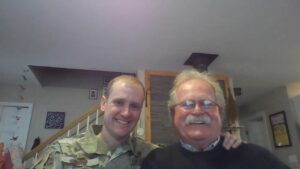
Blake Curtis and Ryan Wing
Description
Blake Curtis (74) and Ryan Wing (39), uncle and nephew respectively, talk about their road to the military and the experiences and lessons learned from service.Subject Log / Time Code
Participants
- Blake Curtis
- Ryan Wing
Venue / Recording Kit
Tier
Partnership
Partnership Type
OutreachInitiatives
Transcript
StoryCorps uses secure speech-to-text technology to provide machine-generated transcripts. Transcripts have not been checked for accuracy and may contain errors. Learn more about our FAQs through our Help Center or do not hesitate to get in touch with us if you have any questions.
[00:06] RYAN WANG: My name is Ryan Wang, and today is actually my 39th birthday. It's April 26, 2023, sitting here in my house in Monroe, Maine, and I'm sitting here with my uncle Blake Curtis. And, yeah, it's.
[00:26] BLAKE CURTIS: So I'm up. Yes, my name is Blake Curtis. My age is 74 years old, and I'm from Searsport, just down the road from where we're recording this in Monroe with my nephew on his 39th birthday. So we're glad to meet Ian Gonzalez and looking forward to sharing some of our family history with you. Take it away, major wing.
[01:02] RYAN WANG: So I appreciate being able to sit down with you today and just chat about kind of our military stuff. And, you know, I, we've had some discussions over the year, but, you know, it's, it's, I think it's important to capture family history in this way and oral history. And so I was kind of thinking about my own military journey tomorrow being my 22nd military anniversary of joining. And just, I think it's important to capture moments. What was it like for you? So you were drafted, is that right? Or were you, did you, so what was it like, you know, kind of getting, getting that, getting that notice and getting, kind of starting your own military journey?
[01:57] BLAKE CURTIS: Well, the terminology at the time was, you got your greetings from Uncle Sam. I was just out of high school and living in Connecticut, and it was four of us living in a duplex, East Hartford, Connecticut, and three of the four got greetings from Uncle Sam. Two of us actually qualified to be taken in just to kind of clarify this whole era of the military at that time, it's what we used to call it was a straight draft. There was no lottery at the time. So basically, our government was kind of pulling from poor and rural areas throughout the country, people that were not going on to the next level in education. So it wasn't until December of 1969 that they came up with a lottery, which supposed to have made it a little more fair. Yeah. So if you got a number, then you didn't want to be a low number for sure.
[03:25] RYAN WANG: What date or what year was it when you got your draft notice?
[03:30] BLAKE CURTIS: Let's see. It must have been, oh, gosh, I don't know if I've ever asked that question. I'm thinking it was probably in November of 67. I was due to go in in February of 68 as we, as you know, your grandfather, my father was dying at the time of cancer, so I felt as though that I needed to be there for my mom and still had four younger children at home. So I went to my recruiter and he gave me 120 day delay, which tacked on another year of service. So instead of two years, I was basically overnight I was in for three years, so. But it was well worth it. I was around when dad died in March. So that was a, that was the beginning of my adventure, just because I had an older brother, your uncle Malcolm. He had gone to Vietnam in 1965 and he didn't have a lot of positive things to say about Vietnam, so I was reluctant about going in. But dad being a world war two Navy man and having his brother shot down over France during World War two as a bomber pilot, he made me promise that I would go in. I had seriously not. I had not seriously considered going to Canada or apply for conscientious objector. But after promising him I would go in, obviously we had to follow through with that. So that was my introduction to good old Uncle Sam.
[05:50] RYAN WANG: Congratulations from Uncle Sam. Welcome to the US army.
[05:55] BLAKE CURTIS: Yeah, the one of the worst greeting cards I ever received, but actually ended up in Vietnam with one of the guys that got drafted at the same time. Rick Belcher was his name, and we're still friends to this day, so. So why don't you kind of share with everybody how you happen to get into the military?
[06:29] RYAN WANG: I was looking, you know, I was looking at school, really at college, and, you know, mom and dad support all three of us, me and my sisters, to, you know, to the nth degree, but on, on blue collar wages and. And being the youngest of three and. And not, uh, knowing that how the, the education system worked and knowing that I was going to be. My oldest sister was going to graduate college the year I would be entering. So I wasn't going to get a lot of financial aid and didn't want to put that burden on, on my folks, uh, to, you know, go into debt for my college education and didn't. Didn't really want to go into debt either, to finance my own college education. So I knew that the army guard was right in Belfast and down the road, a clique and, and the, the recruiter had been through the schools and stuff and had talked about, you know, the, the best kept secret in Maine and wanting to. That they would pay for college education. So I decided that I was going to go that route to help pay for school because they would free in state tuition. And so I decided I was going to join and if I went immediately, the summer. So they had an option called split off at the time. So it was an option to join when you were 17 and go to basic training the summer between your junior and senior year of, of high school. So. And if I did that, then I would return in time to finish my senior year of high school and then go to go to AIT, the job school the following summer and then be able to start college in the fall. At least that was all the plan that I had worked in my, out in my head of how it all play out. And, you know, it was so, it was April 2001, and I won't forget the recruiter, one of his like lines of, you know, how great of a choice this was was that the battalion as a whole hadn't been anywhere since World War two. And it was, you know, it mostly, you know, stayed active duty. The ice storm of 98, 99 had been in recent history and that was kind of the most. There were some folks who volunteered for Kosovo and those sort of things out of the, out of the army guard, but by and large, that was the extent of their participation at that point. So I thought this was a pretty sure bet that I would join up. And so I found myself day after my 17th birthday down in mePs, down in Portland, the processing spot, and raised my right hand and did all that and went off to basic training.
[09:25] BLAKE CURTIS: Right.
[09:26] RYAN WANG: A couple days after my junior year of high school ended. And you went wherever I was in Fort Leonard Wood, Missouri. So, yeah, hot, hot, hot. Fort lost in the woods is its colloquial name in the army circles and didn't know that. Yeah, Fort lost in the woods. It was an interesting experience. I was 17 and lived. I traveled a little bit over to Europe, Germany, and, but really not very much in, in the states. And so that was a, it was a, it was an eye opening experience. Just a, it's a melting pot as you know, going through basic. It's just a, everyone's going through and everyone's got an equal, equal footing of nothingness as you're going through there. And. But then return from basic training, it must have been very end of August or if nothing, the 1 September of 2001. And within a couple weeks of returning from basic training, 911 happened. And so I was sitting in government class at Mount View and Mister Fitzpatrick, the government teacher, he wheels in the tv on a cart into the classroom and word got around that this was happening and pulls up on, on the tv and we, of course, no one knew what was happening at the time, but within a few days of that and as more information came out that this is foreign terrorism and all this, I'm realizing that I joined the US army. And that my sure bet decision of April 2001 was no longer such a, such a sure path.
[11:19] BLAKE CURTIS: Timing is everything.
[11:20] RYAN WANG: Timing is everything, you know, and it's so I thought, you know, and funny thing, while I was at basic, I remember the drill sergeant, Drill Sergeant Hudson, and she was a stern drill sergeant. I'm sure that becoming a drill sergeant as a female in the US army requires a stern hand. And anyhow, she asked everyone, you know, who here joined for the college benefits. And I smartly raised my hand that I had joined for the college benefits. And she quickly educated me that that was not why I joined and that I am part of the US army. And at the time, I was thinking to myself, well, I joined for the college benefits. I don't know what you're talking about. I'm going to get my engineering degree and six years from now I'm going to be, you know, debt free, debt free, fat, dumb and happy and go on my merry way. And that this is a, this is great. And that her words came ringing back to me pretty quickly as I was sitting there, you know, contemplating how, you know, the next few years are going to go. And it was, it was actually kind of surreal because we, you know, the guard drills one weekend a month, typically the first weekend of the month, and, and so 911 happened. And I'm waiting for, you know, a phone call to report to there and I heard nothing, nothing from the unit at all. I show up and drill in October and, you know, freshly back from basic training and waiting for, you know, what's going to happen next. And it was pretty business as usual on the, on the army side. They were very much, uh, you know, they, they hadn't been anywhere since World War Two. So it really, even for the folks that were in, it was, we won't be, we won't be going into an engineering battalion. So heavy equipment operators, so, you know, if we're going anywhere, it's going to be infantry guys first and that sort of stuff. So we're not, we're not going to be part of this sort of, sort of idea. Because a lot of them had seen how quickly the first Gulf war had gone and mostly in air war and things like that and turkey ship operated. Yeah. So, yeah, you know, meanwhile, my air brethren on the air guard side, they were immediately activated and stood up and were flying sorties out of there to support national defense right afterward. And so much different experience. So, you know, fast forward a couple years. Well, about a year and a half in November of 2003, I had been I did my AIT, I came back and, you know, certainly things changed in that time, but it was November, Veterans Day, actually, of 2003, and one of the. One of the guys I was in the guard with was on an instant messenger program on the computer and sent me a message of, hey, did you. Did you get a. A call? My uncle Sam letter was, you know, did you get a call yet from. From Sergeant Martell, our squad leader. And I said, no, I haven't heard anything. He said, oh, well, we're getting activated. We're going to Iraq or we're going overseas. I don't think at the time we knew exactly where we were heading. And I was like, oh, crap, you know, this is suddenly, suddenly coming real and so rapid.
[14:57] BLAKE CURTIS: Little interjection.
[14:58] RYAN WANG: Yeah, sure.
[14:59] BLAKE CURTIS: When I was working at tire warehouse, that was my winter job, as you well remember. This little french dude came in, he was probably mid to late eighties, Gallant. Gallant was his last name. And just after you guys were actually sitting at the armory in Belfast with your unit kind of locked down at that point, he came in to get tires to put on his pickup truck. And we got talking about, you know, how silly it was for, you know, after all these years to be sent into combat. And he said, well, it's odd you should say that, because I was part of that 50 something years ago. The last time they activated, he said, I'm from up in Aroostook county. And he said, I actually came down here to join the unit. And then they attached us to another unit, and they were actually in the fighting. I don't remember where, but the casualty rate was about 80%. So, I mean, that that whole thing kind of came together with his experience. And I'm saying, holy, here we go again. You know, these kids as a guard unit, you think that they would be kind of in the background for people that were activated to step in and make sure that things at home were being taken care of. And it was a bit of a cluster because I was actually in touch with a friend of dad's. He was. Started out as a NCO and ended up going through warrant, and he and cousin Jeannie's friend, she was also a warrant. They actually kind of got stuck trying to take care of the families of the people that were being deployed to Iraq to make sure that they had the things they needed for Christmas and what have you. So Ben Moore was his name. Ben was a bit of a character from Stockton Springs. That didn't surprise me, at least, that he was a friend of dad's. But anyway, so go ahead and continue on with your little. Your journey.
[17:46] RYAN WANG: Yeah, so it was, we started in the Belfast sometime in later November. Basically, they told us to get your stuff in order and report in. I think they gave us a week or so to report into Belfast, and then we started going in there every day at the armory. And this is a big deal for Waldo county, and not just Waldo county, but the state, because the battalion as a whole, that was activated, it's about 500 folks, and that is certainly the largest military mobilization in our state for quite some time. And the first one for Iraq. In terms of any sort of large mobilization. The air guard folks were supporting it after 911 in terms of local support for homeland defense. But in terms of sending folks overseas, it was one of the first guard units to do that out of the state. There was some folks in the transportation battalion that got sent over a little before us, and they were operating mostly out of Kuwait to support the logistics side of getting folks in the country. But it was not, it was very apparent that it was. The organization wasn't there yet. You know, we were surprised. Surprised? Well, it just, you know, it hit the nation like a ton of bricks, and it wasn't on anyone's plan, obviously, national, to have to do that. And it's like you said, that the guard traditionally had been used much more of a standby force and a backup to, to the active duty. And this kind of marked the change of how the guard was being used military wide, and not just our unit, but just the Iraq OEF OIF conflicts really changed how the guard was looked at and needing to use it, because the active duty post, first Gulf war, they pulled back the active duty a lot smaller. So it really didn't have the force it needed without the guard to step in that. And, of course, you know, a 17 year old me didn't understand any of that at the time. But, you know, hindsight is a wonderful thing. But anyhow, we started doing our training in Belfast, and then we, in the kind of the fashion of how little this was really thought out at the time is all the training doctrine really had evolved out of Vietnam, and a lot of it had evolved. Some of it was the first Gulf war, but a lot of the manuals on convoying and things like that were really field manuals that were developed at the tail end of Vietnam and lessons learned out of Vietnam still being taught in the army of 2004 when we were 2003. So we spent a couple months in Belfast. Right after Christmas, we, we left Belfast and headed to upstate New York. So we went pretty much to the coldest place in the continental Us. Rome, New York. Just Watertown or Rome water. Sorry. Watertown, New York. Just Fort drum, just off the Great Lake. So one of the coldest place and really one of. I remember picking up a newspaper while it was there, USA Today, and a little map on the back of it showed the coldest places, and it was negative 30 some odd degrees. And it was. It was. It was the coldest place in the continental us.
[21:31] BLAKE CURTIS: Perfect training.
[21:33] RYAN WANG: Exactly. So we spent from January to march there and then. And then flew through. We've made a stop in Germany for commercial. We flew on contracted air. This the sketchiest, you know, seven, whatever, 47 that ever been on. It was a. It wasn't globe. It was some contracted airline. And I remember the. We. We were carrying all of our stuff. Our leadership wanted to make sure that we had all of our, you know, sensitive items. You have your M 16, you've got your combat gear, you got your flak vests, and I, you know, we were going on a commercial airliner, and. And we had. We checked some bags. We had filled a couple Conex boxes that got loaded on ships to get shipped over ahead of us, but we also were wearing. We had our. We had our big military frame backpack and all of our chem gear and everything in it and all this stuff that they wouldn't allow us to check the bag, but to process it there, we had to carry it.
[22:48] BLAKE CURTIS: So had they got away from the rucksack?
[22:51] RYAN WANG: No. So we had the. We had the. We had the frame rucksack, and we had. We had our m 16. They made us. They made us take our bolt out of our M 16 and put it in our pocket, tied onto the piece of 550 cord in our breast pocket. And as we walked through the metal detector, pass our M 16 around the metal detector and then walked through. I don't know what they were trying to protect from, from at that point, really. We're here to help you. We're traveling on an air, and it's just, it was a nation that just didn't know which way was up still, you know, a couple years after, still.
[23:27] BLAKE CURTIS: Trying to connect the docs and the.
[23:29] RYAN WANG: Poor flight attendants, air crew who are trying to. To, you know, get us in there. We had our. We had our rucks all stacked up against the bulkhead, and they're. They're kind of freaking out of like, this isn't. This isn't allowed. This violates so many FAA regulations of, you know, we got. The overhead bins are all, like, duct taped shot. Not all of them, but some. Several of them were broken, and they were being used and abused at that point, transporting us military back and forth overseas and contractors. So we all were on this commercial airliner. Flew, I'd say direct. I think we stopped in Germany just for refuel. We were off it for 30 minutes or so, maybe an hour. Weren't allowed to leave the terminal, and. And then went from there right to Kuwait. So we went from. It was march at that point, from Watertown, New York, to. And I don't remember exactly where we flew out of, but somewhere right in the vicinity of Fort Drum. Might even been on Fort Drum, but. And. And into Kuwait. So it. You know, it was 100 plus degrees and quite a juxtaposition of the. Or just. Yeah, quite a transition going from one to the other. While I was in drum, they decided that I had to have my wisdom teeth out and in order to deploy, so they. But they. I wasn't going to be on base long enough. Their policy was, if you had general anesthesia, you had to be on base for 30 days after. Well, we weren't going to be on base for 30 days after, so they just. Local anesthetic for my bottom two. And, you know, that was almost worse than the deployment. I was having an army dentist remove my bottom two wisdom teeth with just local anesthetic. And so I get on this airplane and can't open my mouth more than, like, three quarters of an inch. Cause my jaw was all frozen up for a month afterward. But anyhow, we flew to Kuwait and spent a couple weeks there and then headed off on c 130s out of. Out of Kuwait, up to Mosul, where we were there for the next.
[25:45] BLAKE CURTIS: Yeah, yeah. The next thing that kind of came to me was through your mom. And at that point, you were notified that. That you're enlisting in the guard was supposed to be for four years of paid education, that yours happened to be at the University of Maine. Then you found out that they didn't tell you the whole truth when they recruited you as a 17 year old, that it was four years consecutive. So your mom call me. And I got more than a little upset. And, you know, things happen sometimes for a reason. The local recruiter, Preston Ward was his name. They would come to tire warehouse to get their vehicles, recruiting vehicles to have their tires changed and whatnot. So I took. I took Preston. Took Preston Ward aside because I've known Preston for many, many years and kind of said what the hell's going on here? I mean, you get these young kids and you convince them that they're going to be taken care of for their education. All of a sudden you leave them in Belfast for an extended period of time when they could have been still in college and then stick them up in a hellhole in New York before you even shipped them out. You guys were probably six, eight months before they probably activated you. So, so basically he said, well, that, that was something that should have been addressed. And I said, yeah, no shit.
[27:58] RYAN WANG: It was a lesson on reading the fine print.
[28:02] BLAKE CURTIS: There's a lot of that in the military. So, yeah, we, we never got over that hurdle. You know, I said, you know, just be truthful. These kids, you know, say, hey, you know, if something crops up and you have to be activated, that's downtime from your education. So I asked a state representative about it and he says, well, it's a federal issue because you guys were activated by the feds. And of course, then the fed said, well, no, they're a state run program, so it's a state's issue. So I ended up chasing my tail on that. But I just thought it would be kind of a nice little tidbit for anybody that thinks about going into the guard or the reserve. They may want to read the fine print. The military is really, really good about that.
[28:55] RYAN WANG: I think there was, you know, I think there's more truth in advertising now than it was partly because of the reality that this is, this is part of the garden now, you know, and it's not where when I joined, it was, it was not, it was not the service. It wasn't the, it wasn't the expectation of service.
[29:20] BLAKE CURTIS: That's correct. That's great.
[29:22] RYAN WANG: But all the folks who came in.
[29:23] BLAKE CURTIS: But somebody should have stepped up for sure.
[29:26] RYAN WANG: But it's, and it worked out fine. I. Yeah, absolutely.
[29:30] BLAKE CURTIS: You are an officer here.
[29:31] RYAN WANG: I am an officer. I decided after my, my six years of service with the army guard to go up to the air side and see what that was about. And it's been a great, that's been a great experience, transitioning from service and then getting commissioned and, you know, you learn, you learn a lot of lessons as you go through about leadership and working for folks that you see, some of the folks are like, you know, that's nothing. That's not how to treat people. And then, you know, you, to be given the opportunity to then be the one in charge to make different choices. I try to, you know, I try to take those lessons that I learned as a, as a low enlisted guy and to, into where I'm at now and in leadership to be able to, you know, make sure that I'm operating with their, with their best interests in mind. So, so, and it's worked well. It's, it's been, it's been, every day's, every day is an experience. So.
[30:32] BLAKE CURTIS: Yeah, but, you know, it's just a little reflection I guess. We got about ten minutes here. Ryan kind of brought it to my attention when we were talking about doing this program which we there again, we really want to thank Ian for reaching out to us on this, but neither of us really thought about ourselves as being, quote, a warrior. Military was not a total fabric of our family, although everybody was kind of aware of what we ended up doing for our country. Me being one of my, there was five brothers in my family and we all served at some point since the late fifties, up until probably the late eighties and now, of course, now the new generation of Major Ryan Wing here and a niece that just has recently retired from the air force of 20 years. So most everybody should think and thank this generation. It always comes back to what's happened to this next generation and not what we were. And it always comes down to people like my nephew and nieces and uncles and cousins and brothers that all served and always stepped up to make this a safer country to live in. So I appreciate Ryan including me in this little chat. Hopefully he'll come back around out of the archives and maybe one of our great, great nieces or what nephews might come across it and enjoy this little chat.
[32:41] RYAN WANG: The way I think about it is that it takes folks willing to continue to serve to allow it to continue to be a voluntary military. We haven't as a country had to reinstitute the draft since Vietnam. And it's because people continue to step up and want to serve their country. And it doesn't, it doesn't happen by accident. It happens because people are willing to say yes. And I serve because I want my daughters to have the option to serve or to not to serve. And so continuing to have a voluntary force in our country is really important and it's not for everyone. But I've, I've kind of gone full circle of saying that, you know, six years and, and thank you. I'm going to step to the side to now being full time in the, in the guard and it's, it's a great, it's a great service to serve. It's a, it's to be able to to be able to serve others and to serve our country is, is a, is a, is a humbling opportunity. And the folks that choose not to, I don't hold anything against anyone for the choices they make. It's just the, it's a, it's something that I feel like, you know, allows. Allows it to be a choice for the folks who don't want to. And that's a. Well said. That's an important thing.
[34:17] BLAKE CURTIS: Well said. I mean, it was one of those things where I, you reflect on the people that served before you and the hardships that they went through. And like we were talking earlier with Ian, the fact that we've had all had experiences with the World War two veterans, which are leaving us at a rapid rate. So this is kind of neat to have this opportunity to, to have our, you know, part of our experiences, you know, on, on tape. So.
[35:03] RYAN WANG: I think it's, my service is part of where I've, where I've gone in my life. And it's something I reflect on quite a bit. But it's, you know, I was, it's not all, it's, it's, it's not all one thing. You know, I think that most folks who haven't served in the military think that, you know, if you've gone to combat, then there's, then there's, then it was probably an awful experience. And my, the surprise I've had over the years, as there's been more time away from that, is that there's some really fun memories of having to go do that and stuff that, you know, you don't expect as you, as you're going through it, that you look back on those fondly. Some of the guys that I served with are still guys that I consider incredible friends because of that shared experience.
[36:06] BLAKE CURTIS: But it's one of those things where we both went in at such a young age, you know, conditioning certainly wasn't really a big issue, you know, with your PT tests and stuff like that because it just came pretty natural to us. So, yeah, it was more of a competition, you know, especially in basic training, to see who could, who could outshoot each other, who could outrun each other. They will run, dodge and jump. So in that aspect, it was like you said, it was rewarding. And there's people that you served with that continue to be part of your life. Back when I had the restaurant in Searsport, I had an individual that I served with in Vietnam that actually came from Colorado, flew into Manchester, and because he owned a Harley Davidson, he had a registration on his Harley that he was able to rent a Harley in Manchester. So he drove to the restaurant, and, of course, our appearances had changed a lot, especially him beard and do rag. And he showed up at the restaurant, and as he was paying his bill, he basically put down a photo of him and I in a bunker in Vietnam. And it just totally, totally flipped me out. So he was able to spend some time with myself and my wife, Katie and brother Dale and Sharon, and share some of our not so pleasant experiences. But I was really super pleased that he was able to find me. And he landed on his feet. He's done extremely well. Not all of us made it through that gap, but it was one of those. You don't call the war the conflict. It kind of calls you.
[38:29] RYAN WANG: Yeah. It's one of those things that no one wishes they went through. But it's perspective that you gain that I feel like you can't replace with anything else.
[38:39] BLAKE CURTIS: Oh, absolutely. It's not well put.
[38:42] RYAN WANG: It's, you know, would I choose to go back and do that? No, I'd rather not. But at the same time, like, how can. How can I like where I'm at today and not respect? You know, having had gone through it, I don't know if I would land in the same spot, and none of us do, but it informs kind of how. How you're built. You know, it's those.
[39:06] BLAKE CURTIS: Yeah.
[39:07] RYAN WANG: You know, I think of it as, like, the building blocks in a. In a structure that it's one of the. The key ones is built for.
[39:15] BLAKE CURTIS: Yeah. I'd just like to take a minute. I would like to thank our national VA services and setups. They finally have started taking care of a lot of my brothers and sisters from my era, as well as the korean war veterans, as well as Desert Storm. And, you know, both Iraq and Iran, excuse me, Iraq and Afghanistan. So they're really. I think they're really stepping up and reaching out to veterans that certainly need the assistance, both physically and emotionally. So I think the. I shouldn't say this because I don't have any facts to back it up, but I. I think the suicide rate, especially coming out of Vietnam, I think, is certainly declined just because of the help that people from that era have received and continue to receive both monetarily and physically and spiritually. I think they've. Think they've done an admirable job compared to years past. So a little tidbit. Our VA hospital in Togus Maine, moved by our state capitol in Augusta, is the oldest VA hospital in the country. It was established during the civil war. So, yeah, it is also a veterans cemetery there as well for people that can't afford to have themselves taken care of at the end of their lives. So that's always good information as well. So thank you, Ian.
[41:18] RYAN WANG: So thank you, Uncle Blake.
[41:19] BLAKE CURTIS: Yeah, man.
[41:20] RYAN WANG: Great to sit with you.
[41:21] BLAKE CURTIS: Love you. Love you.
[41:23] RYAN WANG: Love you, too. I asked you guys a quick question. Sure. You have the time? Awesome. Yeah. Yeah. We're at 40 minutes. But Ryan, thing that struck me is you said that just kind of breaking the notion that active duty is only one experience. And you said that you have some memories of it being really fun or being really surprised or meaningful and not just active duty but, but, you know, warzone stuff, you know, and there's, there was a quote that I'm going to butcher it, but Tim O'Brien, the things they carried, I don't know. We had to read it. It's kind of surreal. But post during my senior year of high school, which was, you know, after 911 and during my service, but, you know, he talks about. And he was a Vietnam vet himself and talks about that, you know, people say war is hell and, but war is also connection and, and fun in times. And it's not that, you know, that, it's not the experience is fun. It's just you find humans are humans and you find you're able to find fun and human connection in those moments. And, you know, there are times that I've laughed harder than I have, you know, in any other time in my life because you're, your emotions are magnified by these things, but you're also just, you're stuck in boredom and the old, you know, the adage about, you know, wars, long periods of boredom punctuated by moments of terror. And it's true, you know, there's a lot of time to fill that you're just having to do that. And kind of the, especially as low enlisted guys, the, you know, shit, you, the antics that you do to pass that time. And so it's, you know, I think it gets painted with a single brush of, you know, well, this must be terrible. And, well, yeah, there are, there are pieces of it that are. But there's there's also, you know, kind of profound connection and, and joy that is found in, amongst the rest of that. That isn't, it isn't just one thing. And I think that's, you know, as folks wrestle with like, you know, how to talk about combat experiences and how to do those, it's kind of, you know, for folks who haven't been there. That's, I think that's why some of the disconnect exists between folks who haven't experienced a war zone stuff and people that have. It's just because it's a really complex mix of a lot of things and, and, you know, it's nothing. It's not a, you know, a single experience. And every person's experience within that is different as well, that it's a whole bulbed up, complex set of things.
[44:20] BLAKE CURTIS: What comes back to me. What comes, what comes back to me is the, while I was in Vietnam for, I was there for two tours and. But it's the music there was eventually getting to us through various people coming from the stateside, bringing that new vibe, the new energy of the sixties, Woodstock, and all of the groups that were hitting it big back in 68, nine and 70. You hear it, and now even at my age, it, you kind of drop right back into where you were, who you were with, what you were doing, you know?
[45:16] RYAN WANG: So in that aspect, I was curious. You just kind of answered it. But if, if there's something that comes to mind as a especially meaningful or connective or hilarious or, you know, fun moment that you had, if you'd like to share, you know, if something comes to mind and, yeah, I mean, some of the stuff that I remember, I was. So they had a small Internet cafe in our, I say Internet cafe, a bunch of computers. And some of the, the locals had assisted setting up so we could have Internet on base. And one of the guys was charged with collecting the money. And then we would have to transport it up to the northern part of Iraq because they didn't dare to operate within the city of Mosul anymore because they were Kurds who were running the Internet for us. So we would transport every, I don't know, month or so, we would have to set up this weird through. Couldn't tell you what time we're going to be there, but we're going to meet up with you. And I have your money for your Internet that I'm going to provide. So the guy who was doing this was on leave, so he asked me to take care of it. So I find myself in a convoy driving north out of Mosul up into the kurdish area, where we get some resupplies in a fairly unarmored tractor trailer truck because we're heavy equipment operator with a probably like $1,000 and $1 bills in my, in my, in my cargo pocket and a Ziploc bag. And I'm just thinking in my head because at that point, roadside bombs and ieds were really reality of what was going on. And we had lost a couple guys already due to, due to that, that sort of stuff. And, and I'm just picturing the scene as if I get, you know, hit, blown up. There's just going to be the shower of $1 bills coming down and I.
[47:14] BLAKE CURTIS: Head into a strip joint.
[47:17] RYAN WANG: But we had also arranged, and again, this is stuff I probably shouldn't say as I'm still in the military. We'd also arranged for, with this, this kurdish Internet provider to get us a case of beer because, of course, this wasn't allowed. Dry country and general order number one, all sorts of, you know, breaking all sorts of rules. But we said if you, you know, if you show up with a, with a case of beer in a, in a computer monitor box or something that could, could be, you know, concealed, would greatly appreciate it.
[47:55] BLAKE CURTIS: And more $1 bills available.
[47:57] RYAN WANG: Yeah, more bills available for this. And so, but what I was thinking was, you know, like a discrete twelve pack of, you know, can, twelve ounce cans. And what I find myself with is a, is a 24 case of 16 ounce tuborg, which are turkish beer stuffed into a monitor box, a large, like, CRT monitor box. Walking across the loading yard in front of my sergeant major, you know, 30 pound box of beer, trying to fit it in the cab of a single cab, tractor trailer truck. And not the easiest feet. But we were determined to make sure that that was not left behind. And so it was, you know, and you just, you figure out ways to make it, make it tolerable. We had, we had packed a grill, a charcoal grill in our Conex box that got shipped over and it got delayed by months, but eventually arrived. But it was probably a four foot long, like, family day sort of charcoal grill. And for some reason, the bx across the way on the, on the. Had a pallet of charcoal. So we bought the whole pallet and we would find whatever we could get our hands on to grill in our off time to just kind of break bread and be, you know, be in community somebody.
[49:23] BLAKE CURTIS: And somebody sent you a box, a very large box of golf balls.
[49:27] RYAN WANG: Yes. So managing a golf course at the time.
[49:32] BLAKE CURTIS: And so I either up with a lot of recycled balls, so to speak. So I boxed them up. I asked my sister, his mom, what, what he could use. And of course, there's no shortage of sand over there. So his sand trap game is really good.
[49:50] RYAN WANG: My short game is terrible, but I get out of a sand trap. It wasn't the strangest thing that was shipped to us, we had a, for some reason, I don't know why, but someone's shipped over a large, I mean, like, you know, two foot by three foot box that was full of trucker hats. Like, I don't know why people were sending over, like, random stuff. And some of it was like, you know, for the kids of Iraq and some of it, you know, teddy bears and stuff, thinking that we would have opportunities to try to be, you know, spread.
[50:23] BLAKE CURTIS: Yeah, goodwill spread.
[50:24] RYAN WANG: Goodwill and. But someone sent a box of trucker hats over it. I have no idea. But there was like, so we may have had some illicit alcohol around, and we're sipping on that and trying on, there's a Trans Am hat and all these old school eighties trucker hat. I ended up one that just says I'm the painter, and just enlarged block letters and just laugh and those just funny moments that remind you that you're human for a while and, but, you know, it doesn't detract from, from the other pieces of it, but it's just part of the complete picture of trying to make, to exist in a, in.
[51:12] BLAKE CURTIS: A spot that when, when I first got to Vietnam, we flew into Cameron Bay. And of course, luck is a lot to do with getting through that 365 days what you were obligated to pull. And we got hit that night, and everybody's scurrying around trying to figure out, you know, trying to come across what you trained to do. I mean, I was there probably 6 hours, and we got hit. So with the dust settled, everybody, they lit off a siren and said everything was clear. So I'm walking back to the hooch, and there was five brothers sitting on a bunker harmonizing, you know, the bebop, you know, the fifties and sixties. And these guys were killing it, man. And I'm just thinking to myself, like, is this going to be one of the last things I ever experienced, you know? And at that point, of course, not being from the city, these black guys headed down, I mean, you know, so I said, you know, if I'm going to cash out, man, at least I got out on. Yeah, I mean, they sat there most of the night, you know, just ad libbing and so that, that was obviously, uh, you know, something obviously that's stuck with me for sure for all these years.
[52:53] RYAN WANG: Welcome to Vietnam. Yeah.
[52:54] BLAKE CURTIS: Yeah, yeah, yeah, yeah. But, yeah, I mean, it's one of those things where you can't. Right, let it get you down.
[52:59] RYAN WANG: You get a combination of a, you know, an attack and. And beautiful harmonies on the same trip, so it might be the end of the recording. Anyhow, house, wrap it up. Good stuff.
[53:15] BLAKE CURTIS: Thanks a lot.
[53:16] RYAN WANG: Yeah.