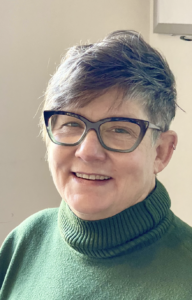
Mary Beth Majors Interview
Description
Mary Beth Major MS, APRN, AGNP-CEconomic necessity was the impetus for enrolling in nursing classes at Minneapolis Community and Technical College. Caring for medically complex patients experiencing health care inequities led me to St. Catherine University College for Adults RN-BSN Bachelor’s Completion program. St Kate’s focus on Social Justice and Academic Excellence were foundational in my decision to pursue a master’s degree in nursing in the Adult-Gerontology Primary Care Nurse Practitioner program. As a nurse I have had to opportunity to work in Homecare, inpatient Med/Surg/Dialysis, Neuro/Med/Surg ICU and dementia care. In my current role in Palliative care, I am invited into a person’s home as they near the end of their life. I am entrusted with their life stories and delve into what’s next. I listen with my heart.
My wife Sue and I enjoy “getting nature in our eyes” and biking around Minneapolis together. My adult children are making their way in the world. I am Pro-Queer and Pro-Choice! I volunteer with Pro-Choice Minnesota at tabling events State Capitol protests and as a Clinic Escort.
Here is a link to a nursing theory that Mary Beth holds dear: From: https://nursology.net/nurse-theories/theory-of-emancipatory-compassion-for-nursing/
Participants
-
Mary Lagaard
-
Mary Beth Majors
Interview By
Keywords
Languages
Transcript
StoryCorps uses secure speech-to-text technology to provide machine-generated transcripts. Transcripts have not been checked for accuracy and may contain errors. Learn more about our FAQs through our Help Center or do not hesitate to get in touch with us if you have any questions.
00:13 Starting a voice memo recording with Mary Beth Majors on January 9 20th, 2024, at St. Catherine University. And then for the purpose of the Zoom recording, this interview is part of the St. Kate storycourt interview. Nursing interviews. My name is Mary Watzka Lagaard I am 70 years old. Today's date is January 20, 2024. I'm speaking with Mary Beth Majors, who is my former student but colleague now, and I'm recording this interview in St. Paul, Minnesota.
00:57 My name is Mary Beth Major. I am 58 years old. Today's date is January 20, 2024. I am speaking with my friend, colleague, Professor Mary Lagaard I am recording this interview in St. Paul, Minnesota. St. Kate's.
01:24 All right, let's get started. So tell me about your decision to be a nurse. Did your community, family, faith, health, beliefs, or culture impact that decision?
01:41 This may seem like a roundabout story, but when I was six or seven, I spent a lot of time in the basement of our home in Ohio. We had a lot of tornadoes, and so we would spend a lot of time in the basement. And my mom would be sewing, and I would have my little doll and stuffed animal. Pet clinic, hospital clinic, set up under the staircase. I added tv trays, and I would set my dolls and my animals up on them, and my iv's were red yarn and inflated balloons. So I believe that's where I started to think about nursing and caring for people, caring for animals, because, right, being a vet, I think most people think, well, I'll be a nurse or a vet. A lot of people do. And that's where that started. I had a great interest in science and nature, always picking up a salamander or a frog or a snake, bringing it home. It was the seventies, so there was a big environmental push. Feminism, all of those things informed me and informed my process of pursuing biology and chemistry and really disliking mathematic, but understanding, I needed to do that. So. But grounded in science and later in my life, when I divorced my husband and needed to support myself, I turned to nursing. It offered a great opportunity to expand on that interest that I already have of science and caring for people and also being able to have a vocation, but expanding beyond a task driven job. So I. My. Well, at that time, my partner, my lover, my girlfriend, because we were not allowed to marry. Sue Schroeder was a nurse as well. I started as a nursing assistant, working the night shift in the float pool at Abbott Northwestern at 39 while I went to school.
04:48 What a brave move.
04:50 Well, I did have. Thank you. I had to, you know, I did have.
04:54 Yeah.
04:54 So I was at MCTC and I would go to nursing classes during the day, and then I would work a night shift. My associate degree was completely paid for by Abbott Northwestern. I didn't have any. I didn't pay for any of my classes, and I graduated with my nursing, but also 90 credits. So I had women's studies and English and writing and poetry. So I. Yes, I. I had previously majored in sorority, but, you know, I was great. I was great back in the eighties, but at 39, I was, you know, I was able to focus on myself and not take into account what my mother or my father thought because they thought I should be a doctor, certainly not worry about other people's perceptions about what I should do at this age in terms of stay at home care for your children. I continue to and still do care for my children. And one of the best things I did was go back to school, get my nursing degree, and continue to work in nursing. So I received my associate degree. I was hired at Abbott Northwestern. I worked in the renal med surg. And that's. Yeah, it's difficult in that you have people with the chronic. The chronic illness, so many comorbidities and just really, people were admitted because they were having, you know, they were decompensating, they were having acute issues and really listening to people talked, you know, share why they weren't compliant. Such a great word, compliant. And that was. That was an experience. You'll ask me probably a little later about older nurses or seasoned nurses, and so we'll touch on the word compliance, probably. So. Anyway, so I worked for five years on the renal med surg, and I learned a great lesson about reactivity and my own reactivity, my own tendencies to want to control things and the dynamics of a workspace and the dynamics of the dynamics of role and your relationship to the person versus the diagnosis versus the issues or the exacerbation that got them there. Moving beyond the diagnosis, moving beyond the behavior compliance again. So I was there for five years, made some great friendships, had some wonderful mentors, and then I opted to apply and I went to the ICU. So I was in the neuromed search ICU for five years and. Which prompted me to return to St. Kate's to get my bachelor's and then continue on and get my master's in adult gerontological nurse practitioner primary care, where I met my dear friend Mary. So here we are.
09:20 Well, one thing I've always really been drawn to is that you really seem to listen to your patients and see beyond what they're supposed to do and more toward their story, too. And I think that might be one of the reasons why we're friends, because we both struggle with that a little bit on how to do that.
09:48 Well, I think the struggle is in the shifting expectation and role of nursing. I have the luxury, and it's sad that the word is luxury, but I think in today's dollar driven out, come forward healthcare time, time is monetized. And I appreciate that we need to be efficient and that we need to actually truly focus on outcomes. I do appreciate that. I think that time allows you to build trust, and without trust, you are taking a framework and shoving people into the framework. And I think that that's where we have, you know, healthcare, you know, that's where the, you know, we are not, we are not taking into account the differences.
11:23 And what do you mean by the differences?
11:26 Well, you were saying that. And so here's what our saint sisters of St. Joseph of Carondelet on the value to love thy dear neighbor without distinction. And I, and I, you know, and that's, that is, that is, you know, love thy neighbor as thyself. It's a version of the Bible, and we know. I don't do the Bible. However, I've really been thinking about this. How do you live this value through the profession of nursing and then love thy neighbor without distinction or other people without difference. We are unique. We do bring, and, you know, a diagnosis, a genetic history. We bring the experiences of our, you know, genetic trauma, our genetic input, our genetic benefit. So that story, that information isn't always available when you only delve into the diagnosis and the meds. So I am grateful for the time and the luxury of being able to sit with people, be present with people and understand what makes them distinct. What is the difference?
13:13 You're present to their narrative and how.
13:16 They'Ve worked it out or not.
13:19 Or not. Yeah.
13:20 Because we, we don't always have any insight into what motivates us.
13:29 Or our patients.
13:30 Well, right. Certainly not.
13:32 Yeah.
13:33 And not if you not having insight into yourself means you probably aren't going to have much insight into another. So I think that it isn't a luxury. It's, I mean, it's a blessing. I am grateful for it.
13:59 So let me hear. Let me see if I hear you right. You're saying reaching out to the neighbor without distinction maybe means first reaching inside and understanding yourself. Am I understanding that right?
14:18 Certainly. We have to be reflective in order to not be reactive.
14:25 What a nice turn of phrase.
14:27 Well, I'm pretty reactive, and I'm working on being reflective. So.
14:42 What have been some of your best moments of being a nurse?
14:56 I think if you're on social media, there's a trend right now where you see all these tiktoks and you see nurses kind of running free in their environment. You see them doing funny tiktoks about all the difficulties of nursing. Like, I have just. I've just literally cleaned up someone's wound, and now I'm eating a burrito. You know, it's just. It's funny and it's extreme, but there are certain. There are certain things that nurses experience that are profoundly shocking, and you aren't necessarily able to share that with anybody else who's not a nurse. And so being able to be present work through, you know, again, scary, terrifying, powerless, intimate, tragic moment, because those are all the things that happen. Nursing is working an extreme while we're trying to maintain homeostasis and return people to balance and health, and you're just busy going, please don't get out of bed, please don't eat that. Please eat that. Please take this pill. Please stop smoking. And it's. So you have this opportunity to look at the complexity and absurdity of life and death with these people you work with as you. As you're doing your best to care for other people and their families. And those are the best moments. I mean, on a simpler, you know, a simpler point. Potlucks.
17:11 Yes.
17:12 Don't underestimate, you know, the power of a potluck running. Running from the mother baby unit back to the ICU to get, you know, equipment to get the rapid transfuser, taking that person to ECMO, you know, hearing, you know, Doctor Blue mother baby. Right.
17:45 Could you just explain for the listener, Ecmo a little bit?
17:50 ECMO, in short, is a machine. It's an engine that bypasses the heart and the lungs of a person or a body because they failed. And so it is an engine that keeps a body alive. And so this. This woman was. Had a. I mean, she had an amniotic, you know, an amniotic embolism. So, yeah, that was probably the most traumatic thing I've ever done.
18:27 So that was the biggest challenge. How did that story end up?
18:31 She died. Well, she was dead.
18:33 She was dead already.
18:34 She was already dead. And they did an emergency C section, and I was orienting to the ICU, and I was doing. I was being afloat, and we ran to the mother baby, and there were intensivists so intensivists are highly trained, very specifically trained acute care physicians. And I. I had never seen so many ICU doctors in a room working so hard, ever. And they were sweating. There's probably 60 people trying to keep this person alive. It was horrible. Horrible.
19:24 Did the baby survive?
19:25 The baby survive?
19:27 And then kind of. How did this group of people process the outcome?
19:33 We didn't.
19:34 You didn't.
19:35 So.
19:36 Okay.
19:36 I just didn't work. I called in. I'm gonna call in. I can't. I can't come back. I need a day.
19:45 Yeah. Referring to your reflective nature.
19:51 Yes. I'm gonna read a book. Well, that's.
19:56 I'm going to take care of myself.
19:57 Right. I need it, too.
20:00 Yeah. It sounds like that's where that you've learned that. That's where it starts for nurses.
20:08 And I think that there are times when we don't take care of ourselves because there are a lot of unspoken rules or there were unspoken rules about what nurses do. And I think that nursing had been such a gendered occupation, vocation, calling. And I think that. I think. I think because it was tied to calling and the assumption that women are inherently carers, caregivers. And the concept of long suffering, which is bullshit.
21:02 I kind of like that model. Long suffering is bullshit.
21:05 Long suffering is bullshit. And yet, don't we, though?
21:10 And you had referred to nursing as a vocation from the very beginning, so it seems like it's evolved to self care and being responsive. But also, first, you can't respond if you can't have it together in yourself.
21:31 And I think that there. I think that many people, or. Well, I mean, I don't know, maybe America, Virgo, you know, what are you if you don't work and what is your job? And I think that there is such a toll when we provide care for others and if, again, we don't care for ourselves. And.
22:12 How do you care for yourself?
22:15 Well, the last three years, there has been a shift. I lost myself. I think there were certain things that I used to teach fitness. I used to teach aerobics, and I remember yoga. And so that was a creative outlet. It was a physical outlet. And with starting as a nurse practitioner, I wasn't able to teach my classes, but it was also time. There's a point where your body is no longer able to do certain things, you know, in health and fitness. Again, health and fitness is. Again, there's the ageism. The ageism of health and fitness and beauty. So. And we had a pandemic, and my wife had cancer. So, yeah, there was a lot. There was a lot. But now I'm taking care of myself by hiking, going out. I mean, I always like to have some green in my eyeballs, little nature in my eyeballs. As I like to say it. I'm doing my best to eat healthily. Well, it's ironic. So. Hipaa, hippa, hipaa. I don't know if you know this. If you say it three times, like, it's like abracadabra. Anyway, so there's a gentleman that I'm taking care of, and I was. I've been present with him. I've been listening to a story, and I am trying to find a way to connect with him or really talk about his morbidity and mortality. And he's really, really avoiding. He's. He's. I, you know, it's too simple to say he's in denial.
24:54 Yeah.
24:55 He's a storyteller. And as you listen to him, he's. He rewrites the story. So it would be, some people would say, right, he's in denial or he's lying or. But he literally will rewrite the story with a you present. And that was his job. He's a storyteller. Well, he's a musician and he's a storyteller. And so he's creating his reality in front of you. And I'm sitting with numbers, but these are the numbers, and these numbers reflect the function of your body. And I'm trying, I'm trying to address it. I'm like, okay, do we bring the number? Do we bring the big picture? And I'm a big picture macro. Right. Do we manage, you know, do we manage the number? Or do we talk about the culmination of all the numbers? Do we. Do we move forward with it? Do we march this out? Do we allow you to, you know, live in the past and glory days? And I don't, I don't know. Still don't know what to do. But then I have been sitting with this gentleman, and I said, what are you going to do, man? What am I doing? Do you want to do this? And it's not a value judgment of what he's doing. No, this is where he is doing what he's doing. I'm over here doing what I'm doing. What am I doing? Is this really how you're going to manage?
26:29 Yeah. Do you.
26:31 Do you want to be living in the past? So, so his position.
26:38 Yeah.
26:39 And his process has informed me to change.
26:44 Oh, cool.
26:46 And so less sugar.
26:53 That's what I was going to say. And the result is less sugar.
26:58 And again, here I am. Who am I to tell you when I myself.
27:03 Yeah, right.
27:04 Who am I?
27:08 No, no, I understand that paradox. It's like, how can I really connect and reach out with you when I too have the same kind of dilemmas?
27:24 But. And as long as you understand that we are the same. Yeah, that I am. I am without distinction and without difference, but I am still without. But those distinctions and differences still inform.
27:43 That's a helpful turn of phrase.
27:45 Yeah.
27:51 So summarize what he taught you, because this seems really pivotal.
27:57 It is incredibly pivotal.
27:59 Yeah.
28:06 I. So, you know, in this nurse practitioner role, it's unsure if I'm providing primary care while he is having congestive heart failure and chronic kidney failure. You know what I mean?
28:38 I do know what you mean.
28:40 Gotta get my DEA. 8 hours of what? Okay, so there's that regulatory stuff, and here are my numbers. And then I can look at your number and I can talk about a number and I can tell. And so that would be the primary. Right? The primary. I'm going to be a number. Data driven.
29:05 If you're working within the system, you have to have that connection. Yes, but it seems like you're really offering him much more.
29:15 And I'm. Right. I'm trying to talk about the palliative piece and I'm. And to me, palliative is. Right. It's about symptom management. Right. They always talk about symptom management. But what are the things that have led to this and the symptoms that I'm treating? Like there, is this a symptom of. Is this a symptom of injustice? Is this a symptom of the fact that you literally didn't have access to care or because you sought ways of managing your depression, anxiety and trauma? So that's the story. And we can sit there and talk about take a pill, draw a lab. But that is, that, that doesn't speak to how he got here and how we help him in this moment. And helping him may not be draw the lab and take the pill.
30:48 It sounds like what you're kind of tapping. First of all, I don't know, let me just be really clear. But it sounds like what you might be tapping into is the cultural and american injustices that we've really done and how truly. And so you're really seeing the pain and the suffering that result and how people have made their way with it. And who am I to say anything different?
31:20 Exactly. And then I'm here to push a framework on you again, the health, you know, the health model. Yeah, yeah. Oh, my.
31:37 Yeah, right.
31:38 And then I'm, you know, then I'm the deliverer provider, the hammer. So it can be a difficult place. And so I don't have an answer.
31:53 I was just wondering. It was such a provocative question, though. That's what I'm dealing with. I think it's a provocative and a real question. It might be. You know, I've always thought you're such a great, I don't know, a storyteller, but maybe you've caught on to something that is that many providers, nurses feel is kind of such a quandary. They don't know, kind of how to. How to even connect with him in a way that's meaningful. I mean, other than be present and witness.
32:33 And to be witness to frailty.
32:39 Yes.
32:39 And know that we don't have every answer. So I remember when I was taking one of my first, my first nursing classes, and we had to write a care plan.
32:52 Yeah.
32:53 And I failed care plans massively. I mean, I was like, what are you talking about? And you will appreciate this. Maryland, the professor, I mean, I can see her right now. She was super concrete. She was very good, very concrete. And she said, she said, I don't understand. Like, I really don't get, what am I doing? And she said, well, it was like, you know, the nursing falls, I think it was about falls. Yeah. I was coming at. I was working theory. I was completely writing in theoretical stuff, and she was like, move the rug. I'm like, move the rug? What do you mean? Take rugs out of the room? So, you know, again, very concrete. Yes. It's an actionable. Right. The result. Take the rug out. I was like, of course. Why wouldn't you? But I mean, honestly, the amount of conversations I have about you need to move that rug. I mean, I never would have. I was like, really? Is it really about moving the rug? And it actually is about moving the rug. And I think the reason I bring that up is sometimes there's things that just seem so reasonable and logical, and you're sitting with someone in their experience, and you kind of slow blink them, and you go, whoa, maybe you want to do this. But again, we get stuck in our habit and we get stuck in patterns, and we sometimes lose sight of ourselves or don't even realize that there's a different way of doing things.
35:01 If you had three wishes for the nursing profession, now that we've kind of talked about the bigger picture in a way, what would they be?
35:26 I would like nursing. I don't, I, you know, this is in response to what's happening in healthcare.
35:38 Yeah.
35:38 In insurance. Yes, I think that, and long suffering. I think that right now there is a massive push to have nurses spend less time at the bedside caring for patients and their family because there's no closed system. And that it's become charting that isn't nuanced and it is driven by the dollar. And that to me, becomes task and procedural. And yet if you don't have time to build rapport and trust, you aren't able to talk about what are the barriers. And I do think it's time.
36:48 And.
36:49 I think it's been drilled in women that we're supposed to do these things, we're supposed to care and we're supposed to have this innate thing that makes us great nurses. And then now you're telling me I can't do the thing. So it's kind of true. So I would, I would hope that people, women continue to use their voices to push back at, I mean, frankly, corporate healthcare. I think that there's more to nursing than scanning a pill. I think that collectively we could, nurses could pushback. But I, and I think it's empowering unions and I think it's, I think it is the unionization of nursing. I know that people say that I'm a profession and a union isn't professional. And I think that that's classism at its finest. And I think right now there's also younger, younger people are, younger nurses are traveling, younger nurses aren't necessarily staying in a health system, you know, in healthcare or hospital. So that changes the landscape within the hospital. So I don't know if I have an answer.
39:02 Well, what I hear you saying and then you, this a little bit of a dialogue, just a question is we need more, we need more advocacy for what we really do provide and we need to build our community of nursing, because if I listen, you know, trying hard to listen to your comments is there's this theme of potlucks, you know, power pot. There's a theme, a background theme of community, of caregiving, and that seems to be another piece of it. I don't know, but I think it's a very important message.
39:45 Mary, thank goodness you're here to interpret.
39:55 Well, we've always kind of connected like we have. Yeah. Yeah. Well, so, but then what would you wish for yourself in this in addition to survival? Okay.
40:13 Well, I enjoy and I'm grateful for this space for, again, expanding my skill. It allows me to. It does. It allows me to be nuanced. I'm able to meet with people and work, generally work in conjunction with them. So it's not me taking, again, taking a care plan and go move the rug. I mean, I still say, move the rug. And I say things like, well, I'm a funny nurse practitioner, and so I use humor, and I'm a jolly bully, but I am able to develop relationships with people. When I was in the ICU, we did things to people without consent, really, because family members and family dynamics. So it was always interesting to watch the power in the room. So that is something. That is something that I'm always watching.
41:40 Talk about that a little bit. Watch the power in the room. Do you have an example?
41:51 Maybe so many examples. I remember there was a person who had fallen, broken their hip, hit their head. They had dementia. They were intubated, and they fixed their hip, and they had a ventrice. And I was like, what? I'm like, what are we doing here? And one of our intensivists, who was brilliant, but playing God, in my opinion. And the family said, and, you know, the family was praying, and which, fine, that wasn't the issue. But then they, you know, can you save him? It's like, well, he's already on the path. I mean, I don't understand what we're doing here. That's what I'm doing. I'm over here like this, like ladling tubing, right? What? Pressers. Okay. You know, and the intensivist said, well, God willing. And then I, you know, pointed to the sky and looked up, and I'm like, well, wait a minute, hang on. We are supporting this person through better chemistry, and that's fine, but that's not realistic, and we're not having the big talk. And so right now, I'm the proponent of the big talk. I am the polst and healthcare directive queen.
43:37 So, no, I can join you on that. Yeah.
43:40 And I, you know, and that's. That's, you know, there's that the paternalism of healthcare, and it doesn't necessarily translate to a female nurse practitioner either. That's my favorite. Well, I mean, what's your degree in seeing? This is where I kind of go, oh, no. You know, should I have completed my doctorate so I could say, doctor, just to play with your bias?
44:11 Yes.
44:11 But then I'm also like, no, I don't know if. I don't know if I can write a paper right now, but no, can you write. Could you write a paper no. Would you use AI to do all your research? Yes.
44:29 Yes. Yes.
44:33 So I don't know if that answers your question, but that's my answer.
44:39 It's kidnapped for me. What do you, what do you now know about nursing that you wish someone had told you about before you got into it, before you started?
45:02 You are so dangerous your first year.
45:10 That is so true.
45:13 You're so dangerous, you don't know what you don't know.
45:16 Yes.
45:17 And that is where the mentor having a wonderful preceptor. And this is where, again, I think if you're going into nursing because you can quickly make money, that is, then you're dangerous too.
45:42 Yes.
45:43 In my opinion. Not that people don't do that and not that they're not good nurses, but if your motivation is to work, you know, 700 hours a week, you are dangerous. And then we really need to talk about that exploitation of the person who needs money and why we will do that. And so this is where nursing doesn't serve women at all, in my opinion.
46:23 That is actually a very bold move. I love it.
46:28 Yeah. We continue to exploit women.
46:34 How could the profession kind of work through that or set it aside? Or is it really the institution of institutionalized medicine?
46:47 Institutionalized medicine, yeah. I think. I think globalization, right? I think we're in a big power shift. Don't, don't make me go all conspiracy theory, but truthfully, I mean, they're consolidating power. They being insurance. Insurance companies and. Yeah. And pharmacy and.
47:09 Yes, they are.
47:10 Right. Well, sure. And you really have to think about if you exploit your, if you exploit your, your citizens, what are you doing?
47:18 Yeah, how does. Well, I. And that feeds into my. And how does that serve the greater good?
47:25 Right.
47:25 Yeah.
47:26 Well, who's greater? Exactly. And who deserves the good? And this is where we ration care. And we. We ration. Ration medicines.
47:39 Yes.
47:40 Access.
47:46 Maybe we need to blow it up and start all over again.
47:53 Burn it down, rock all the boats.
47:59 You know, since it seems like a lot of your issues kind of run up against kind of how feminization or being a woman and our special characteristics that we bring to the table kind of feed into supplication. So then what does nursing need to do to kind of break that? I don't know that hook.
48:28 Well, and I think that that's where nursing theory was the shift.
48:32 Oh, because that's a good point.
48:35 So. Yeah, I have, this is like one of my favorite nurses.
48:42 Oh, I wondered how I. You had that on your phone. What? There he is. This is the.
48:48 So that was from nursology. And I remember. I mean, I remember doing this with. And I did it with Rachel and Alex and they were like, what do you want to do? I want to do this theory. This is your favorite. Oh, for them.
49:05 For the audience. Describe it just a bit, because I do think it is beautiful.
49:09 So it's compassion. Possible equals relief of suffering is at the top of this model. And at the. So that would be at the north or the top of the page. Quantum pip. And at the bottom is compassion impossible equals violence and suffering. Then it's a large circle. And along the outside of the large circle is social justice, emancipatory practice, equitable healthcare policy. And then there's an equator or a midline. And below that, at the bottom is health disparities, gaps in care, social injustice, sociopolitical oppression. So at the top is a bio, you know, again, a bio compassionate space. There's two intersecting and venn areas that talk about nurses decreasing suffering and a continuation between patients and nurses. And then below that, in the biotoxic space, is nurses contribute to suffering. Patients and nurses. And that, to me, this speaks that just because you're a nurse doesn't mean you are automatically providing healthy or. Yeah, healthy, or focusing on the healthcare of the individual that you, through perpetuating social injustice or healthcare disparities, gaps in care, you're actually contributing, again, to the suffering of a patient or a person. And so I think this is where not speaking up when there is that injustice, not speaking up when. How do we get this person medication or how do we get this person physical therapy or how do we help this person get a ride? How do we reduce barriers? And if we are not engaged in that process, we are contributing. And so, again, the assumption that just because you're a nurse, you're doing good, this is one of the most damaging things that is aligned. That's a myth.
51:54 So, because I think that's so beautiful and so expletive of your stand, would you mind sending me a picture of it? So would we. Could we on. When we display your picture, display that next to it, because I think. I think I've heard a lot of the themes that. That picks up in your story.
52:19 Right.
52:19 Yeah. So, of course you would have a theory and that.
52:25 And again, so, you know, when I look at it.
52:29 Yeah.
52:30 And I say and again, about 100 times. So you can just edit that out. When I was looking up the, you know, the sister's carondelet.
52:38 Yeah.
52:39 So one of the things we talked about being in distinction, one of their val, a few of their values that it says, do all things women are capable of. So I hey, let's do all the things, but respond to injustice and be prophetic. And so that is respond to, to me to injustice. So that's being aware, noticing, including the science of stuff, understanding theories, and then be prophetic, march it out, be active in removing the injustice, the barriers. But I think that the sisters of Carondelet focus on the charisma that the spirit is in us. But I think that there needs to be more than just the spirit. And here we're going to back it up with some science, we've got some theories, and then let's drive this to action. And that is one of the reasons I wanted to come to St. Kate's. Here's where I take a little trouble with the sisters.
54:12 I want to hear the portrait.
54:15 So in the portrait of a daughter of St. Joseph. So this was written. I don't know if you go on the website.
54:24 Yeah, I'll go look, do a little.
54:25 Check it out thing.
54:30 Talk more.
54:35 Excellence in their temper, known by their gentleness, quiet in their glow. I do not think that any of that is serving women. And I do not think that continuing that in the nursing profession vocation process is going to help anybody. Yeah, rock the boat. Burn it down.
55:08 You're saying if you're going to be quiet, be deadly.
55:11 I don't think you should ever be quiet, but yes, if you are going to be quiet. But I think, I think that too often the mystical or the inferred implied you have it, don't. You're doing that to control.
55:25 Yeah.
55:26 And secrets keep us sick. Let's bring it up. Let's talk about it. Let's talk about the places where we did not provide care for people.
55:38 Yes. And where we did injustice, like in the indian schools.
55:45 Absolutely.
55:46 We do. They do. Let's own it.
55:48 Let's, let's providing. You know, you talk about what are some of the things that informed you how many, how many men died from HIV? Men and women, but yes, right. Yes, I'm Gen Z. I am absolutely. I am absolutely that Gen X, sorry, I'm not a Gen Z. I'm from that era. And to see my, you know, my friends who know friends die.
56:15 Yeah.
56:17 And, you know, maternal care and trans people looking to align with who they are, who they know they are. Right. We're gonna deny healthcare, abortion access. I mean, ridiculous. I cannot. But for sure. Ozam pick what the f. I don't get it? I just don't get it.
56:46 You added the humor at the end there.
56:48 I'm the funny.
56:50 I was going to say, what else do you want to say?
57:02 On the same side of the other side of the coin, I do agree with the sisters of St. Joseph of Carondelet do all the things that women are capable of. And this job vocation calling has allowed me to see and do things that I didn't think I could. And I'm grateful for that. And then I think being a nurse has allowed me to have entree and a gravitas when I make statements. So when I speak out about injustice.
57:41 You know what you're talking about. Yeah. It's just I would love to quit on a high note, but there are other questions here that is quite a good high note. How about just one or two more?
58:04 Sure.
58:05 Okay.
58:07 Maybe you can edit it.
58:10 Well, I just think that that was just really very meaningful and very to you too, is what I'm sensing.
58:17 Absolutely.
58:18 Yeah. How about telling a time when you advocated for a patient with an ethical value and what happened, and then we.
58:29 Can end on that. I think. I think we do it every day, every single time. I think there are times when you really do nothing. You don't have it in you. And then hopefully you pass that information along in report and what you're doing is you're sharing the story, you're creating the support, the web, the interconnectedness. I think that sometimes there would be like, I don't, I don't have a good feeling about this, or, you know, I'm worried about this. And I think that worry is something that I do, but I think it's a way of knowing, as you used to say, it's a way of knowing. And you could say, I'm not sure what's at play here, but I think we should be present, be alert. I'm going to share this with you. And you knew who you could talk to, who would continue to check in with that patient for whatever it was.
59:53 But then that's building the community of caregivers and the standing together around. Yeah. Which is an emotional potluck. It's truly what it is.
01:00:09 It is.
01:00:15 That. Is there anything else you'd like to say?
01:00:19 I just am so grateful for you, Mary.
01:00:24 And likewise, because deep inside I feel like we're sisters, you know? Thank you. Yeah. We can give each other a hug. Oh, man. We're stopping the recording now, I think. Wait a minute. It's hard to find the stop when you're crying the.