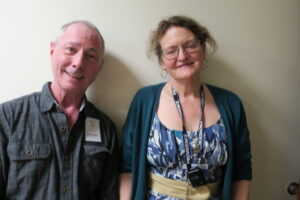
Storey Squires and Steve Heck

Recorded February 8, 2024 40:51 minutes
0:00 / 0:00
Id: APP4292750

Description

This 63 year old professional at a non-profit, long term care facility talks about the institutional and personal impact of Covid on staff and residents.

Participants

  • Storey Squires
  • Steve Heck
  • Hear Me Now Providence

Interview By

Languages


Transcript

StoryCorps uses secure speech-to-text technology to provide machine-generated transcripts. Transcripts have not been checked for accuracy and may contain errors. Learn more about our FAQs through our Help Center or do not hesitate to get in touch with us if you have any questions.

00:03 Hi, Steve.

00:04 Hi, Storey

00:05 I'm so glad we're doing this. Thank you.

00:07 This is great.

00:08 Yeah. As you know, I've been the volunteer coordinator at the mount for quite some time. I think it's about 23 years. And I've been at the mount for 28, almost 28 years. And so we've worked together. And you know that I'm leaving shortly this role. And it really is important to me that I share some of my memories of what it was like during COVID I previously shared memories of sort of general memories of the mount. But this is a chance to sort of reflect on what happened over the last. Well, almost four years ago. Almost four years ago.

01:00 Before we go any further, could you explain a little bit more what the mount is, what that refers to?

01:04 Oh, yes. Providence, Mount St. Vincent in West Seattle.

01:07 Thank you. Sorry. And a little bit more. What is that? Okay.

01:13 Well, when I came here, it was considered one of the best long term care facilities in the United States. It's long term care, assisted living, a large childcare program, which was really unusual. Usual very robust volunteer program, and sort of a sense of community. A robust sense of community. There's also a separate building behind the mount. We call it the Mount, which is for retired Sisters of Providence and some sisters of other orders. It's just been. We're about to celebrate. Tomorrow will be the hundred year anniversary of when the Sisters of Providence moved into the mount. So there's a big mass. So this is the centennial year, and it's been a really important part of west Seattle. And I think it's really served a lot of Seattle in general for providing really good. The model is resident directed care, where residents really call the shots about how they live. Now, Covid has changed a lot of that, and. But still, I would say that the spirit of the Mount continues because it brings together so many people who are very heart centered and really love and care for other people. A good friend of mine, Darryl, used to say, who worked here, he used to say. I'm not supposed to say his name, I'm sorry. Used to say, the mount is full of very social introverts. There's just this deep quality, but there's also this, I care about you social quality. So that's amount. But we are a healthcare organization, and healthcare has been significantly impacted by the COVID pandemic. And there was an initial impact that had a lot to do with the actual disease, or not disease, but virus, I guess. And then at some point it transitioned to being not just that, but also these other things that were happening in healthcare, like staffing shortages.

03:46 I know you have prepared ideas about what you want to talk about, and we sure have time for that, but could you. Maybe this is part of what you thought about. What was it like when you first dawned on you that Covid was happening and it began to manifest, and then what the initial reactions were within your work setting?

04:03 That was a really interesting process for me, because I was not paying attention to the news very much. And I think it was a Sunday. Well, very early in March, because it was the day of my stepsister's birthday. I had an incredibly social day. Like, usually I don't. It was a Sunday. Had my hair cut. Met my stepsister and my cousin for breakfast at a place she wanted to go, which is Arthur's in west Seattle, packed with people. Then I went to visit a friend of mine in an inpatient mental health facility, which was packed with people. And then I went to Sephora in a university village, which was packed with people. And I want to circle back to Sephora because something really sweet happened. But that. And then. And Stephanie told me my stepsister said that her adult children did not want her to come out. And I was like, really? And she. The next day, she sent me an article about what was happening in Italy, and my heart broke, and my blood went cold. Like, oh, boy, this is what could be coming. And that's when I knew. And I had actually been scheduled to go with my longtime beau and his two adult daughters to Washington, DC. It was going to be my first three week vacation in a very long time. And we had planned this. It was mid March, so shortly thereafter that we knew we were going to have to cancel the DC trip. And then the last meal I had with other people at a restaurant was West Seattle fish company with Paul and his two daughters. And we were like, we're not even going to go to the coast. This is shutting down. And I remember saying, steve, I remember saying to them, you know, because I work in healthcare, I'm held to this higher standard. And then, boom, everything seemed to shut down. And I remember being told that we had to wear our id badges when we drove into work because we could be pulled over by the cops if we weren't an essential worker. We had to prove. And I remember driving out onto 35th and barely having to look to see if any cars were coming because it was a ghost town. And. And then what was happening at the mount was. There was definitely a deer in headlights period. I have a lot of faith in the clinical staff that were here at that time. So they were, but there was so much unknown, you know. So I was asked to write a policy called emergency corps volunteers, like, because pretty much all the volunteers were told not to come. And then we knew we were going to have to have some volunteers. And so I remember trying to write this complicated policy, like, how do you pay attention to potential legal requirements but also deal with this? My brain is almost frozen because it's so also weird. And then another thing I remembered, we had a screening desk set up fairly early, and there was a family member of a resident. It was very painful for family members to suddenly they couldn't visit their people. And there was a family member who was a teacher, and I think she was an OT, actually. She was furloughed. And she said, well, I'll come in and help with the screening desk because we had to reconfigure all these roles. And I remember at some point point, you know, a certain amount of cynicism. Is she coming in because she wants to see her? There were all these concerns about families trying to sneak in or stuff like that, but she wanted to wear a shield. And at that point, the answer was no, you can't wear a shield. And so she said, I'm leaving, you know, and just, it was just a few days later, I think, when I was told I was going to be on the screening desk, I was in a big meeting, and I said, well, can I wear a shield? And the answer was yes. And then a few weeks after that, it was, we were buying shields. We had to buy our own shields at first. And then shields became mandatory. And we had to reuse medical masks at first because the supply chain was so challenged. So I remember being taught how to make my medical, and there was a lot of fear around surface it like we didn't know anything. So if you put your mask down wrong, you know, have you contaminated yourself?

09:00 Didn't know that it was actually airborne. And that was the risk at that time, right? Yeah.

09:05 Oh, yeah. Oh, and I'll tell you the Storey about the fab four who spent a year working when we didn't know it was an airborne and they just went to service. Then there was a. I do, one of the things I remember was sitting at the screening desk. It was a makeshift screening desk at first. And the receptionist, who was, since it was closer to the reception desk that it ended up being, she hung up the phone and she said a word that somebody says when it's all coming down, you know, and I said, what? And she said, the west Seattle bridge is closing for three years. And I remember having a feeling, will I ever see my family ever again? You know? And, yeah, so there was, oh, the other thing that was amazing during that time, though, was there were several mount volunteers plus other community volunteers that sewed cloth masks and we got 1000 cloth masks. They were for staff to wear out in the community. And then eventually they were for residents. And I still remember being at this table, two tables, and it was like a crayola box or whatever. They were just beautiful. And the staff, that was like a high point for them. This was a really hard time. And they were like, oh, masks for me. And seeing them pick them out. And so there were always these kind of weird moments of resiliency. I remember seeing somehow a golf cart was involved because trying to get, they were going to lock all the doors except the front door. So they had to help anybody who was going to SJR, particularly the sisters who lived over there, St. Joseph's residence, somehow they were able to borrow a golf course. So watching a golf court drive back and forth, at first there were these moments of whoa. And yet that first spring, I've kind of blocked this out, but I think there were a group of residents that died then. And I remember two volunteers being very upset because they both had visited a resident who was hard to connect with, but they had connected, they had succeeded. They were of, the two volunteers were of two different generations and they, for whatever reason, had the patience to be close to this person. And she was in that early wave that everybody was up on. They designated a certain area five south and five center when it was bad. I think maybe all three of those neighborhoods at one point, at least two, and they couldn't come and see her. They could talk with her on the phone. But I later realized how really hard that was for them. And at some point I did not go up to the COVID area until things loosened up a bit. I don't remember the exact sequence, but maybe I was wearing a mask and maybe it wasn't. It certainly wasn't like in the really bad early wave because we had a break between the first wave of 2020 and then it came back again. I think it was called Delta, if I remember correctly, in the, almost towards the end of the year. And I did go up to five cent south at one point and it just, I was verclempt because I saw they still had tape on the floor, so they took a hallway and they split it. And one, it was like airplane runways they had arrows. One was clean and one was dirty. And I realized that they had. There was just so much work that went into, you know, gowning up, ungowning, and we were all being trained in that stuff. And I do remember a moment. There was a nurse that was about to retire, and she prolonged her stay here, but she did retire, like, after a year or something like that. And I was walking up to the parking lot, like, half a block behind her, and I could see it in her shoulders, just the fatigue. And I was just, wow, this is. She's really, you know. And there were. But there were, again, there were lovely things that happened as well. Votes of confidence, kind of. And then. So the screening team. I mean, the first, I want to tell you about the sanitation team. So I call them the fab four. One of them was. Had just started as a volunteer. It was a noda volunteer, and no one dies alone. And he was and is a computer programmer of some kind, although he and his wife moved to eastern Washington, and his wife was a nurse here. So he said, I'm coming in. I'm sorry, but I'm doing this with my spouse, and she's here. I'm here, okay. Then there was a volunteer who just started whose father lived here, and I had a strong connection with him because he was from Schenectady, where I'm from. She said, do you need any help? And I said, yes. And she said, okay. And I knew for a fact that that family had a very strong from doing a hear me now with her and her father. That service was very important. Then there was this guy who had retired, and he was also a computer guy, but he had briefly considered being a nurse and volunteered. And he said, I'm coming in. Okay. And then there was sister of Providence, and I was just telling her this yesterday. She was retired. She was in her probably in her late seventies at that point. She's in her early eighties now. And I knew she had been an administrator of some kind. And she showed up in my office and she said, I want to help. And my brain split because one part of me thought, oh, I have to honor her as an administrative type and think of something highfalutin for her to do. But what do we need help with cleaning and sanitation? And I was like. And I just looked at her and I was like, we need help with cleaning and sanitation. She didn't miss a beat, said, how do I. Where are the rags? Or whatever, you know? And so what they did was every day, Monday through seven days a week, for just around a year, this fab three cleaned assisted living. All the doorknobs, all the railways. I mean, handrails, all the handrails in the stairs, they sanitize them. And I did that many times myself. It was a real workout, and it usually took an hour and a half to do. So they did that. They, you know, they traded off. They made a calendar, whereas the sister went to SJR and did that. But that was really amazing, you know, that they were here. And then what happened was the. We started bringing back volunteers in October of 2020 to do what's called, what's called be well visits, because the most isolated residents actually were the assisted living residents, because long term care residents would always, you know, unless they were sick, they would be eating in groups and such. So their lives did not change all that much, except for the masks and the shields and such, whereas assisted living residents, they could. The only way they could go outside is if they went for a walk. No communal dining, nothing like that. So. And I will say, I want to kind of go on record by saying one of the sort of hard things of that time. And I understand it, but it's. It was a trade off. And clinical staff who I support, I think they were very strong. In some ways. They were skeptical about volunteers, like, particularly maybe the people who had not worked with volunteers before. Will these people do the right thing? Whereas I knew, of course, they would do the right thing. Are you kidding? And one thing I do want to say is that one of the early learnings was that people. It was passing in waves, in part probably, because staff were eating together and not distancing, because we didn't really know that. Right. And so one of the healthy things about all this, there was some really good communication. We got a weekly report of, if I remember correctly, it was. Well, at first, it was how many people died that week and how many people were sick? Staff. And I. Let me just say this, Steve. Staff have been, you know, obviously sick a fair amount in this. And it was understood that some of us, like, I could quarantine, I could live alone, but a lot of people had families and they had multi generational families, and, well, let's just say that no volunteer got sick until everybody started getting sick. And that was the summer of 2022, I think. So I was like, hmm, who's been taking care of good ICP practices in the community?

19:52 And I'm sure you've included some things already, but if you want to take a second and go over your notes to make sure that we've got, like, 20 minutes left.

19:59 Oh, my gosh. Okay.

20:01 So the things that are important to you that you want to make sure registered.

20:04 Okay. That's great. So the dining shutdown, we had to bring our own food. That was a big change for me. But I could learn that I could cook again. I mean, I forgot that I could cook, but we know many of us were packing in. I had my own little cooler and such. We could go shopping early in the morning as essential workers. And then one thing I definitely remember is PCC. I went on an early morning shop. I spent more than I have ever spent on groceries, like, times four, like a used car. Okay. And the team, the thing that the team did that was really well done. And I read a New Yorker article about how Covid should have been handled. And this was. There was a playbook that Obama left that was not okay. You've heard about that. Well, one of the things is have consistent and clear communication by. By an identifiable source. So every week we had a town hall for family members, and we had a town hall for staff. So the basic clinical leadership was two doctors and two nurses. And they each had their own kind of specialty. And I thought they did a really good job about that. And often those questions, you could ask any question, and there were so many times that I asked really stupid questions, but I'm so glad. That's when I learned I did not have to shower as soon as I got home or eventually learned I didn't have to spray down food. And one thing that I do remember, one appreciative moment was the first family town hall. At the very end, it was kind of silence, and then somebody said thank you, because it was, you know, we could unmute and ask questions. And then another person said, thank you, and then another person. And it was like a sound sculpture. And I want to say there were at least 50 people. And at one point, a man's voice came through and his voice broke, and he said, thank you for taking care of my mother. And it was really. It was really special. Those town halls began to change over time. There was much more confrontation, like, why are you doing this? Why is it. This is the way it is in this place? Why are you doing it this way? It became harder, but it was always. It always felt really healthy to me. Ask any question. Here is a straight talk, of course, deeply confidential, about who was sick or anything like that. And then the other kind of weird thing that was happening is that sometimes staff would just disappear, and we'd realize, what? Where is that person? Did they quit? Did they get sick? Are they working from home? It was weird that way. But we started doing some functional things. We started a stand up meeting every morning for at least people like me who considered department head and just check in. So everybody had a. Had a say about what was going on. And at first, that was really helpful. I loved it. It was a way to really understand, you know, oh, you're clinical, and this is your thought and your housekeeping, and this is your thought, and this is dining services and volunteer services. But as things changed with COVID it became really stressful for me to hear that because there were so many holes in staffing. And I used to say I was getting PTSD from those hearing that. And I think that was because I felt tremendous responsibility, probably too much. And I kept up with my counseling during this and was often asked, you know, like, is that really your responsibility? Because there was just this feeling of, we have to save them out, you know? And then I wanted to mention, because I saw this nurse today, the very first, you know, we got into routine. So one of the very first things that we did was a giant testing of all employees back when there was very few tests available. And that was almost like a music festival. It was so elaborate. People were coming in cars. People were. We were lined up. Well, it was happening at the west entrance, but we were lined up way back to the south patio, and we had to wait, you know, and so finally it's my turn where I know I'm going over to this area where. And, oh, the people who are doing the test are not mount employees. For the most part. They're other providence. They dress like they're on the moon. You know, you couldn't tell who was who, and I. But they're playing music, and so when it's my turn, the song and Venus, you know, and Venus was her name. So the nurse in the moon suit. And I started dancing. You know, I walked over like this, and she met me like this, and we went behind a partition, and she pulled her mask down and she said, it's me. And it was my mom's hospice nurse. And so. And I just saw her, and I said that Washington, that was a human spirit moment. Like, oh, the other, when I was waiting for some other. We did that a few times. A few times when I was waiting in line, I thought, it's amazing how human beings adapt, you know? Wow, we figured this out. Somebody figured this out. And it's pretty functional.

25:59 And how different that is from AIds. When the nurses would suit up like that.

26:03 Yes.

26:04 It never changed. It stayed serious. People didn't find the humor then. Yeah, I think we did a better job as a culture this time, right?

26:12 Yes, we did. We did very much. And, you know, I haven't really thought about that as a compare and a contrast. That's something I'll think more about because the possibility of death was definitely there for everyone. For everyone, exactly. And I will say, I want to shift to. When we got tests first, they were PCR tests, so there was a long wait. But when we got routine tests at the mount, there was more of a sense of control, I think. And then when the vaccines came, that was amazing. And I still remember, I mean, it's. I had no control over this. I had. Well, I. I was so scared when I got the email, like, this was on my phone. You can sign up for testing. You're in line enough to sign up for. I was so scared, I could barely get my time scheduled. And I had to choose between going to swedish or going to the mount. And for some reason, I decided to come here. And I'm so glad I did because I walked into. It was the first session was in the cafe, and I knew I was going to take the vaccine. I'd done some research, and I was like, yeah, I'm down for this. I have no hesitation. And I walked into the cafe. The administrator was on one side and one of the clinical leaders was on the other. And I just looked, and there were nurses from a pharmacy who were giving the shots. And I burst into tears. And these two women, who I think are more thinkers than feelers, just looked at me like, what? And somebody who was standing behind me went out of her way to just put her hand on my shoulders. And the really cool thing that happened was I had the vaccine, and then we had to wait 15 minutes in the cafe, and the new young director of spiritual care had, again, music. And she kind of sashayed over to me. And so I kind of sashayed over to her and we started dancing. And then there was a circle of women from different countries who were dancing together. And that became my thing. I dance in the virus. I've always danced in the virus. And so that was really cool. And once the vaccine came, we started having more. Then we were in trouble because we were just running out of staff, and we needed that time, the staff, the screening desk was going on from 06:00 in the morning until 10:00 at night or something. 09:00 at night. And there wasn't staff to do it, you know, so pressure was on to get volunteers. There was a staff person who came in and did the very early morning. But slowly over that spring, after the. Of the vaccine we started, we got this great group of people who were on the screening desk and I did that role myself and it was challenging. Everything was happening and those women were so on the ball and I don't think they've ever fully gotten their due by management because you have to have done that to know how many balls you were juggling. And then my job changed, though, a lot because in the sense that I was responsible for. And this was also happening with the screening, I mean, with the COVID tests, there were some volunteers who were helping with that. And if the volunteers didn't show up, I had to be there to do it. So I did have. I started becoming aware in 2021 of a lot of stress that was happening because I thought that once the pandemic, once the vaccines, you know, hey, back to normal, kind of, right. And I did not see the staffing shortage and the money woes coming and I had a lot of stress in my body. I ended up, well, you were really helpful, Steve At one point, I think the first thing when staff would disclose to me how they were worried about this, that or the other thing, I would feel it, and later usually had a migraine, went to the ER with possible stroke symptoms. At one point, that was expensive and unnecessary, but good, you know, that's what the paramedics told me, but I don't know if you remember, but I, well, I went, I guess it was in 2022, February of 2022, I had a panic attack on the freeway and my heart was just not behaving normally quite a bit. And so I went to my medical doctor and she looked at me and she said, a beautiful, kind eyes. She said, will you help us? Help you? And I said, yes. And she said, I want you to take a month off. And when I had had the panic attack was when I thought of I was considering taking a break and it was so scary to me that I had a panic attack. But she said, will you help us help you? And I still remember, oh, she knew how to do that. And coming back, that gave me the steel backbone I needed to say to my boss, guess what? I've been told I need a medical leave. And eyebrows raised all over first floor, kind of. And so that's why the card that you sent me, I don't know if you remember, you sent me a card or an email, I can't remember because I know you sent me a card that got to me after I came back from. So it was the email. You said it was either take the long view. I think it was play the long game. And I felt so affirmed by that.

32:45 Good.

32:47 And that's what I did. Yeah. And I tried. Yeah. And I think I modeled that for other people to some degree, but I also took a lot of. I mean, that's where I think the road to leaving the started was when I started hearing that there were some people who thought I was taking too much time. And what was happening is that union staff were able to take time and people who were in my situation were taking time very under the radar, you know, when they could unconsciously sometimes say it again.

33:23 Unconsciously sometimes just not deliberately saying, okay, I'm going to take some time off, but just unconsciously finding ways to.

33:30 Yes, yes, yes, exactly. Exactly. So. But things started getting better. I think it would be in 21. It made a big difference when the Emily shop and the sewing ladies came back. Oh, I need to. I need to say that during the period of time the screening desk was happening, this place was a vault. You probably remember it. Your name had to be on the list to get in. You had to answer eight questions. You had to have somebody manually check your temperature. And the swap, well, that was testing. I'm talking about the screening below. Yeah, yeah, yeah, yeah. And incrementally, there were these wonderful changes. But the mount seemed to be behind the eight ball, like, trying to do it the old school way that was the most labor intensive. And so we eventually got a place that people could put their head up to them so we didn't have to stand up each time for temperature. And then, lo and behold, one of the volunteers was very instrumental in saying, hey, I go to a doctor that has electronic screening, and this is a volunteer on a limited income. And she said, I will donate some money, like, I'm talking $25 or whatever, to help you get this. Can you imagine that? Like what? And that's one of the things that got the ball rolling on the electronic screening. So there was this huge effort to man that screening desk or woman that screening desk for over a year. Well, anyway, and then there was a long period of slog. It just, you know, just slogged through it. And you have the screening desk. You have to do your ICP. You have to be very careful in the community. I eventually started connecting with other people, and my. I didn't see my partner one hard time was when a family member kind of gave me some grief about how things were at the mount. And, oh, he suggested that we move into the staff. Move into the mount. And, you know, have you thought about that? And this is some months in, and he had, he had been a volunteer, so that's why I knew he was a family member at that point. And I said, I have not seen my partner for three months. I have not touched my partner for three months. And he went, oh, I'm sorry, you know, so at some point one day, I thought I was going to cry, and I said to Paul, can you please come over and spoon me? And we'll both wear masks. And, well, let's just say we learned how to test, at least to this day, if we haven't, you know, we don't live together, so if we see each other every other week, and that's, we test often at my assistance. We had some huge fights about that. And so I would just say, but it's gotten better and better and better. But there is a huge change at the map because we have more agency staff, and that is different. By agency staff, I mean, people who are here temporarily, it's caused a lot of problems. The former director of nursing calls it a wicked problem. And it's just on so many layers, and it impacts me as a volunteer coordinator because there's not enough people on the neighborhoods who know the residents well enough to help the volunteers. So I have high hopes that that will even out. There's one nursing home in Seattle who did it, right, and I was asked to kind of find out how they did it. And let's just say we did not follow. We didn't know. You know, they just really made a. And then I will say, just kind of winding down, that I got Covid myself, thanks to the fact that Paul, my beau, does not really apparently know how to read a COVID test. And I had to face my worst fear, which was losing my sense of smell. I've always felt that that would be far more impactful than most people thought. And I will tell you, it was scary. It was really scary. It only was really bad for about three days. And it's come back. It's maybe not as full as it was before, but it's back. So that's good. And I just see, I just have complicated feelings about where we are now, because on one level, it was a bonding experience to go through that degree of hardship with other people. On the other, I see people afraid, like, if you're committed, that's great. But that almost means, like, well, here, let me give you some more.

38:34 Yeah. Let me ask, has there been any kind of follow up, a post mortem, let's say, about what happened and just as a group acknowledging what went well, what didn't, as the there been that kind of a group conversation?

38:49 Not throughout the whole community. I would assume that that's going on with clinical people, but then not with clinical and others. There hasn't been, no. But I am going to tell people on the stand up meeting tomorrow that I did this oral history about COVID and encourage other people to do it because the memories fade, you know, and I'm very aware that the memories are strongest when things were the most scary, you know, and then it was just like this big blah, you know? And so some of those, I hope some of the clinical leadership, you know, really do the oral histories. So I'm just seeing if there's anything I. Yeah, tomorrow's the hundred year anniversary, and I really hope that this kind of is a milestone that sets a new beginning of, you know, healing has been going on. Healing was going on from day one, and it kicked into high gear, you know, a few years into it. I would say a year and a half into it. The things that you brought. Hear me now. The opening of the drama program, the things, the parties that we started being able to have, that's all part of healing. There's more to go.

40:16 Healing's never done.

40:17 No, I guess it never is.

40:19 Okay, well, thank you very much.

40:20 Thank you, Steve. January 23, 2024.

40:23 Sorry, I'll start again.

40:24 Okay. My name is Storey Squires. Today's date is January 23, 2024. I'm 63 years old, and my relationship to Steve is friend and coworker.

40:38 My name's Steve Heck. The date is January 23, 2024. My age is 73. My relationship is as a colleague and friend. Yes.