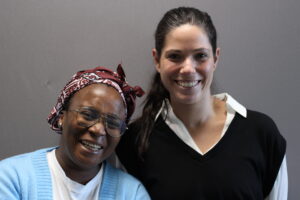
Talia Aygun and Matau Setshase
Description
Colleagues and friends Talia Aygun (30) and Matau Setshase [no age given] talk about their spiritual lives and reflect on connecting with their ancestors.Subject Log / Time Code
Participants
- Talia Aygun
- Matau Setshase
Recording Locations
University of Colorado BoulderVenue / Recording Kit
Tier
Partnership
Partnership Type
Fee for ServiceKeywords
Subjects
Places
Transcript
StoryCorps uses secure speech-to-text technology to provide machine-generated transcripts. Transcripts have not been checked for accuracy and may contain errors. Learn more about our FAQs through our Help Center or do not hesitate to get in touch with us if you have any questions.
[00:03] TALIA AYGUN: Okay. My name is Talia Aygun I'm 30 years old. Today's date is November 14, 2023. We are in Boulder, Colorado, on CU's lovely campus. And I am here interviewing my friend and colleague, Matau.
[00:22] MATAU SETSHASE: I am Matau Setshase Friend and colleague was mentioned November 14, 2023, at Cu Boulder, Colorado.
[00:36] TALIA AYGUN: Okay, perfect. Where should we begin? Here. I think I like the idea of starting with some of these starter questions. So, Matau, if I could ask you, when were you born and where did you grow up?
[00:53] MATAU SETSHASE: Okay. I was born in the tiniest of tiny towns in South Africa, in the midlands. It's a town called Hoopstadt. I was born there 40 years ago. Grew up around the country then because I moved, following my mom and following education, I guess, and then still following education. Here we are. I don't know if you've ever. You've been to South Africa, right?
[01:24] TALIA AYGUN: Yeah, I spent a year in South Africa.
[01:26] MATAU SETSHASE: So have you seen the townships, what they look like?
[01:29] TALIA AYGUN: I did not.
[01:30] MATAU SETSHASE: Right. So if you've ever been to, like, an american native american reservation, it's a lot like those. So I was born in a place kind of like that. Very barren, very difficult, challenging, lack of resources, lack of a lot of stuff.
[01:48] TALIA AYGUN: Yeah.
[01:48] MATAU SETSHASE: Yeah. But I'm here now.
[01:51] TALIA AYGUN: So would you say that what brought you exactly. I know education brought you here to Boulder, but were there any other places that you were thinking about ending up, or was this always the place that you thought you would be?
[02:10] MATAU SETSHASE: When I make a decision, right, I follow through. If I say, I'm going Boulder, I do not allow myself, the universe, or anybody to debate something else. So I decided, I'm going Boulder. And then channeled all of my energy, spiritual, psychological, all of it, towards getting Boulder. Right. Talked to the ancestors. I talked to my family. In fact, the ancestors, I talked to them first. Right. And then kept everything to myself until I received that letter. And I was like, hi, everybody, I'm leaving. I thought you'd like to know that the road is looking this way.
[02:58] TALIA AYGUN: Yeah.
[02:58] MATAU SETSHASE: Right? Yeah, yeah.
[03:00] TALIA AYGUN: That's so refreshing. That kind of resolve, I think, is really impressive in some ways, because I feel like my whole way of being, it can be so airy sometimes. I'm just kind of like, well, wherever I'll end up. Where were you thinking of going up? I had some ideas of maybe going to other programs when I was pursuing the direction of media studies. But I think in some ways, this is where my heart was set, too. I grew up in Baltimore, Maryland, and I have a turkish background. And I think, considered one and a half generation. My mom was born here. My dad immigrated in the eighties. And on my mom's side, the side that was most kind of americanized or hybridized into some sort of immigrant culture in the US. My mother's brother actually ended up somehow going to undergrad in Boulder for one semester before he dropped out to be a ski bum. He's kind of like the rebel of the family. That was sort of the untamed spirit, I guess you could say. And he actually didn't tell my grandfather that he was dropping out. And it wasn't until the registrar's office called my grandparents and was like, hey, your son's not enrolling in classes and he's nowhere to be found. Just. Just so you know. So anyway, I had this kind of familial tie to boulder, and I really idolized my uncle. I looked up to him in a lot of ways. And coming out here was so cool as a kid to just see the life that he was making and creating out here. So maybe, I think that, I don't know, falling in his footsteps in some ways.
[04:55] MATAU SETSHASE: Was your family a bit worried when you said Balder because of what happened?
[05:00] TALIA AYGUN: Yeah, I think so. My mom, I think she sent me off with some bear spray and a tent or something. She really thought this was out here in the wild, wild west. But I think I've also tried to maybe adopt a little bit of a defiance in my family. So maybe following my uncle's footsteps was a natural, natural progression, I think. But, yeah, that makes sense to you.
[05:33] MATAU SETSHASE: Because when you asked me how did I end up here, it wasn't so much the place itself, as in, I was pulled by people.
[05:41] TALIA AYGUN: Yeah.
[05:42] MATAU SETSHASE: Right.
[05:42] TALIA AYGUN: Yeah.
[05:44] MATAU SETSHASE: So I met Nabil and I met steward, and I was like, okay, I would like to be taught by these people. I would like to learn from these people. I would like to become what I think I can become under their tutelage. Right?
[05:56] TALIA AYGUN: Yeah.
[05:57] MATAU SETSHASE: But then small, weird little things keep happening. I don't know. Okay, so I used to read people magazine when I was small.
[06:08] TALIA AYGUN: Yes, I have very vivid memories doing the same.
[06:10] MATAU SETSHASE: And then there was this girl who was very, very pretty. She looked like it all. She was on the COVID almost weekly. And then she. She was kidnapped and subsequently murdered. And then at the time, I remember being a teenager and being so heartbroken and reading up and following up. And then in the break, I found out she's from Boulder. I'm like, oh. Oh, okay.
[06:36] TALIA AYGUN: Isn't that odd?
[06:38] MATAU SETSHASE: It's not just her. There was a buddhist monk who self immolated in protest for climate change. Right. His name is Bruce Wayne. Bruce Wayne. Bruce Wayne. I'm not sure, but his name is Bruce. But he. I then found out once I was here that he's from Boulder. I was like, okay. It's so weird that I tend to be pulled by people as opposed to places, I guess. Yeah, yeah, yeah.
[07:12] TALIA AYGUN: Do you feel, besides in maybe determining or having some sort of connection in the places you end up, that similar patterns operate in your life with regards to other things? Like if you notice certain, I don't know, occurrences, or do you find yourself almost repeating certain cycles and things of that nature? And do you think that that has some underlying significance?
[07:42] MATAU SETSHASE: So it's funny, my kid was saying the other day, she's sitting on the couch and she says, mommy, I feel like she's nine, right? Well, in a month she'll be nine. So she's like, mommy, this feels like deja vu. And she's like. I'm like, how? She's like, no. I feel like I've been here before, sitting here like this, and you were there on the laptop doing that. And it made me think that I haven't felt that sense of things are repeating for me. I used to have that a lot. I used to have that a lot, that everything repeats. People feel familiar, places feel familiar. But then when I. I think there was a break. So when I went under, took my. Underwent my training to become a traditional healer.
[08:29] TALIA AYGUN: Yeah.
[08:31] MATAU SETSHASE: And I was taught how to live with my ancestors, how to basically not mind time so much. It feels as if everything shifted. Things feel new to me. This morning I was walking up here and the sun was shining and I was feeling something. Right? And I'm like, this feels familiar. I feel good. I don't know. And the thing is, I keep trying to link it to a specific moment as if I felt this way before, but I haven't.
[09:06] TALIA AYGUN: I kind of love that too, though. Like that opportunity to have that curiosity and openness that maybe something you're experiencing is maybe not necessarily for the first time, but, like, novel to you.
[09:20] MATAU SETSHASE: Right. I think most of my life it was just deja vu. Deja vu all the way. And then I think I took a turn in my life that kind of set me on a different branch, on the tree of life altogether.
[09:34] TALIA AYGUN: Yes.
[09:35] MATAU SETSHASE: Are you feeling familiar right now?
[09:39] TALIA AYGUN: I resonate with this sensation of when being younger that you felt maybe more experiences of deja vu. And the rational part of my mind wants to figure out maybe why that is. Maybe it's a phenomenon of growing up or developing or something along those lines. But I do also so think as, you know, maybe as you get older, you're encountering things that you have before with newfound perspective, newfound feeling. And it's hard to say if there's kind of maybe also the period of stasis that it feels like we're in sometimes like what those new experiences are. Just recently, we had a solar eclipse in Boulder, and I had experienced one before. I think it was in 2017. I'm not sure. It struck me with that same sort of excitement, just as if it was happening for the first time that I'd experienced it. And I don't know, it's kind of one of those otherworldly phenomenons. Right. When you were saying that you felt the sun shining, I remembered it took me back to that experience of being under the sun when an eclipse was happening. And that sense of feeling of the sun's not so strong, and it gets kind of eerie. And you think, huh, this is maybe why, like, ancient peoples were so afraid of this happening.
[11:05] MATAU SETSHASE: That's what I thought this morning. It's exactly what I thought I was like even as I walked up again. I'm kind of trying to make sense with myself, and I'm like, why did you need to link this moment to a previous one? You're in a moment, it feels good, but your brain is refusing to accept that it exists in and of itself. Right. Do you want to link it to something you've had? Because I used to have those patterns of deja vu, of experience, of sameness, you know, of repetition. Now I want to. It's almost. My brain reaches out to, like, something that was there, but it's not there anymore.
[11:42] TALIA AYGUN: Yeah.
[11:43] MATAU SETSHASE: Simple. It was the sun. It felt good. I felt happy. There was no.
[11:48] TALIA AYGUN: And that was it.
[11:49] MATAU SETSHASE: That was it, yeah.
[11:51] TALIA AYGUN: I really love this idea. It reminds me of a lyric in a Bob Dylan song where he says, take all you've gathered from coincidence. And sometimes I'm like, you know, really, it can just be coincidence. And we tend to sort of add so much meaning to that in a way. So I just. I really like this idea of not necessarily being bound to mooring your experiences to some type of meaning, which actually reminds me of the question about faith and about different conceptions of faith, maybe conceptions of God, because this conversation is reminding me of the idea of believing in something maybe without necessarily understanding it fully or knowing that it's true, but still continuing to kind of believe in it, in some kind of way, how would you describe your faith or your experiences of your practice of faith?
[12:57] MATAU SETSHASE: Okay, first, if you're gonna ask me of a conception of God, which is.
[13:02] TALIA AYGUN: Also where we can start, because that also is a part and parcel, I think, with.
[13:09] MATAU SETSHASE: I refuse to have one. Yeah, I refuse to have one. I think at some point in my life, I embrace the idea of infinity. If we say God is infinite, my words can only be finite. My conceptions can only be finite. So I, and I think that's probably why I keep trying to connect my experiences to things, because I think, you know, in a finite way, that this must be me feeling the sun, feeling this way. It reminds me of God. It reminds me of something. But that moment of itself was just a spiritual experience by itself. So there's no need for me to try to find language. I think I'm struggling with. I'm forcing myself to exist in this moment.
[14:07] TALIA AYGUN: Yeah.
[14:08] MATAU SETSHASE: And it took me 40 years to be able to say, okay, yeah, I'm feeling good. It feels heavenly. It feels, things are bad right now, worldwide. Back home, my parents are ill. I'm struggling with my PhD altogether. I have no reason to be saying the sun felt amazing this morning. Everything is against me being happy for those 10 seconds, but I felt absolutely sheer happiness. Right.
[14:42] TALIA AYGUN: It's huge. The idea that you can suspend or refuse to corral your experiences in some kind of way is a huge impetus that I feel as well. When I think about faith, I remember this. Okay. I had to write it down because the question actually, it layered on so well to this haiku that my mother's classmate when she was in the 7th grade wrote. And it's just kind of incredible that I think someone who's that young can maybe write something this profound. But my mom would repeat it to me all the time, and it went, faith is like the bird that feels the dawn and sings before the light. And it's such a simple provocation, obviously, like, maybe we have a little bit.
[15:32] MATAU SETSHASE: Of what I felt this morning.
[15:34] TALIA AYGUN: Yes. And so when I thought about just this question about how you describe your faith, I thought, really, it's this invocation to accept and surrender to some sort of feeling that precedes something. Like, to me when we start tasking faith with being about trust and conviction and confidence that something's going to happen. That's where I started to really struggle with this concept of it, because, you know, I don't necessarily think, right that faith needs to proceed or preclude maybe some sort of outcome that's defined, but that, like, incredible opportunity of sitting with and being with a feeling before something.
[16:21] MATAU SETSHASE: What is your spiritual background?
[16:23] TALIA AYGUN: Yeah, I think this might be a side effect of how disorganized my religion has been. I, being Turkish American, am the embodiment of, like, someone that is culturally muslim but doesn't necessarily practice. And I think this is also compounded by the just experience of having an immigrant family as well. But it's never really fit into any kind of easy organization in any way. And so it feels like my understanding of spirituality, of faith has been from an observational standpoint of, like, watching my other family members and elders negotiate sort of their own relationship to the center of their identity, right. As something that is informed by the maybe ideas of Islam, but aren't necessarily part of organized practice. But I don't know. I feel as though there is something to say about faith being something that can move you in a certain direction without knowing exactly what the outcome will be. And maybe this is. I mean, I think that's essentially the aim of most religions, right, is to kind of give you some sort of ease and maybe closure and, like, comfort in that process. But have you. Even though you don't necessarily have or refuse, right, some singular concept of God, do you have anything that comes close in terms of a experience of something that is maybe close to God or godly or heavenly?
[18:19] MATAU SETSHASE: Okay, so I've kind of been like a spiritual nomad.
[18:26] TALIA AYGUN: Yeah.
[18:28] MATAU SETSHASE: Grew up in a christian household. Every Sunday, Sunday school, every Easter, we're going to church ten days for ten days straight in the evenings, you know, talking about Jesus's words on the cross. Then when I reached high school, I went to. Okay, so we had a christian christian family. I was raised by my great grandmother, Christian. But simultaneously, at odd moments when no one was looking, when everything else failed, they would consult traditional healers, people we call Sangomas dinga. So they regularly ventured out of the structure of the boundaries of Christianity to kind of go figure out a trying to go get answers that Christianity wasn't answering or that not Christianity that the church wasn't answering. Right. Then we'd have regular thanksgiving rituals and functions for the ancestors. It was part and parcel. Obviously. I was a child. I didn't see that there had been divisions made. I grew up in people, my neighborhood, my community, people who practiced both. Yeah, right. Just the other one. We didn't practice when the sun was shining and people were looking at us, right? So that's what happened. And then when I went to high school, I got exposed. Well, my last year of. Of middle school, I was exposed to Islam, right? The school. My school was in a muslim neighborhood. So then I got exposed to a different culture, their conception of God, their practices. And then another neighborhood nearby was hindu. So then I'm exposed to that. Then I'm like, okay, what's going on here? There's so much. There's this, there's this, there's this. And then I get to varsity and I'm like, I don't believe in anything anymore. I'm done with all of this, right? And I think I was atheist for like, five years. During that time, I was just relying on my rationality and nothing else, which, of course, I'll allow. Sometimes it was shaken. I think atheists tend to not account for crisis of faith. So they think because they don't believe in anything, they're not going to have anything that's going to shake that moment. So there was those five years. It felt like I. Then after that five years, then I ventured into Buddhism, went to many, many retreats, meditative retreats, didn't eat, meditated a lot. Also to say, I hate meditation now, if anybody is asking me. So I have a very dense background. Ultimately, in the end, all my questions weren't answered, which were, what am I doing here? Who am I? What should we do? The answers that I'd been given through various religions would answer me for that moment. And then I get to the next phase of my life. And then the answer would have to come from somewhere else. The last ten years, the answer came from embracing my ancestors, going for the training, which was harsh, painful. I want another way for it. But I went for that training and then practicing, combining the various strategies, methods, ways of living, ways of connecting with God and making them work. Kind of a patchwork of spirituality. That's what's been happening.
[22:42] TALIA AYGUN: What do you feel? I would love to hear more about the ancestral connection to your spiritual practice, and I'm sure this will continue to come out in the conversation, but you and I share some overlapping interest in things like the excesses that you're talking about. Right. Things that doesn't fit into easily answerable questions. Right. And so I'm curious about how these ancestral connections have addressed some of those things that spill over. Those questions that spill over. And does any of it come from a negotiation of things like one of the most unanswerable questions, which is what comes next after life?
[23:31] MATAU SETSHASE: Right. The thing with at least my relationship and my encounters with my ancestors and the way I've been taught, and the people of my community is, a relationship with the ancestors is a constant negotiation. Not bargaining, but negotiation. Right? Speak to any South African, they'll tell you they're tired because the ancestors are always asking for this. They're always asking for this. They're always asking for too much. Right. It's almost like you give with the one hand, you take with another. Then I had to sit with that transactional and I kind of sense of, okay, what is this?
[24:11] TALIA AYGUN: Yeah.
[24:13] MATAU SETSHASE: Every time I need to do something monumental, I have to slaughter a cow. Every time I have to do this. What is this? How does this work? Then I had to. Because of what you asked me, I had to think about what comes next because I've had dreams, I've had visions where I've seen them. I've been in other places, and I'm like, okay, so then they're in an entire reality world over there. They're not chilling there, hanging out on hammocks, eating grapes and playing flutes and drums and dancing. And it doesn't look like anything that I would imagine paradise is. It's an actual world with things that are being done right, teeming with people, with life. So many people. So many people. I couldn't believe it, right? And I'm like, okay. But then it means, in as much as I'm asking, please help me here, they're probably saying, please help me there, right? So it kind of has to be, what is it that I have to do here that makes it easier for them to rest a little aside.
[25:26] TALIA AYGUN: Yeah.
[25:27] MATAU SETSHASE: And I suppose for them, then the situation is the same, which is, what is our child? What does our descendant need? And they're always five years ahead of me. I figured this out so late, but they're always five years ahead, right? I think I'm clever, and I'm like, okay, I want to go to Boulder. This is what I plan to do in Boulder. Spiritually, I want to do this. Academically, I want to do this. Then I'm like, I get to Boulder, and I'm like, okay. I bargained. I asked and I begged, and they let me come to Boulder. And then I get here, I'm like, hold on. What the hell? I've seen this place. I've had. You see the. The bridge that goes into academic housing?
[26:21] TALIA AYGUN: Oh, yeah.
[26:22] MATAU SETSHASE: I had this frightening, frightening dream that my ancestors were standing on the other side, which was cu boulder, and I was on the other side, which was my home. And I was trying to get there, and it scared me. It looked so expensive. It was like a huge gorge. And I was like, I can't cross that bridge. I can't cross that bridge. And my, one of my elder grandmother standing there, she's just smiling and she's doing this, and I'm like, come, come over. And then when I get here and I come to class literally the first day, and I'm coming from housing and I'm like, oh, dear heavens, what is happening here? So then I'm like, many, many years ago, I had this specific vision, right? So I'm like, okay, I'm always a couple of steps behind, so I think it requires a little bit of surrender as well. And as much as I'm a rational person and I want to negotiate and I want to understand, there are things I'm comfortable surrendering at this moment in my life. Right.
[27:26] TALIA AYGUN: I want to respond to this idea of dreams and seeing elders or ancestors in dreams and knowing your background and knowing your work. I'm wondering if you can help me interpret. Ever since I was a child, the first time I ever saw an elder or an ancestor in my dream washing the night that my paternal grandfather died, he was in Turkey and we were in the US. And I woke up in the morning and I told my mom and dad that Bjukbaba had died and my father hadn't even called yet to receive the news. And he then later learned that my grandfather had passed. And I remember being a kid and feeling like it was eerie and odd to have, you know, had that moment of realization maybe before the news had come, but other repeated sort of occurrences happened as well. I wonder if there's any meaning behind having a reoccurring dream that a grandparent or someone that, you know, has, who's close to you, who's died in the dream, they come back to life. But there's this awareness in the dream that they're dead. And so. And it feels like I'm the only one that knows they're alive and they're trying to say something to me. And it's almost this really eerie kind.
[28:53] MATAU SETSHASE: Of, I want to laugh at you because it feels obvious to me because of the conversation we just had. You know, they're alive. Like I've just said, there's an entire life, world experiences that they're having. So to them, they come to you. They know, you know, and you're being too rational.
[29:13] TALIA AYGUN: Too rational. And in the dream, I feel like I'm. I feel as though someone's going to find out that they're alive or maybe that they themselves don't know that they're alive. It's this weird kind of simultaneous understanding that they have passed away, but now they've come back to life. And it's really interesting, and I always wondered if maybe that happens now. Listening to you around something in my own life that I should be paying attention to, maybe during a period in my life where I should be channeling them more, but just also in terms of remaining close to this connection, I think is something that we share on some level, because beyond any sort of religious kind of identity I've had, I heard more often my mom say that she was praying to her mother or her great aunt or her, you know, a passed on loved one than I ever heard my mom say, you know, I'm praying to God or I'm praying to that energy was always directed in that direction. But, yeah, I guess my question here is just how do we come into awareness of what our ancestors are trying to tell us or having a connection with them after they've passed?
[30:43] MATAU SETSHASE: I can tell you that I had the calling, which is the sense that you should go on this path and become a healer, which is it comes through dreams, through visions, and other people can tell you as well. I had the calling, according to me, in 2010, right? But according to the people I was consulting at the time and to the ancestors that had been coming to me at that time, they'd been speaking to me for a very long time, and they felt like I was rejecting them because they'd been speaking for so long, and I'd been passive or avoiding. Passive and kind of like, ah, these are just dreams of. It's not really real, you know? But then when somebody did say to me, they felt like you were rejecting them, then I had to sit and think about the many, many times I've seen my great grandfather, I've seen my grandmother, I've seen people who've passed come talk to me about stuff, and I'd be like, sometimes I just know things out of the blue that I had no way of logically knowing. I had no access to those things, but I knew them, and I just thought I was special and I was important and I was clever, and, oh, wow, me, I'm so intuitive, right? So all of those moments where I was being. Where I was fattening up my ego and being self congratulatory about my vivid dream life, about my connections was literally me emphasizing me as a knowledge maker, not someone who's receiving knowledge, right? So I honestly don't even have an answer for you, what I wanted to say was, my mentor has become. There are some things, you know, I've heard, you know, you've heard me say this. There are some things only time can put together. There will come a time when it will make sense, what the dreams meant.
[33:03] TALIA AYGUN: Yeah.
[33:04] MATAU SETSHASE: And I am so. Such a positive person and so rooted and such a deep believer simultaneously. I am also so cynical.
[33:16] TALIA AYGUN: Yeah.
[33:18] MATAU SETSHASE: So what if I never make sense of it? I have something most people don't have, some of my family members don't have. I get to connect to my great grandmother. I get to connect to people who died long ago. I get to hear about things, and I have the pleasure of saying, hey, come here. Come see what we live like, you know? So I have a much bigger spiritual web of connections. You name it. It's my ancestors. It's when I was going through the buddhist moment in my life. I wanted to take refuge. I was thinking about it seriously, and then I had these dreams where I was back at my great grandmother's home where she was born. I'd never. I don't have a strong memory of it, but it came in the dream, and there was this ocean water, just flowing waves and waves. And in the water, there's a Buddha sitting in the water. And I'm going outside of the water and I'm going towards him, running away from the water to him, and he shakes his head at me and he points back into the water, right. So then I didn't know what the dream meant. I just felt rejected, right. And I was like, but what does this mean? Only later, once I go on the path to become a south african traditional healer. I understand, oh, our ancestors are in the water.
[34:49] TALIA AYGUN: Oh, my gosh.
[34:50] MATAU SETSHASE: Right? That's where I am to find my healing. I can go this way, this way, this way altogether. It's supposed to come to the water somehow to find what I need to find.
[35:04] TALIA AYGUN: And you don't realize that until much, much, much later.
[35:07] MATAU SETSHASE: It was like a decade later.
[35:09] TALIA AYGUN: Yeah.
[35:10] MATAU SETSHASE: That I realized, right? So that's why I'm like, time is probably something we have to sit with very uncomfortably.
[35:17] TALIA AYGUN: So uncomfortably. So uncomfortably. I think that's why meditation is so hard for me. Be expected to be alone with my own thoughts. Who can do that? Like, it's scary in there. I don't want to have any alone.
[35:31] MATAU SETSHASE: When was the last time you tried to meditate?
[35:33] TALIA AYGUN: I think I. You know, people say you can just do it anywhere, anytime. I think that my meditative practice does. I think I do things that resemble meditation sometimes, but whenever I try to, like, stick my. Yeah, whenever I try to, like, say, you know, okay, start a timer and just start meditating and then stop. It's never a good time, but whenever I can kind of feel maybe that sense of, I don't know if it's abstraction, but the feeling of really just letting something be a passing thought or experience. That does happen to me. And maybe it's a flow state kind of, but it never happens. You know, when the yoga teacher says, okay, now the class is overdeveloped, start meditating, you know, do you think maybe.
[36:27] MATAU SETSHASE: We try too hard to be in these religious or connected modes? And so because of that, there are moments when it happens just voluntarily, spontaneously. And we miss them.
[36:40] TALIA AYGUN: Yeah, totally. Totally. And we miss them because we don't have the language maybe, to say what they were or identify them in any kind of way.
[36:51] MATAU SETSHASE: Let me ask you, please ask me. I don't know whether we still have time, but let me ask you one super important. Your disposition, your posture, your religious practice. Can you pinpoint, do you have a specific moment where without it, things would have been different or where it was crucial to you just being able to get up the next day?
[37:16] TALIA AYGUN: Yeah, I think understanding and processing loss and grief is really where it comes, where it's invoked the most. Earlier you were saying that atheism kind of fails when it comes to explaining crisis or explaining some sort of break or I fissure. And I think grief and loss is precisely that. It's a type of crisis in a sense, because we know it's coming. We know that it's the most reliable to occur thing in our lives, but we don't understand necessarily how it unravels us or how it undoes us. So I think in terms of grief, in terms of understanding also, that grief is never complete. Right. And that maybe this is also why my elders visit me in my dreams, why I still feel to this day, right. This ongoing visitation is where some type of spiritual and religious, at least understanding, or, like, quest has had to kick in, in a sense. And I also think, and maybe this isn't enough to call it religious, but just sometimes in the ecstatic experience of understanding another person and really feeling that briefly, it's always a glimpse, but just that, like, incredible oneness of some type of interconnection is where without some higher understanding, I wouldn't be able to notice how important that moment is or just how kind of rare it is, at least in terms of, you know, day to day life. And there have been opportunities and experiences where I feel like that type of ecstatic connection has happened. And like I said, it's always a glimpse, and it feels you can never get back to it, but at the same time, you're like, wait a second. Like, that's the glue. That's, like, the thing that's holding it all together is the ability to relate and to connect like that and to just see a stranger as if they were, you know, someone you knew an entire lifetime, I think, is the one good thing that maybe we can do as people. But I also feel like in describing one more thing, too, that I want to ask you is in terms of feeling like this, maybe different quality or ability you had. I loved what you said about feeling like you weren't just generating knowledge from some center, but that you were actually maybe a vessel that was receiving it in some way. I mean, this is a very, or can be a really energetically powerful, but also maybe even draining experience or heavy.
[40:26] MATAU SETSHASE: Draining heavy.
[40:28] TALIA AYGUN: How do you go through just day to day being endowed with such a gift of feeling and of receiving? And how do you kind of contain it in terms of your day to day experiences? Or do you contain it? Is the point that you don't. You just go through life with this gift and also this ability to be open to receiving. I mean, that's just such a rare quality to me.
[41:04] MATAU SETSHASE: Every day I have an awareness that if I hadn't gone for my training to become a healer, if I hadn't acknowledged the calling, if I hadn't acknowledged my ancestors, and if I didn't practice, and if I didn't think of them as my guides, as my connections to God, as my anchors, as nearby, as accessible, and as something I should cultivate, right? I shouldn't be frightened when I see them in a dream. In fact, when I don't see them for a long time, I panic. I feel like something is wrong, right? Every day I'm aware of that. And I'm grateful for that. Because had South Africa not been what it was when I became a teenager, when we were still under apartheid, someone like me would possibly have been locked up for seeing these things and talking like this and sounding like this and saying, oh, no, my ancestor came by. Oh, no, I have visions. Oh, no, I have this, right? The religious traditions that I know, that I had thus far known and the medical traditions that I had thus far known would have worked to manage and conceal and limit a that part, right? If we accept that we can't know the human brain fully, someone like me, my descendants, and some members of my family who are also now healers as well, were the kind of people that would never have thrived in an environment that didn't allow people to freely speak like this, to normalize that. Okay. Every night I have a horrible, horrible insomnia. I struggle with it, which means every night I have to be intentional about what must happen when I sleep. It's a lot of work. It's draining. It's heavy. So sometimes I stay up for, like, 24 hours without sleeping because I'm like, another night, I can't do this, you know? But then when I sleep and nothing happens, I wake up and I'm like, okay, okay, what's wrong? What happened? What's happening? Is my space contaminated? Am I feeling heavy? What's happening? I'm feeling disconnected. I feel untethered. You know, it's both difficult and both a source of consolation. So it's hard. And I'm trying to teach my kid to kind of be aware of everything. Cause she wakes up and, like, I had a dream, 123123. And I'm like, oh. Oh, lord. Okay, yeah, I have to intervene and say, okay, look, she's a child, right? Just let her be. Don't send messages through her. I'm here. If you have messages for me, I'm here.
[44:01] TALIA AYGUN: Right?
[44:03] MATAU SETSHASE: If you feel strongly about it, there are other people you can call and tell. Please tell Madau. One, two, three. Let this child be a child, you know? But my sense of the. After we die has expanded. My sense of what is possible while I'm here has expanded. You asked me a question which I wanted to respond to. I don't know if this will make sense. You asked me, what objects have I received from my people, from my family, from my ancestors? And what objects would I like to share? Nothing physical, right? I receive stuff in my dreams all the time, but the moment, the problem is, it all relies on me to materialize it. They'll give me gifts, but I must make them material. So many things, so much. Often they show me rose. They gift me, like, these beads. I wear these beads, right? I've been gifted more beads, but then I'm the one who has to take whatever the beads represent. I'm the one who has to bring it to life, materialize it. So now I have to go and find the beads. They represent something. They represent some kind of healing, some kind of connection that I might need, right? So through, it's never over for me. My ancestors will constantly be giving.
[45:30] TALIA AYGUN: Yeah.
[45:31] MATAU SETSHASE: So in a way, I feel. I feel better. I don't know someone who's had existential crises from, since she was seven.
[45:44] TALIA AYGUN: I know, right? Some people are like, oh, I'm having an existential whirlwind in my twenties, and you're like, try savage.
[45:51] MATAU SETSHASE: It's been all of my life it's been like this. I've been asking these questions, right? And the only benefit we can give philosophy ever as a discipline is that it forced me to ask even better questions and to not stop asking questions, right? But I did need answers somewhere, but the questions will remain, right? There's a quote I should have brought for you from Reina Maria Relke. Do you know the poet? He says it's a book called letters to a young poet. There's a quote in there that says, the young poet writes him questions about his journey as a poet trying to become a poet and is asking for counsel and advice. And one of the questions was, how do I make sense of things? What do I do with this life? And what is poetry supposed to do? And then he says, do not go looking for answers. Do not go opening for doors. Sit with the questions. It's not like direct quote, but basically it was just learn to be comfortable with the questions before you start seeking answers first, which is in a very.
[47:11] TALIA AYGUN: Very roundabout way, it's connected to the objects, right? It's just contained in one singular object. It's more about where the where and how you're guided to the thing or where you sort of represent and fill the thing with meaning.
[47:28] MATAU SETSHASE: But what are you planning for the future, though? What do you see?
[47:32] TALIA AYGUN: Oh, man. I think I have the opposite experience that a lot of people feel like they may have with their disorganized of religion, where I didn't grow up with anything in the way of anything that was organized. So now I'm like, hmm, maybe I have all of these questions still and I can do the opposite. Where I, you know, grew up with nothing and now I'm maybe looking for some stability. Whereas people who grew up with, like. Exactly.
[48:05] MATAU SETSHASE: I was thinking that's more likely to happen to my child because I am so free form as a parent. She's likely to go seeking that organization, because in that organization there's community as well, right?
[48:20] TALIA AYGUN: Yeah. There's a giant sense of a place.
[48:23] MATAU SETSHASE: To go, people to ask belonging, which, if you're some kind of nomad or if you're some monk or nun, a sketch one. Everything is solitary.
[48:36] TALIA AYGUN: Yeah.
[48:37] MATAU SETSHASE: All your questions are by yourself. You have to marshal all you know by yourself to deal with loss, to deal with, just conflict to deal with, to even just understand, to make sense of being happy. You have to stand there and do it by yourself and rely on what you can google. Right?
[49:02] TALIA AYGUN: Yeah.
[49:04] MATAU SETSHASE: But like you said, if you feel connected to other people, a sense of connection in other people, that is inexplicable, what would it be like if in that moment of vulnerability, you're able to go to that person and say, can I just be there? Can I just be right next to you? Right.
[49:25] TALIA AYGUN: Yeah.
[49:26] MATAU SETSHASE: So I think that's what probably the organization offers, the structuredness of religion office.
[49:32] TALIA AYGUN: Yeah. It shortens that distance to get distance to someone. Totally, totally. I know, and I think that that makes a lot of sense. I do think that maybe it's a side effect of also growing up with maybe more questions than answers, that it feels that people, especially like you, that shortened distance where you can just get right there. I mean, that's what I felt meeting you for the first time too, where it was like it took very little for us to get to the meat of the thing. Right. Whereas there's all these other barriers or all these other kinds of structures that you have to get through, even to just breach a connection with someone. Right. Or to practice your faith or to do it the right way. And I don't know. I think there's something to be said for both the double edged sword, the gift and the burden of being that type of permeable type of body. Yeah. Going through the world, you absorb. You have the potential to absorb so much that is either, you know, for better or for worse.
[50:49] MATAU SETSHASE: I want to say something amazing about you, that, which is why I wanted to have the conversation with you. Other than overlapping interests and being in the same department and being friends, I had my professor of philosophy, very, very old man. People steadily dropped out of the class throughout the year and the end of the year. Towards the end of the year, it was just me. So I would come to class, he'd teach, and then I'd ask him a question. You know what he'd do? He'd fold his hands, walk towards the window and look outside and deliberate, think about stuff, and then come back to me with an answer. So the first time you spoke to me, I felt that you were very contemplative with your response. And you're the kind of person who things are allowed to emerge when you speak into. Right. Because I get heated by words. So I need people who are not scared of words, who are not scared of being quiet, who are just fine. Thinking through stuff. So I was like, no talking to Talia. She's exactly like Professor Fisahi. She's the person who I can talk to without worrying if I'm saying enough. Am I not? Am I understandable? Is my worldview legible? Yeah.
[52:18] TALIA AYGUN: I so appreciate that. I feel like I am both an external and internal processor, and I feel like there was exactly the same way with you. If I was to externally process something, you would be right there to at least grasp what I'm trying to say and find some sort of relation to it. And I think that that's just a real. A real gift and a real blessing, if we will, in this program. Right. To have someone like that. And I acknowledge what a task it is really, to go through such a deep, constant negotiation of yourself, of yourself.
[53:04] MATAU SETSHASE: Of reality all the time. I have to. When the thing is, it's not even that. My family is. We're all practicing, or we're all accepting. There's so many dynamics. There's politics. So at some point, some members of my families branched off and felt that they wanted to adopt this particular religion. But this other religion that they adopted, which is a new kind of Christianity that people are practicing, they spend a considerable amount demonizing people like me and my ancestors. I was like, ugh, I see this stuff in academic documents all the time. When the missionaries write about people like us. Now I have to take it from my own family. But then we had a huge moment where my great grandmother passed away. And then the trouble is, okay, so how do we send her off? Do we send her off this way? Do we use the christian way? Do we use this way? Oh, man. It was a very hard week. I remember standing in the hall where my aunt, she's a drama queen of it, didn't include me, my mom, or anybody else in the program. And then to speak for my. To speak about how we grew up with my great grandmother, I included all other people. And then I decided. I didn't decide. My kid went off and ran. She was a baby. She went off. She ran to the casket and kept holding it. She kept holding it and wouldn't let go. Right now I have to get up from where I was, and I'm forced to come to the front. Now people are seeing me in all of my dress code that, okay, I'm not like them. I'm a different one. I shouldn't be here. Right? Then I go and I try to pull her off, and then I kind of squat down. I'm like, listen, this is what happened. She's in here now. The whole place is entirely quiet. And then I kind of remembered, and then I thought, okay, she's not there by mistake. I'm not being pulled to the front by mistake. I have to acknowledge who I am. What? This is who we are. Even if it's not fashionable, even if it's not normative, we have to acknowledge that she's gone to join their ancestors. She will be an ancestor, and she was a living ancestor elder to so many people. And all of these people are gathered here. And nothing about verses quoted from this specific book addressed that. That she was a member, an integral member of this community, and she was meaningful in these people's life in this way, and she was meaningful in teaching us, our traditions this way and this way. You know? So then I stood up there by myself. Even my mom was kind of scared, because it's kind of an odd thing to stand in front of people and insist, oh, oh, no, no. Ancestors are real. I don't care what you say. This is what I believe. So to do it by yourself, then I was like, no, I'm not by myself. I'm with her. She's next to me. I'm with my kid. I'm with all the other ones that I have come to collect her, to go to the other side. Right? I'm with whoever the head guides are, whoever the angels are. I'm with them. And that has always been my posture. Never, never be too shy to acknowledge. This is my belief. I believe in life and life giving and life affirming stuff.
[56:56] TALIA AYGUN: Absolutely.
[56:57] MATAU SETSHASE: And this is what we do. We heal, we extend life. This is what it is. Anything else is human. Politics is human negotiations. So at that moment, I was very vulnerable. I was alone. It was just me and my kid in the casket next to me, speaking to a hall full of people. And I had to be about it. I had to kind of say, hey, this is who I am. This is what we believe. These people are carrying us. Right? When things fall apart, you'll be coming to someone like me. You guys come see me. We've even consulted with people who are heads of their own churches. After hours, they come see us. So I felt, okay, this is not a legitimate spiritual tradition. But you all know inside your hearts that you've been talking to people like me. You consult with people like me. So I had no reason to feel embarrassed or shy or humiliated. So then I. And I've lost so many people so many times, I had to attend a friend's funeral this week. It was hard, it was painful. And I realized the difference is, with my great grandmother, I did the thing. I stood my ground, I acknowledged my belief, and it was easier for that reason. Not less, not, well, challenging, but it was less challenging to let her go. And she's the one person who I can say, even though she's gone and she's an ancestor, our relationship is at ease because at that moment, I did what I had to do.
[58:45] TALIA AYGUN: Yeah.
[58:45] MATAU SETSHASE: Yeah.
[58:46] TALIA AYGUN: It was a real. A moment. An intervention of healing.
[58:50] MATAU SETSHASE: Yes, it was an intervention. Yeah.
[58:53] TALIA AYGUN: Where you were precisely in some sort of mediumship, like you're negotiating the side that is deeming, you know, this way of believing as non normative, and then you're also staking yourself, like, this is the. This is what it is. And I can't think of anything more of what a healer is and does is enter that kind of intervention with a certain amount of care and empathy and maybe not hold any one side accountable for, you know, I mean, that hurts, right?
[59:30] MATAU SETSHASE: Not hold on so dearly.
[59:32] TALIA AYGUN: Yeah, exactly. Exactly. I think that's a great note to end on. Okay, perfect.
[59:42] MATAU SETSHASE: Are there any last words that I'd like to share?
[59:44] TALIA AYGUN: No. I feel like we could just keep going forever. And I feel lucky to have had this conversation with you and just makes me more. It makes me more eager to keep learning.
[59:57] MATAU SETSHASE: Every time I meet you, you know, I always fight you because I feel like we should spend more time together.
[01:00:02] TALIA AYGUN: I know. I know.
[01:00:04] MATAU SETSHASE: It's always like, thank you so much. Grateful that we talked.
[01:00:07] TALIA AYGUN: I'm grateful, too. Thank you.
[01:00:09] MATAU SETSHASE: I hope it means something next year sometime. I'm sure not tomorrow.
[01:00:15] TALIA AYGUN: I'm sure it will.
[01:00:16] MATAU SETSHASE: Okay.
[01:00:17] TALIA AYGUN: Thank you.
[01:00:17] MATAU SETSHASE: Thank you.