"There were TVs on the drill ship in 2001... we watched the second plane hit the World Trade Center...from the middle of the Pacific Ocean"
Description
Micropaleontologist Timothy Bralower has sailed multiple times on JOIDES Resolution and a mission-specific platform. He reflects upon how communication at sea has changed over time, from mailbags filled with letters waiting in port when the ship returned, to the use of email while onboard. Tim also shares his thoughts on how discovery has changed, including the joy of having total surprises when core arrived on deck. Listen to hear Tim's stories, including speaking to the news media when he had to make the call for drilling into the Cretaceous, and what it was like to be the co-chief scientist during 9-11 with a member of the science party that didn't know whether her father was on the plane that hit the Pentagon."Being a micropaleontologist is the number one best place to be on the drill ship" - Tim Bralower
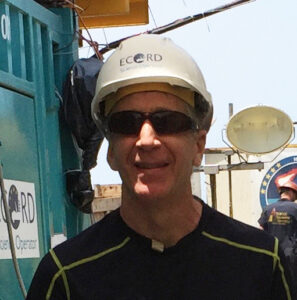
Interview recorded December 19, 2023. Image provided by Tim Bralower from Expedition 364.
Participants
-
Tim Bralower
-
Laura Guertin
Interview By
Keywords
People
Places
Languages
Transcript
StoryCorps uses secure speech-to-text technology to provide machine-generated transcripts. Transcripts have not been checked for accuracy and may contain errors. Learn more about our FAQs through our Help Center or do not hesitate to get in touch with us if you have any questions.
00:00 Hi. My name is Laura Guertin and I was an onboard outreach officer for expedition 390 on Joydee's resolution in the South Atlantic transect.
00:07 My name's Kim Bralower I'm a professor of geosciences at Penn State University, and I've sailed on five expeditions. Leg 122 back in 1988, leg 143 in 1992, leg 165 in 1995, leg 198 in 2001. And I was a co chief scientist on that leg. And then I was on the drilling platform in the Gulf of Mexico in the Chicxulub crater. Expedition 364 in 2016.
00:38 That's a lot of expeditions, Tim. And so I'm sure you've got a lot of stories you could share. What are we going to be talking about today?
00:45 Well, there are a lot of stories, some of which I probably wouldn't want to share on this, but some of them I will share. And I think one of the things that I've gained with this length of time sailing is a vision of how communication has changed over this time period. And that's what I wanted to start talking about today. In 1988, I was a very young scientist, and we sailed out of Singapore and we went all the way down to the coast of Australia and back for two months. And during that time period, we had absolutely no communication with friends and family.
01:20 There wasn't even a telephone to use to call home.
01:24 If you wanted to use the Landsat line, it was $50 a minute. So you didn't. You only need that in an emergency? Yeah, that's. That was. That's a, you know, a guesstimate after how much? It was very expensive. So you only use that in an emergency. You left the port, and then when you got back to Singapore after two months, there was a bag of letters waiting for you. So then the letters got opened up and you heard from your family members at that point, but over those two months, you had no communication with the shore at all.
01:55 Wow, you were really isolated then. So you didn't hear from family, but you didn't know what was going on in the world in terms of current events or anything?
02:02 Not all, not at all. And then. So then the next two legs, 143 and 165, there was a daily email blast. So they would go out once a day and back in once a day. So at like six in the morning, email would go out and come back in the. So you have one set of communications with people a day, and that made a huge difference. So you could email with your friends and family members at that point, but just once a day. And there was no tv? No. Radio, no. Nothing apart from that.
02:31 Now, was there a length restriction on the email, too? Could you write 1000 words or how did that work?
02:38 You couldn't send images and stuff like that. It was limited by a number of bytes in the message. So you could write a long letter or something, but you couldn't send a.
02:46 Big files across, so at least there was some regular communication. And you probably would have had to plan that with someone back home where one day they would be the next day, then you would be the following day.
02:57 Right? Yeah. All your messages would cross over.
03:00 Wow. And did that make you feel more connected, less isolated?
03:04 Well, I still think you feel a little isolated, and I'm trying to think which one it was. It was 165 was the Christmas leg. So we were out for on that leg, and I'd just gotten married, so that was a very lonely leg for me because I'd just been married. I was out at Christmas, and I have to say, christmas on the junior was a little sad. Everybody bought presents that they gave like a random set of presents to somebody else, got your present, et cetera.
03:29 Kind of like a Santa swap or something like that.
03:31 Santa swap, right, exactly. The crew did a great job with the meal, and it was in the Caribbean, so it was sunny and we ate on the deck and all that. So we had a nice barbecue on Christmas day, but it was still a little sad.
03:43 Yeah, barbecue on Christmas day never happened for me either. I grew up in the northeast, so winter snow, cold temperatures, that's part of the holiday season, right?
03:52 Yeah, no, that part was nice. So then it all changed. And this is the story that I wanted to get to, was 2001. I was the co chief, and we were out there on September 11. The story I wanted to tell today was about what happened on the ship on September 11. So we were out there in the western Pacific on Schatzke rise. So I think it was like a 17 hours time change. We were 17 hours ahead, something like that. 13 hours, something like that ballpark. And we had just drilled a really incredibly exciting core. One of the science objectives from the cruise just got totally done at that point. It was early on in the lead. Wed left Yokohama at the end of August. So this was early in the expedition, and we just drilled this ridiculously exciting black shale from the actian. And you could just tell it was oozing organic matter. It turned out to have like 36% organic matter. So we were all extremely excited. And it was nighttime out there, so it was like two in the morning or something. And we went down to celebrate and have dinner. And as we were eating, somebody came down and said, a Cessna just hit the World Trade center. And of course, by this time, there were tvs on and CNN on the drill ship in 2001. So we then went up to the. To the science area where the sort of headquarters were, and we watched the second plane hit the World Trade center.
05:21 From the joy, I can't imagine. Wow.
05:25 It was the most unreal feeling because there we were in the middle of the Pacific Ocean, and even amongst scientists and drillers and technicians, we had connections to the World trade Center. People knew people who worked there. And it turns out one of our scientists didn't know whether her father was on the plane that hit the Pentagon. He was scheduled to be on that plane. And so we had a whole day of waiting to find out because we didn't know. And there was so little communication and uncertainty at that point. We had a whole day where we didn't know whether her father was on the plane. And we were just. The two coaches were talking about what we would do if he turns out he had. And we would have basically had to go back to. Almost back to port, back to within helicopter range to get her off the ship. There's no way we could have her stay on the ship for another six weeks. The plan was we would pull pipe and we would transit back to within helicopter range so she could be transferred off the ship. Fortunately, as it turns out, he had taken an earlier flight. Thank goodness. But that was the most unreal experience of my whole life, being out there on the. On the drill ship for that.
06:41 And that's nothing you can prepare for.
06:42 No, no. And, you know, we had lots of discussions with the operations folks about ending the leg right there.
06:48 My goodness. And then coming back. I can't imagine, even just for the first 24 hours. I think everyone must have been stunned and just trying to wrap their head around what was happening and that you were so far removed from it.
07:01 We felt so distant from it all. We did have communication. We were able to watch the news, and CNN was on absolutely round the clock, so we didn't leave that. But not a lot of science got done for a few days there. Basically, people were stunned. People were totally stunned. And, yeah, there was a lot of concern about family members and, you know, what was going to happen in general in the world. And there we were in this little bubble in the middle of the Pacific Ocean. And at that time, I have to say, the science of this objective did not seem very important to anybody.
07:36 Right, right. I mean, just trying to process what was going on. When you're not with your closest family and friends. I mean, certainly when you're on the ship, your scientists are your colleagues and they become the people that you confide in, because that's who's right there and that's who you have the regular contact with. But it's still not the same.
07:55 Absolutely. And, you know, the other thing is, we left port in the pre September 11 world, and we came back into port and everything in the world had changed. When we came back to port, sailed into Honolulu in November of 2011, everything had changed. It was just an unreal experience to be out there on that leg during September 11.
08:14 There must have been some really heavy hearts throughout the rest of the expedition.
08:18 Oh, yeah, yeah. You know, even though I think it was a very successful leg, the whole leg was kind of shrouded in a little bit and clouded by the events that went on in the world.
08:30 Oh, my goodness. Amazing perspective.
08:34 Yeah, it was global events.
08:36 Wow. And that. And imagine if you didn't have that communication. Imagine if you were back on the, your very first leg back in 1988, where it was two months where you had no news. And then all of a sudden, if you came back into port and heard that news.
08:49 Yeah. That would have been much worse back then. Just hearing snippets of it this way, we could actually really understand what was going on. Yeah. Yeah. So the other thing I wanted to talk about was how discovery has changed. Over the time I've been sailing, our discovery has changed.
09:06 Okay.
09:07 1988, we were sort of at the end of the time period when you would go out and you would have total surprises. I mean, I think that still happens in some fields today. Like, if you're in a newer field, like the microbiology drilling, you probably have more surprises. But in the stratigraphy, pale oceanography field, in ocean drilling, you generally today know what you're going to be drilling. There have been some exceptions to that, like the New Zealand leg recently where they drilled an old continent. That was one. But back in 1988, we had no clue what we were drilling. And we went off to the Exmouth plateau. We knew what the upper layers would be, but we were out there to get the Jurassic, where this was the jurassic leg. And we thought we were going to get a beautiful teffian jurassic section. When it turned out, we went in the site where the Jurassic was supposed to be. The. The site was supposed to be the youngest. The Jurassic was supposed to be the youngest. There was no Jurassic there at all, we went right into the Triassic, so we missed the Jurassic altogether. And that was a total tonal, total surprise. And it was really fun because the Triassic turned out to be really interesting and exciting. It was a reef. It was a reef like a four reef reef. So. And it turned out to have a lot of microfossils in it, and that's how we knew it wasn't Jurassic because there were microfossils that I'd never seen before, and I knew they're Jurassic. So that was really fun. And then in the actual and geo leg, there were tons of surprises out there as well. I mean, we had tons and tons of surprises as to what we drill, and that was in 95, but today, you know, 30 years later, almost, you generally know what you're going to drill. Maybe a little bit different in some of the antarctic legs that have gone out recently where there's a little bit of uncertainty, but overall, you kind of know what you're out there to get. And I think that's changed over the course of the program. Of course, if you go back to the Glomar challenger, those were pure expeditions where they were just discovery mode. You didn't know what was under the seafloor when you went to drill in the Caribbean, for example. Is this going to be miocene, or is it going to be cretaceous? You didn't really know that. And so I think that's changed somewhat. And I have to say I think it was a little more fun when it was Christmas time. I mean, not Christmas time on the ship, but Christmas time on the science part. You didn't know what you were going to get, and there were some really interesting surprises. You felt like you were pioneers in a way.
11:39 Ocean exploration certainly has changed through time, and it's thanks to the advancements of technology, the ability for us to be able to map the ocean floor, to be able to collect samples, to do seismic profiling, whatever it takes to get an idea. But, yes, I think certainly back at the beginning of scientific ocean drilling, it's, let's find out what's there to start with. And now we're learning more about our ocean. But as you said, there are still some surprises because so much of the ocean is unexplored, and there's still so much we can learn through scientific ocean drilling that we have yet to discover. I think we don't even know what questions to ask sometimes.
12:17 Absolutely. I think you're absolutely right. It's just the questions have changed over time. I mean, drilling has made such fundamental discoveries in my field over time, but I think that the main questions are changing now, and there's so many exciting fields that we have to explore in the future.
12:35 As you mentioned, microbiology certainly being one of them, being able to collect that material and preserve it so we can get it back to a lab to be able to do those analyses. And that there's, I think, even more audiences that are curious to learn about RC Florida than in the past. I was surprised when I sailed and I was doing the outreach tours from the ship, that there were some students that said, I didn't know. We did research out at sea, and it sounded like they knew there were cruise ships that would go back and forth across the ocean, or maybe ships delivering cargo, but that scientists were out on the water doing research comes as a surprise to some students and even at some of those science outreach events I do for adults.
13:21 Yeah, I think one of the most interesting things to me is sailing with so many diverse type of scientists. And on the Chicxulub expedition in 2016, we had two microbiologists on the ship, and I learned a lot about microbiology from them. And some of the work that they did was some of the most exciting science that was done on that expedition that was really, really interesting and still.
13:43 So much more to come, certainly.
13:45 Oh, yeah, absolutely, definitely. Yeah, absolutely. So that leg was an interesting one, just because it was so different. The leg in 1988, you were in a four person cabin, and then you progressed after that to be in a two person cabin, and it got pretty, I mean, quite frankly, quite luxurious, really, from the expedition point of view. The quarters are pretty nice. And the food, I've always loved the food, you know, eaten a lot and enjoyed the food. Chefs did a really good job. Well, the chefs did a really good job on the drill platform. But what was different was just the level of the operation. And the quarters were really cramped. So there were six people in a cabin and teeny little bunks, like, I'm six foot three. And it was a little difficult getting into your berth, into your bunk. And it was extremely noisy. Now, in the junior, you get used to the humming noise when you get off the ship. It seems ultra quiet. When you're in a hotel room. It takes some getting used to, the lack of noise. If you're in a cabin by the thrusters, it's a very constant noise, and you get used to that constant noise. Whereas on the drilling platform, it was, oh, I'd say, ten times louder. And the noise was not constant. It was extremely loud then. Extremely quiet. Then it got loud again and it was much more difficult to sleep out there. I was out there for about twelve days. Some people were out for six weeks, but I don't know how they did it. I could not have stayed out there for six weeks. I could definitely not have been out there for eight weeks in those conditions because the other part about that, it was much more of a 24 hours operation in terms of your on off. I mean, on the drill ship you have your twelve hour shifts. If you're a co chief, you're going to be working 15 hours a day, more like 12 hours a day. But if youre a regular scientist, youre really working 12 hours a day on the platform. Youre working more like 18 hours a day because its really basically nothing else to do apart from get back in the lab when you wake up. And if youre not sleeping very much because of the noise, youre in that lab a lot. And if youre only out there twelve days, you can lose quite a bit of sleep and still be functional. So that was by far the most intense and actually probably the most tired ive been when ive gone off an expedition. Was that one just because of the, the constancy of it. And then the media were everywhere. There were cameras and microphones everywhere, especially at the end. And that was probably the most intense experience I've had on a drilling expedition.
16:17 And when you're feeling, you're most exhausted and probably not looking your best, and that's when everyone wants to talk to you and hear about what just happened.
16:25 I remember when we crossed the boundary and we got across, that's what everybody wanted to know was when we crossed that boundary and I was the one who identified it because the plankton slides were out before the forearm slides. Chris Lowry was doing forearms and obviously my preparations were a lot easier. So I knew we were in the Cretaceous, but I'd heard about this experience with somebody I'd worked with earlier who made a mistake when about Cretaceous tertiary boundary had been crossed and I wanted to be absolutely certain. Plus it had been up for like 15 or 16 hours and I was looking pretty ragged. I saw my first Cretaceous and I was all mic'd up and I said, I think I need to go take a shower. I unmiked, I took a shower, I looked better and I felt better because I felt more fresh. I got myself a couple of coffee, came back, they said, okay, you can mic me up again. And so we just crossed into the Cretaceous, guys, because I thought about it, the shower thought, okay, is that really a reticulif frenulitis? And I thought, has to be, is there anything tertiary that could look like that little bug? And I was like, no, there isn't. We have crossed into the Cretaceous. I just didn't want to blow that call. That would have been a pretty infamous mistake. So I just wanted to make sure I was absolutely right. So this wasn't very spontaneous, but I felt very good about that call.
17:46 And that's important to note, too, the attention to detail all of us pay when we're out in the field. The detail in terms of collecting the samples, processing the sample, double checking ourselves, making sure it's accurate, it before we then share it, because so many people are interested in our results.
18:04 Yeah. And I have to say, being a microplatologist is, I think, the number one, the best place to be on the drill shape, because you're the first person to know when that core comes up. If you're an anaplankton person, you're the first person to know how old that sediment is. And if you're looking at Paleo sonography or sedimentology leg, and the age is paramount, you're the first person, and you can get that smear slide. And after, like, two or three minutes, you're going to be running upstairs to post that age. And everybody wants to know. So you're kind of the center of attention. And as a young scientist back in 1988, that was just the most exciting thing I've ever done in my entire life, was posting that age, running up to the board and posting that age and sharing it with everybody. And it was, to me, that was just, like, so fun.
18:45 And at that point, you forget about the lack of sleep. Maybe you didn't eat well the night before, because this is what you've been working towards in your career, right?
18:54 Yeah. Yeah, absolutely. Yeah. It's really fun. That was really fun. Really, really fun.
19:01 That's so exciting. So micropaleontology is where it's at.
19:05 I think it's just, you know, to me, it's like. I think it's the most fun I've had during my career. You know? Cause you're out there, you're discovering, and, you know, even though the post cruise research is really interesting, it's. There's nothing like the buzz of getting a sample, running down to the lab, making a slide, looking it under the microscope, and three minutes later, you're back up hosting that age with a nano zone and an age call on that white board.
19:31 So we're revisiting that term discovery here, right?
19:35 Yeah, absolutely.
19:36 It's that discovery that you make when you're out to see that kind of aha moment and the anticipation of making sure that you can share it with others and they can celebrate with you. That wonderful find.
19:48 Absolutely.
19:50 Is there anything else, Tim?
19:53 Well, plenty of other stories. I mean, I think the main thing that lives with me is all of the friends I've made on the show. You've been with people for two months and you make some incredibly good friends over that time period. And there are people I've sailed with multiple times and I still feel very connected with them just because we've been out for, we know each other really well. You're living basically as a family for two months and said I made some absolute fantastic relationships on that ship and.
20:21 You continue to see them at professional conferences, post expedition meetings, and it's amazing how you can keep in touch because you've had that shared experience.
20:30 Yeah, yeah, absolutely.
20:32 Everything from the shared moment of discovery to again, even connecting over the experiences you had on the ship, learning about global events to celebrating birthdays or holidays.
20:45 Absolutely. I feel very fortunate. I feel very fortunate to have had that experience. It made my scientific career so much richer. And I hope that the program can get reconnected and rediscovered and recontinued so that many more young scientists can have that experience as well and that they.
21:07 Know it's not just about the science, as you said, that it's about the community that you are building and that you're creating around you so that you can have such strong science moving forward.
21:18 Definitely.
21:20 Thank you for the conversation today, Tim.
21:22 I've enjoyed very much. Laura, thank you.