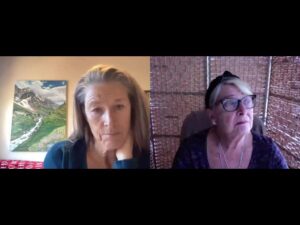
Donna Jenson founder of TimeToTell.org, interviewed by Cheryle Gail founder of BraveVoices.org

Recorded November 27, 2023 39:39 minutes

Description

A Lifetime Of Advicacy
Donna Jenson 76, Cheryle Gail 59, members of Incest Aware. Share the journey of moving through being harmed to being an adult who Breaks The Silence that has perpetuated childhood sexual abuse for generations.
Cheryle Gail: 2023-11-27 18:00:11

Participants

  • Cheryle Gail
  • Donna Jenson

Interview By

Languages


Transcript

StoryCorps uses secure speech-to-text technology to provide machine-generated transcripts. Transcripts have not been checked for accuracy and may contain errors. Learn more about our FAQs through our Help Center or do not hesitate to get in touch with us if you have any questions.

00:01 So, let's see. Please do not close this browser tab until the recording has been stopped. Oh, it looks like we are going. The counter is counting down. 39 minutes. Perfect. All right. I am Cheryle Gail founder of Brave Voices. Donna, will you introduce yourself?

00:20 Hello, I'm Donna Jenson I'm founder of Time to tell with a mission for survivors for people who are affected by incest and sexual abuse, for their stories to be told and heard.

00:39 Thank you. And today is Monday, November 27, 2023. And we are both here voluntarily wanting to break the silence that has perpetuated childhood sexual abuse for generations. So we are speaking up. We are sharing our lived experiences because it makes a difference. And with every interview I do, I'm asking Donna to go on and interview two other people who also want to break the silence and have those two interview, too. And internationally, anywhere around the world, anybody can come and join the Brave Voices archive storycorps community and share their lived experiences and have this archived in the Library of Congress. So when we hear the numbers one out of three, one out of five, that does not include anyone other than who made a police report and had it officially recorded. So those of us who, as children, did nothing, we're not able to do that. This is an opportunity for us to be able to speak the truth of what happened to us and have our lived experiences matter.

02:08 Indeed.

02:09 Yeah. So we're gonna start with, you know, under the umbrella of nonviolent communication, we want to know the facts. What was the observable evidence, if it was recorded by a video or audio recording, what would have been seen and heard? And that is to stay neutral. We're not making judgments about whoever did the harm, being a horrible, terrible devil, because we know the cycle of abuse very often, and we're not making judgments. We're just talking about our personal experiences. So, Donna, thank you for showing up and being brave enough to let us know what happened as a child. So, however, you.

03:08 My offender was my father. And the abuse started in infancy. The physical abuse, harm. The sexual abuse started when I was seven and continued until I was twelve. And the psychological, what I call the psychological and spiritual abuse, continued until I was 46, when he died. Probably a little longer than that because of the residuals of what. How my family has handled this truth. He. It was all his attacks, all his rapes of me were in my bedroom in our flat in Milwaukee, Wisconsin. And after every rape, he said, if you tell anyone, I'll kill you. So that command stayed pretty well lodged in my mind way into adulthood, way into my healing process till I was able to, you know, if not fully purge it, step aside from it, and I, you know, do it anyway. In spite of the. The fear that I was going to die from telling, even after he was dead, that residual, you know, threat stayed with me. I mean, on some level, it's still there. Each time I take a new step to do some kind of activism or artistry around this issue, that the ghost of that threat still will emerge. And I have to take some time to remind myself, or help me get reminded that he can't kill me and I'm not going to die. And in fact, what I am going to do is heal more from telling. So turning that around has been a lifelong quest.

05:33 I'm having to take a deep breath and I have chills on my body hearing you, Donna, and gosh, thank you so much for doing the work to get yourself to a place where you're healthy enough and healed enough and brave enough to be able to break this silence, this. Yeah.

05:59 And one other piece of detail or information is while the rapes were going on, mostly I dissociated. What I came to understand is I put my mind into the sky to basically count the stars. That's what I was doing. So that's just a little extra piece of information about coping.

06:31 It is always fascinating to me to see how, what our bodies and minds are capable of doing to protect ourselves so that we are able to live through the horrible events of what we've heard. So, kudos to that coping mechanism, right?

06:50 Yep, yep.

06:51 Yeah. And during this time, seven to twelve, is there any. Is there had. So I think about childhood sexual abuse in a historical perspective. My father never heard of the subject. It wasn't in his realm of consciousness. Right. And then. And then in the next generations, it is in our consciousness, but we're going to be silent about it. And now we're speaking out, going back in time and history, we know that they didn't have these skills and awareness. So the question is, what could you have imagined happening to give you? I don't know, just, hmm. I don't even know how to ask this question because it's, you know, going forward for parents. What are you promoting to prevent this from happening to children?

08:25 Well, what I'm promoting in terms of the breaking of the cycle is the more survivors who come out who tell their stories, the more our culture sees the vastness of the harm is where attention will grow. And I think that's been the case especially in the last eight or ten years, when I started my work 40 years ago. There was nothing. There were no groups. There were no brave voices like yours. It was, you know, I was in a peer counseling community, and that's where I began to open up and let myself look at what it was I had experienced. And so once I got, you know, I was probably working 15 years on healing before I was ready to actually come out to the wider world and say, I am a survivor of incest. And I think I actually believe, and I parallel this to the AIDS epidemic where being LBGTQ, being gay men, at the time, it was primarily gay men when it started. The vast majority were closeted, and then the plague outed them.

10:06 Yes.

10:07 And not that there still isn't a vast amount of homophobia in the world, but it's shifted exponentially. And I was personally very involved in helping folks around the issue of AIDS back when I was in New York City back in the eighties. So I was up close and personal with that. And I think that was part of what fueled me for my mission to be about survivors telling, and both for this larger social change reason, but even more so because telling is healing. Every time I tell, I heal a little bit more. Every time I meet someone who tells me, that's healing for me. And then, so I just believe it. I also know it's hugely, hugely hard in the beginning and can be up and down throughout our lives as we do this work, as we do this healing. So it was a fairly long answer to your question.

11:27 That's great. Thank you. And what I have learned, starting in 1974, when I cycled across the United States, was that when I am telling my story, and I don't even like to use the word story honestly, even though this is story core, my lived experience over and over and over, that's giving permission and helping them feel comfortable to share what happened to them. So that's what happens. Yeah.

11:57 One tells, another tells.

11:59 It's. Yeah. Yeah. And it is an epidemic. It is. Absolutely. Gosh. Yeah. Even. Even more. More children are harmed than people who suffer with AIDS. So it's like the last social change that I know about that has not come forward. And everything that we do at brave voices is attempting to do it in a way to help people feel comfortable that they can lean in rather than run away and shut the door.

12:39 Yeah.

12:41 So what I would love to hear about is that 15 years of healing and how, you know, how did it. How did you move from disassociation.

12:56 So well, you know, I do believe most of my healing has been done through relationships, which is key, because all my harm was within a relationship with my whole family, actually, because my mother could not protect me. And everybody in the, you know, the extended family avoided it as much as they possibly could to their dying days, so. But it started when I was in a peer counseling community. I also built three women's centers in the New York City area. So there was a lot of personal sharing going on. This is 1971, and it was brand new. You know, we're gonna. We're not gonna talk about our mother in laws, and we're not gonna talk about our shopping. We're gonna talk about ourselves. And it was a big deal. And I built a really strong relationship with someone in my peer counseling community who just sensed something was there and opened the door just a little. And so for two years, in my half hour of counseling, all I did was cry. Just cried. I never said a word. I just wept. And it was like all the tears I hadn't wept as a child when I was left alone from being raped, were now being shed in this counseling session.

14:42 What a gift to get out all the emotions that were inside it.

14:46 Yep. Or start. Get the top layer off.

14:50 Yeah, yeah.

14:52 But I've been in peer counseling for 45 years, and then I got into. I've had two different therapies, group therapy, one with all female survivors and then with mixed gender. And that was the first time I told a man face to face that he made me angry, which was like a huge step. As you can imagine, my family, I've also worked really hard to build a family of choice, people who have my back. And so that when I came out to my family, they were able to, you know, catch me when that whole debacle happened. I also went, can you tell?

15:48 Can we just pause there and tell. Share a bit about that debacle? What is. A camera was recording it. What would that have looked like? How did that go?

15:59 Well, my father was dying of cancer. My brother was mad at me for not coming home and helping more because I lived 1500 miles away. And I said, you. And he said, I know you never got along. I said, you have no idea. And I didn't come out to him at that point, but he and his wife figured it out. They just. His wife was a social worker. And so then he confronted me and said, did dad molest you or. No? He told my mother, and my mother asked me on the phone, ah. And I wasn't ready, but I guess I was, because I did say yes. And it just floored her. Then my brother took it to my father, and he said I should talk to my father and give him a chance to be forgiven, to say he was sorry. And I said, I'm not prepared to do that, and neither is our father. There's been no healing on this subject whatsoever. And if you do this, you're telling him for your sake, not for mine. And he did. And, of course, my father denied it. And my brother decided I was lying and making false accusations. Days of the, you know, the false memory syndrome, people that were stomping around our hearts all over the country. And so my father died. My mother said, I believe both of you because dad had those blackout times, which was hysterical.

17:42 Dad had blackout times?

17:44 Yes, because he was an alcoholic. So that must have been when he was doing this to you. But, of course, you would never have lied about something like this, dear, so I believe you, too. She was just basically being what she always was. And my brother decided to not speak to me and would push me out of his family. And for 25 years, I never got to see my niece. And then he died. And she called me after he died. And then we spent five years inching back towards each other, and we now have a lovely relationship. And I'm close with her and her kids and her husband, but it took 25 years to retrieve that relationship.

18:35 Oh, I'm so glad that she reached out to you.

18:39 Yep.

18:40 And so, as far as your brother not believing, do you think that it was just so outside of his realm of awareness or consciousness that this was happening?

18:53 I have no idea, because he would never speak to me. He would never say anything. So I was left with wonder and had to accept that, you know, I had. Did a lot of healing work around acceptance, accepting that my brother was not capable of holding this truth. His sons are nothing. Abel, either, but his daughter was.

19:29 And how was it to hear from your mother that she believed you?

19:35 Well, you know, it was a. It was bittersweet, because she said she believed me, but she never wanted to talk about any of it. She. I don't need to know details, dear.

19:50 Uh huh. Okay.

19:52 And, I mean, the family pretty much disintegrated after all of that, so. And I was furious with her. Furious. What I realized, because she. She sided with my brother. Oh, well, it's okay. He can't. He just can't deal with it, dear. So that's. You know, so I realized it was after that that I had to do a whole bunch of healing on my mother, not protecting me, which I hadn't paid any attention to. At all. It was hard enough to deal with the healing of my father's crimes, so. Yeah. So we never retrieved the very wonderful, loving relationship we had up until then. And then she died eleven years later. We were just barely cordial.

20:51 Hmm. So you had a loving, close relationship?

20:57 Oh, yeah.

20:58 Until then.

21:00 Oh, yeah.

21:01 Okay.

21:02 She was so proud of me. All the work I did, all the things I've accomplished. She. We would talk on the phone for hours, mostly about my life, and she just was, you know, the support queen of the, you know, and then she wasn't. So.

21:30 And you said up until this, you hadn't realized that she had not been able to protect you, but that you.

21:41 It. This wasn't in my consciousness.

21:43 Uh huh.

21:44 You know, therapists or, you know, key people would say, well, what do you think about your mom? And I said, well, she was a battered wife. You know, she was wonderful. She was so kind to me. She was so gentle, which is all absolutely true, but I put her in that place, you know, the battered wife place, which she was. He was a terror. And so. Yeah.

22:15 And do you believe that it was the alcohol that was he under the influence when he harmed you?

22:25 I do remember alcohol was laced in there. There's no question. But I'm not gonna blame the alcohol. He did what he did. There are plenty of people under the influence of alcohol that don't rape their children.

22:44 Yeah.

22:45 So I'm sure the alcohol helped, you know, if that's the right word.

22:55 Helped numb. Numb them out, and maybe so. And you said that it took a while for you to heal through your mother not protecting you. Is there any specific.

23:11 I did EMDr, serious EMDr work, and that helped. And the level of both my mother and my brother and their, you know, their response and their actions. Emdr was a lifesaver.

23:31 For those of, who have not yet experienced EMDR. Is there. Can you describe a bit of that process for those folks?

23:39 Eye movement, rapid eye movement. A therapist works with you, and basically it's a rewiring of your mind about trauma. I'm not good at describing therapies, so I'm going to invite people to look at. Google it.

23:58 Yeah. Yeah.

24:01 But I'm glad I had some resources already on taking care of myself, having done some therapy, peer counseling and so forth and writing, so that I was ready to just take on all the things that the methodology of EMDR, it was extremely wonderful. And many survivors I've spoken to have found it to be an extremely helpful.

24:30 Methodology for experienced it. And. Yeah. And I highly suggest everyone who has the ability to find and utilize that. There's thousand ways to roam. Right. And so I really love to hear from everybody what are all the routes they got, their healing. So is there anything else along the lines of EMDR that helped you?

25:02 Right. So craniosacral therapy was enormously helpful. Again, I needed to do it at a certain juncture in my Journey. I needed some Earlier Sort of therapy, therapizing, or whatever you want to call it. But the craniosacral therapy was a big piece in working on how, you know, the trauma goes into our bodies. It's cellular. And I really was able to do a lot of Healing through that modality. I highly recommend it if you get. You got to get the right therapist. That's true. And also acupuncture and yoga. Yoga. Yoga, yoga, yoga, yoga, yoga. To this day, it took me a while to get on the Mat. I was in my thirties, but highly recommend it for a discipline of Centering and Healing. It's wonderful.

26:03 Thank you. One of the most beneficial processes I did was the breath work, holotropic breath work. That's for me, turning off the brain and breathing all of emotions that are trapped and stored in the body. Did you ever try any form of breath work?

26:25 I've done some. It's not as appealing. You know, I also heard people that somatic modalities are really good. And I tried that and it didn't quite, you know, but I think what's wonderful is there are so many, there's such a menu out there of so many different ways to, you know, do the healing, do the work and. Yeah, so I also went to a week long intensive residential program. I called it incest camp. And that was amazing. That was out in Arizona at the. Oh, God, I can't think of the name of it now.

27:15 That's all right. We can come back to it if it comes. So prior to the healing years, I know for myself I turned to drugs and alcohol and sex to cope, numb, whatever. Did you have a period of time prior, so during or after the harm and prior to getting to a point of working towards healing that that was.

27:51 Well, it wasn't. It wasn't addiction to alcohol, but I did a lot of partying, if you know what I mean.

28:01 Yeah, yeah.

28:02 Especially, you know, in teens into twenties. And lots of guys. Lots of guys. Lots of guys. But also, again, you know, I talked about my family of choice. So in my teen years, I had, you know, my crowd, my girlfriends, we called ourselves the blue angels. We were. We were a gang without guns. But this group, it was like a second, another, you know, a retreat family for me. We all had dysfunctional families and we just. We were there for each other. And mostly we found ways to make each other laugh and we laughed. We laughed our asses off, excuse the expression, but that's what we did. And I got in lots of trouble because I would never keep curfew. I would stay with them as long and as often as I could because that was a real respite for me from the family.

29:21 And there. Was there something that happened or the transition between teens to 20 and partying and fun to a point of where you wanted to start healing. Did you know was there?

29:46 Yeah. Well, so in between, I had a ten year marriage where I was working very hard to be the perfect wife. I probably got some gold stars on that, but it's an obsession.

30:05 What was that? I'm sorry.

30:06 It's another kind of obsession.

30:08 Ah, okay. All right. Yep.

30:10 Yeah. Serving another man. Serving a man, you know, keeping the house, keeping the home fires burning kind of thing, but. And then I got divorced. And I think that I left him after ten years. And it really. It sparked some consciousness. And also my daughter became the age of seven. And that, I think that's true for many survivors, females especially, but probably not only. But anyway. And I had left him. We were in a new neighborhood. I was in a deli getting cold cuts for the weekend. And the man in front of me was built very much like my father. It was a big man, big hunk of a man. And he was drunk and he was babbling on very annoyingly. I had to leave. I could not stand and near him. And my life was completely in the women's movement. My whole life was all female. I was doing very little anyway, so when I got home, it was like, something's. There's something wrong here. I gotta figure out what the hell is wrong here. And shortly thereafter, a good friend who was also in my peer counselor read me an article written by a survivor in our newsletter. And she was coming out as a survivor. And I'm sitting with my friend and suddenly my head is in her lap and I'm weeping, saying, me too, me too. And that's where it started.

32:09 Thank you for sharing that, because I'm so curious always, what is it that helps us to move from where we were into healing?

32:25 Well, I have to say I was ready. I think that's true for everybody.

32:33 Yeah.

32:34 We go into healing and we take the next step in healing all when we're ready.

32:40 Yeah.

32:42 Pushing it is not a good thing to do.

32:44 Absolutely not. Right. Accepting and loving each of us where we are along our healing journey.

32:51 In the moment. In the moment. Yeah. Yeah, yeah.

32:55 Yeah. And how beautiful that this friend.

32:58 Oh, yeah.

32:59 Somehow knew to share that with you.

33:01 Right? Yep. Yep.

33:06 Hmm. All right, well, we have just under seven minutes left.

33:18 So then I make sure I tell you.

33:20 Yes.

33:21 That I came to understand that I had to tell my story.

33:27 Uh huh.

33:28 Had it. I needed to it to be a monologue. And I wrote a one woman play. Took me seven years. And out of that, after performing the play, I ended up writing a book healing my life from incest to joy. And I've become completely convinced that writing is medicine for us. And that's why I lead writing circles in my program. It's why I, you know, I profess it everywhere I can. But also all of the arts, any artist, any place where we can tap into our creativity either by expressing it or enjoying it in others that are expressing, is so healing. For survivors, it's just critical.

34:25 I thousand percent agree. However, we can pour our heart onto the page and barf it out and process it. I, too. It's barf word. Yes. How writing is how I can process life. It's. We all do it. Another. Another way to roam. Right. And so can you tell us, how can we, how can we find everything that you have to share with us.

34:56 On my website, which is time to tell. Yeah.org and everything is there, all the things we're doing, including ways to get in contact with me. I'd love to hear from anybody that wants to get in contact with me, and I just want to say that in the last, so I've been on my healing journey for 40 years, and I would say it's been in the last ten years that I've come to see that what's really critical when we're ready, is building relationships with other survivors, being in community with survivors as we possibly can. And I wouldn't have said this ten years ago. You know, back in the day, I didn't want to know other survivors. I had enough to just deal with my own stuff, so. But it's just so clear that we're meant to be together. We're meant to be.

35:59 Can you tell me a few of the needs that are met by being with other survivors?

36:04 Well, you know, you get believed immediately. Nobody even questions and doesn't need to even hear a whole lot of explanation. We just get it. We get. And that's worth everything.

36:21 I have chills hearing. That is so true. To be understood, to be gotten.

36:26 Yeah.

36:28 Yeah, yeah.

36:30 So, you know, when I do my speaking, I always say there's three things you can tell a survivor that could change their life. First is it never should have happened.

36:40 Uh huh.

36:42 Second is I believe you. Third is it wasn't your fault.

36:48 Yeah.

36:49 And that's what you get with other survivors. We know those three things without even having to say them. It's in the air.

37:03 Yeah, yeah. It never should have happened. I believe you. It wasn't your fault. Yeah, yeah. Somewhere in there. I also like to include. I'm so sorry that this happened to you. Yeah. It's, you know, that I think about the innocent being that we came in this world, all of our joy, all of who we were and how that is dampered and harmed, and we're silenced and the suffering and my goodness, that moving through that, I wish no human being would ever have to.

37:54 So true.

37:55 Yeah, yeah. And so us breaking the silence, talking about it, knowing that others will hear this and share with us and share with someone that they trust.

38:13 Right.

38:14 Yeah. It gives me hope. So, you know, a lot of people say, Cheryle how can you do this every day? Oh, and I. Every time somebody breaks the silence and tells me I have hope, I am so thrilled that, yeah. And so it's so interesting to. Yeah, yeah. Thank you so much, Donna, for your time and your honesty and inspiration.

38:47 Thank you for interviewing me. This was a pleasure. I'm really glad we did this. Thank you for doing this.

38:56 And, you know, I hope that you'll go on and interview others having heard the.

39:01 Yeah, let's talk about that. Yeah, yeah.

39:04 Absolutely. Good. So easy. We just go to bravevoices.org and to the speak page. And all the directions are there for those who feel inspired to share their story.

39:17 Indeed.

39:18 All right. Thank you so much, Donna.

39:21 Thank you, Cheryle And you take care.

39:24 All right. Have a beautiful day as well.

39:26 You too.

39:27 Thank you.